
For SaaS companies, building a great product is only half the battle. The bigger challenge is getting the right people to discover it, trust it, and choose it over competitors.
That is where SEO and Digital PR work together.
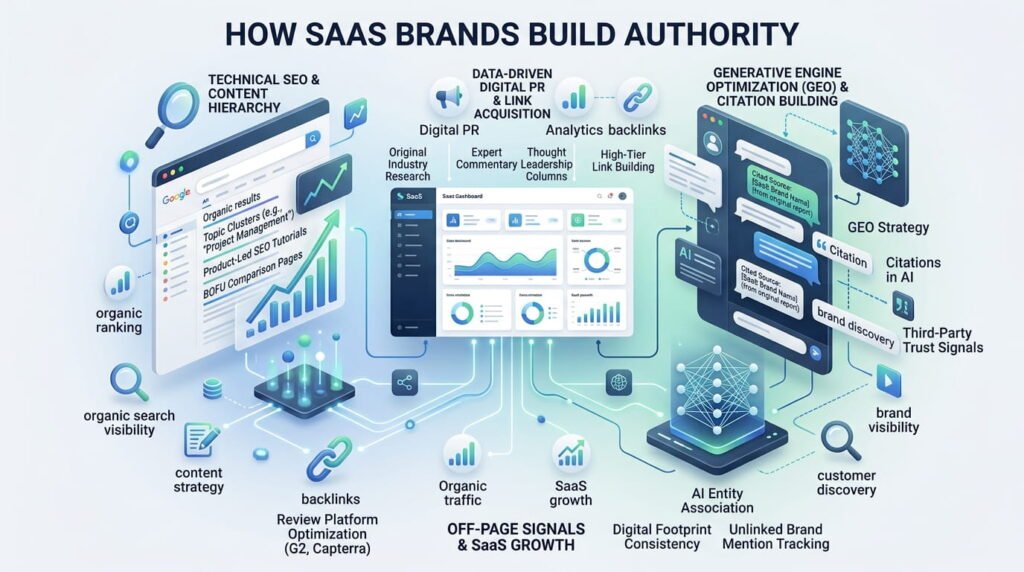
SEO helps SaaS brands become visible when potential customers are actively searching for solutions. Digital PR helps build the credibility, mentions, relationships, and authority that make a brand more recognizable and trustworthy.
When these strategies are combined properly, SaaS companies can build a stronger organic presence without relying entirely on paid advertising.
Why Authority Matters for SaaS Brands
SaaS markets are often crowded. Multiple companies may offer similar features, target the same audience, and compete for the same keywords.
Simply publishing more blog posts is not enough.
Search engines need signals that indicate a website is relevant, trustworthy, and authoritative. Customers also look for evidence that a SaaS company knows its industry.
Authority can come from:
- Relevant backlinks from reputable websites
- Industry publications mentioning the brand
- Expert contributions and interviews
- Original research and data
- Helpful educational content
- Brand mentions across relevant websites
- Strong internal linking and topical coverage
- Positive reputation within a specific industry
The goal is not to collect as many links or mentions as possible. The goal is to build relevant authority around the problems your SaaS product solves.
1. Create Content Around Real Customer Problems
A common SaaS SEO mistake is creating content around keywords without understanding search intent.
Instead of producing generic articles such as “What Is SaaS?”, focus on specific problems your potential customers actually face.
For example, an email automation SaaS could target topics such as:
- How to reduce abandoned email campaigns
- Email automation workflows for small ecommerce teams
- How to segment customers for automated email campaigns
- Email marketing automation mistakes businesses should avoid
These topics attract users who are closer to needing a solution.
Your content should demonstrate expertise rather than simply inserting keywords into an article.
2. Build Topical Authority
One article rarely establishes a SaaS website as an expert.
A stronger approach is to build topic clusters around important areas of your product.
For example, a project management SaaS could create content covering:
Project Management
→ Project planning
→ Team collaboration
→ Task management
→ Workflow automation
→ Productivity
→ Remote project management
→ Project reporting
→ Team performance
Then connect related pages using internal links.
This creates a logical structure that helps search engines understand the relationship between your content while making it easier for visitors to explore the website.
3. Use Digital PR to Earn High-Quality Mentions
Digital PR can help SaaS brands get exposure beyond their own website.
Instead of simply asking websites to publish promotional content, create something journalists, bloggers, and industry publishers actually have a reason to reference.
For example, a SaaS company could publish:
- Original industry research
- Customer behavior statistics
- Annual industry reports
- Expert surveys
- Proprietary data
- Market trend analysis
- Interesting case studies
- Industry predictions
Original information gives publishers something valuable to cite.
That can lead to brand mentions, referral traffic, backlinks, and increased awareness.
4. Turn Company Data Into Linkable Assets
SaaS companies often have access to valuable data that other businesses do not.
For example, a CRM company might analyze millions of sales activities and discover trends in response rates.
Instead of keeping that information buried inside the company, the brand could turn it into an annual research report.
A report such as:
2026 Sales Response Time Benchmark Report
could become a valuable resource for sales publications, marketing websites, business blogs, and journalists.
This is much more powerful than trying to force backlinks into unrelated guest posts.
5. Build Relationships With Relevant Publications
Digital PR is not just about sending thousands of pitches.
Quality matters more than volume.
SaaS brands should identify publications, websites, newsletters, podcasts, and industry communities that their target customers actually follow.
For example, a cybersecurity SaaS should prioritize cybersecurity publications and technology outlets rather than unrelated high-authority websites.
A backlink from a relevant industry website can be more strategically useful than a link from a completely unrelated domain simply because that domain has a high authority score.
6. Use Expert Commentary to Build Brand Visibility
Founders and senior employees can become valuable sources for journalists and publishers.
Instead of promoting the product in every opportunity, provide useful expert opinions on industry developments.
For example:
“What does AI mean for SaaS customer support in 2026?”
A SaaS founder with genuine experience can provide a concise, data-backed perspective.
If that commentary gets published, the company can gain:
- Brand exposure
- Referral traffic
- Author credibility
- Relevant mentions
- Potential backlinks
- Stronger industry recognition
This also helps turn the people behind the SaaS into recognizable experts.
7. Earn Backlinks Through Useful Resources
Not every backlink campaign needs to revolve around guest posting.
SaaS brands can create resources that naturally attract references.
Examples include:
- Free calculators
- Templates
- Industry benchmarks
- Original statistics
- Interactive tools
- Research reports
- Comprehensive guides
- Glossaries
- Checklists
For example, a SaaS company selling financial software could create a free ROI calculator.
If the calculator genuinely helps users, other websites may naturally reference it.
That creates a stronger linkable asset than a generic promotional article.
8. Don’t Ignore Brand Mentions
SEO teams often focus entirely on backlinks.
But Digital PR is also about getting the brand discussed in the right places.
A relevant brand mention can increase awareness even when there is no clickable link.
For SaaS companies, the bigger objective should be building a recognizable brand associated with a particular problem or category.
For example:
Brand → Product category → Specific problem → Expertise
Over time, this association can become extremely valuable.
9. Combine SEO and PR Campaigns
The biggest opportunity comes from combining both strategies rather than running them independently.
Imagine a SaaS company publishes original research about remote-work productivity.
The SEO team can:
- Build the research landing page
- Optimize it for relevant searches
- Create supporting articles
- Build internal links
- Target relevant keywords
Meanwhile, the PR team can:
- Pitch the research to journalists
- Contact industry publications
- Approach relevant newsletters
- Offer expert commentary
- Promote the findings through professional networks
One research project can therefore generate both organic search value and media exposure.
10. Measure Business Impact, Not Just Backlinks
A SaaS company should not judge SEO and Digital PR purely by the number of links acquired.
Track metrics such as:
| Metric | Why It Matters |
| Organic traffic | Shows search visibility growth |
| Non-branded clicks | Indicates discovery through search |
| Keyword visibility | Measures search presence |
| Referring domains | Shows authority growth |
| Referral traffic | Measures PR-driven visitors |
| Brand mentions | Indicates growing awareness |
| Demo/sign-up conversions | Connects marketing to revenue |
| Assisted conversions | Shows indirect campaign value |
A campaign that generates 20 highly relevant backlinks and several qualified leads can be far more valuable than one that generates 200 irrelevant links.
11. Avoid Low-Quality Authority Building
This is where many SaaS SEO campaigns go wrong.
Buying hundreds of random backlinks, publishing generic guest posts on unrelated websites, or chasing domain metrics without considering relevance can create a large backlink profile without creating meaningful authority.
The better approach is:
Relevance + Quality + Expertise + Consistency
A smaller number of genuinely useful placements can be more valuable than a large number of weak ones.
Final Thoughts
SaaS brands need more than technical SEO and keyword optimization to compete in crowded markets.
They need authority.
SEO provides the foundation for organic visibility, while Digital PR helps put the brand in front of relevant audiences and build credibility across the web.
The strongest strategy is to create genuinely valuable content and research, promote it through relevant publications, earn high-quality mentions and backlinks, and connect those efforts to measurable business outcomes.
For SaaS companies, authority should not be treated as a vanity metric. It should be built as a long-term business asset that supports search visibility, brand recognition, qualified traffic, and customer acquisition.