

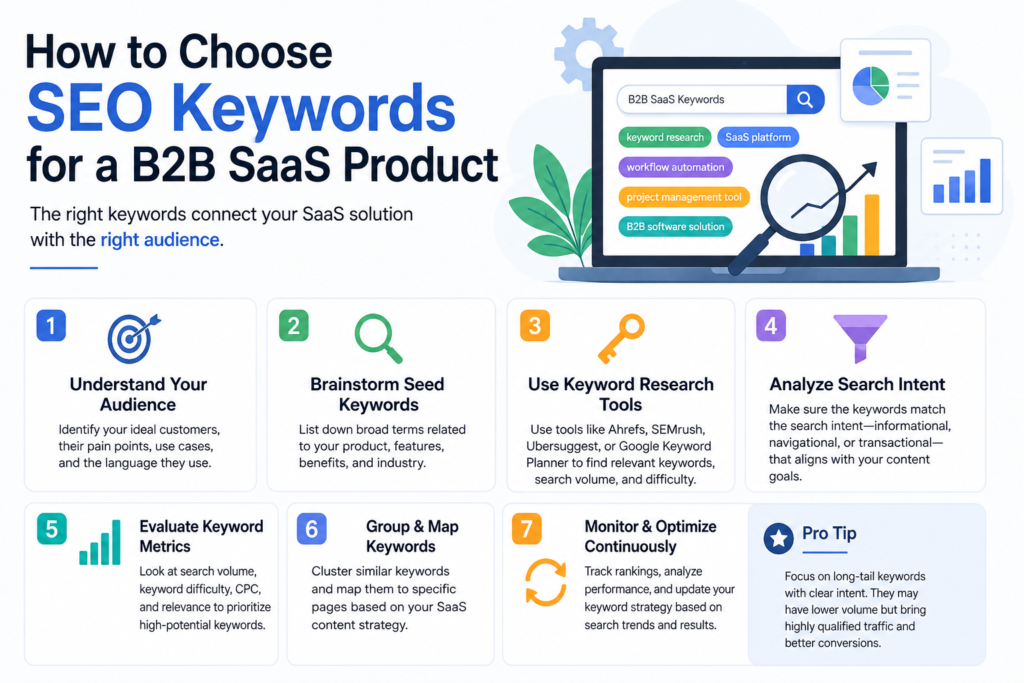
How to Choose SEO Keywords for a B2B SaaS Product
Choosing SEO keywords for a B2B SaaS product is not simply a matter of finding keywords with high search volume and adding them to a content calendar. The real challenge is identifying the searches made by people who have a genuine reason to care about your product.
A keyword can have thousands of monthly searches and still generate very little business value. At the same time, a more specific keyword with a few hundred searches may attract highly qualified prospects who are actively looking for a solution your company provides.
That is why B2B SaaS keyword research needs to go beyond search volume. A strong strategy considers the problem behind the search, the audience performing it, the user’s stage in the buying journey, the competitiveness of the query, and the relationship between the keyword and your actual product.
For SaaS companies, the goal should not be to rank for everything. The goal is to build search visibility around the topics that can attract the right audience and contribute to long-term organic growth.
Why Keyword Selection Matters for B2B SaaS
B2B SaaS buying journeys are usually more complicated than simple consumer purchases. A potential customer may discover a problem through a Google search, read several educational articles, compare different approaches, evaluate software providers, check pricing, investigate integrations, and only then request a demo or start a trial.
That means your SEO strategy needs to reach potential customers at different stages rather than focusing only on people who are already searching for your product category.
For example, someone searching for how to reduce customer churn may still be trying to understand the problem. Someone searching for customer retention software is more likely to be researching solutions. A person searching for best customer retention software for SaaS companies is further along and may already be comparing vendors.
These searches are connected, but they have different intent.
A successful B2B SaaS keyword strategy understands those differences and builds content that supports the buyer from initial research through commercial evaluation.
Start With the Problem Your Product Solves
One of the biggest mistakes SaaS companies make during keyword research is starting with a keyword tool before understanding what their customers actually need. A better approach is to begin with the product itself and identify the problems it solves, the people experiencing those problems, and the language they are likely to use when searching for a solution.
For example, imagine a SaaS product designed to help sales teams automate lead qualification. The obvious keyword would be lead qualification software, because it directly describes the product category. But limiting the strategy to that one phrase would overlook a much larger set of relevant searches. Potential customers may also search for terms such as “how to qualify sales leads, automated lead qualification, lead scoring software, how to prioritize inbound leads, or B2B lead qualification process.
These searches are valuable because they represent different stages of the same problem. Someone searching for “how to qualify sales leads” may still be researching the issue, while a person searching for “lead qualification software” is already considering a software-based solution. Both audiences can be relevant, but they should not necessarily be targeted with the same type of page.
This is why B2B SaaS keyword research should move beyond product-category terms. People often search for the problem before they search for the software that solves it. Understanding that behavior allows a SaaS company to build content that reaches potential customers earlier in the buying journey instead of waiting until they already know what type of product they need.
Look for Long-Tail Keywords With Real Business Context
Long-tail keywords are another important opportunity for B2B SaaS companies because they often reveal much more context about the searcher.
Consider the difference between CRM software and CRM software for small recruitment agencies. The first query is broad and could represent almost any type of business. The second immediately tells you that the searcher is looking for a CRM, belongs to a specific type of business, and may have requirements that are different from those of an enterprise company or an e-commerce business.
That additional context can make a keyword more commercially useful, even when its monthly search volume is much lower.
A company selling project management software, for example, may find opportunities around searches related to remote teams, marketing agencies, software development teams, client collaboration, construction projects, or specific integrations. These searches may not generate the same volume as a broad term like “project management software,” but they can attract visitors whose requirements are much closer to the product’s actual capabilities.
The key is not to create a separate page for every possible keyword variation. Instead, identify the long-tail searches that represent meaningfully different audiences, problems, or use cases, and create useful content around those needs.
For B2B SaaS, specificity can often be more valuable than raw search volume. A smaller group of highly relevant visitors can have far greater commercial potential than a large audience that has no realistic reason to purchase the product.
Build Keywords Around the Customer Journey
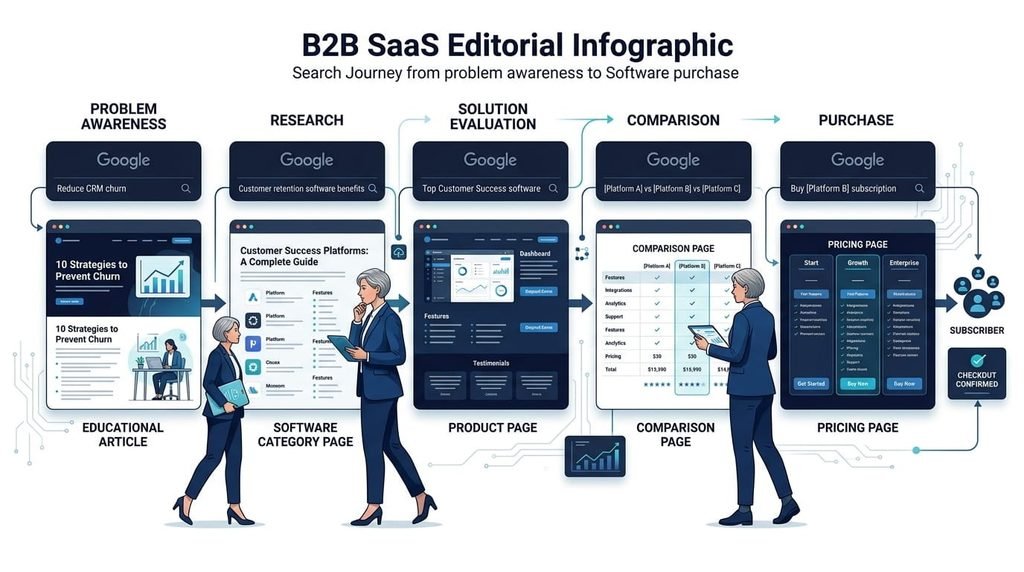
A good SaaS keyword strategy should reflect how people move from recognizing a problem to evaluating and purchasing a solution.
At the beginning of the journey, people often search for problems, definitions, and general advice. Later, they move toward software categories, comparisons, reviews, pricing, and alternatives.
This can be represented as:
| Buyer Stage | What the Searcher Wants | Example Search | Appropriate Content |
| Problem Awareness | Understand the problem | how to reduce customer churn | Educational guide |
| Research | Explore solutions | customer retention strategies | Guide or resource |
| Solution Research | Find software | customer retention software | Product or category page |
| Comparison | Evaluate options | best customer retention software | Comparison article |
| Alternative Research | Compare known products | HubSpot alternatives | Alternative page |
| Commercial Research | Understand cost and value | customer retention software pricing | Pricing/product page |
| Purchase | Take action | customer retention platform demo | Product or conversion page |
This framework helps prevent a common SaaS SEO problem: building a website that is full of informational content but lacks strong commercial coverage.
Educational keywords are useful because they attract people early.
Commercial keywords are important because they reach people who are closer to making a decision.
Your strategy should make room for both.
Start With Product and Category Keywords
Every SaaS business needs to understand the keywords people use to describe the category it operates in.
Depending on the product, this might be something like sales engagement software, employee onboarding software, project management platform, customer feedback software, or workflow automation software.
These terms are often highly relevant because they directly describe the problem the product is designed to solve.
However, category keywords are frequently competitive.
Established websites, software directories, review platforms, and major SaaS brands may already dominate the results. That doesn’t mean you should ignore them. It means you should avoid building your entire SEO strategy around one broad term.
Use the category keyword as the foundation, then look for more specific opportunities around problems, audiences, industries, integrations, use cases, and comparison searches.
That creates a broader and more realistic path toward organic visibility.
Don’t Ignore Low-Volume Keywords
Search volume is useful, but it should never be the only reason you choose or reject a keyword.
Imagine two keywords.
The first receives 5,000 searches every month but attracts a broad audience of students, researchers, consumers, and businesses.
The second receives only 150 searches but is used mainly by decision-makers actively looking for the type of software you sell.
The second keyword may be far more valuable.
B2B SaaS companies often operate in relatively narrow markets, so highly specific searches can generate meaningful opportunities even when the monthly volume looks small.
This is especially true for searches that include a particular industry, business size, use case, integration, or software requirement.
The right question is not:
How many people search for this?
It is:
How valuable are the people who search this?
Analyze Search Intent Before Choosing a Keyword
A keyword may look perfect in a spreadsheet and still be the wrong target.
Before committing to a keyword, search it manually and study the current results.
Look at the types of pages ranking.
Are most results blog articles? Product pages? Comparison websites? Software directories? Templates? Reviews? Videos?
The format of the results gives you valuable information about what search engines believe users want.
Suppose your SaaS company wants to rank for “employee onboarding.” If the search results are mostly guides, checklists, and educational resources, trying to rank a product landing page may be difficult.
On the other hand, if the results are dominated by software providers and category pages, the query may have stronger commercial intent.
The important lesson is simple:
Don’t choose keywords without studying the search results behind them.
The SERP is evidence.
Use it.
Separate Informational and Commercial Keywords
A B2B SaaS website should not treat every keyword as a sales opportunity.
Some searches are educational.
Someone searching how to automate employee onboarding may be looking for information about the process.
Someone searching for the best employee onboarding software is likely evaluating tools.
And someone searching employee onboarding software pricing may already be considering a purchase.
These queries should not necessarily lead to the same page.
A practical SaaS content strategy assigns each intent to the format that best satisfies it.
Educational searches generally work well with detailed guides and explanatory articles.
Commercial investigation searches are often better served by comparison pages, category pages, and software reviews.
Transactional searches may belong on product, pricing, or demo pages.
Matching content to intent improves both user experience and SEO efficiency.
Use Competitor Research to Discover Opportunities
Competitor research is one of the easiest ways to identify keyword opportunities you may have missed.
Look at SaaS companies serving the same audience or solving similar problems. Study the pages that generate organic visibility for them and examine the themes running through their content.
Pay attention to product-category pages, comparison pages, alternatives pages, integration pages, industry-specific landing pages, and educational resources.
But don’t copy the competitor’s strategy blindly.
Your product may serve a different market or provide a different solution.
Instead, use competitors to understand how the market talks about the problem and which topics already have search demand.
Then decide where your business can provide something more useful or more specific.
Find Keywords Based on Customer Problems and Use Cases
Some of the most valuable SaaS keywords are not product keywords at all.
They are problem or use-case keywords.
Imagine a SaaS platform that automates invoice processing.
The company could target the category term invoice automation software.
But customers may also search for:
how to automate invoice approval
or
how to reduce manual invoice processing.
Those queries describe what the customer wants to accomplish.
This creates opportunities for educational content that introduces the problem, explains different approaches, and naturally connects readers with the software solution.
Use-case content can be particularly powerful because it connects SEO directly to the practical jobs customers need to complete.
Consider Industry-Specific Keywords
B2B buyers rarely evaluate software in a vacuum.
They often want a solution that works for their specific industry or business model.
That creates opportunities around searches such as CRM for recruitment agencies, project management software for marketing agencies, HR software for startups, or analytics software for SaaS companies.
These keywords can have lower search volume than broader category terms, but they often communicate stronger intent because the searcher has already defined their context.
There is an important warning here.
Don’t create dozens of near-identical industry pages simply by changing the industry name.
An industry-specific page should exist because the product genuinely solves different problems, serves different workflows, or has meaningful relevance for that market.
Otherwise, you are creating pages for keywords rather than creating useful pages for customers.
Research Competitor and Alternative Keywords
SaaS buyers frequently search for alternatives to products they already know.
Searches such as “Salesforce alternatives,” “HubSpot alternatives,” or “Asana vs Monday” reveal people who are actively comparing solutions.
These can be commercially valuable because the searcher is often already somewhere in the evaluation stage.
Comparison content should be handled carefully.
A strong comparison page should explain real differences between products, including factors such as functionality, integrations, pricing where the data is accurate, ideal customer profiles, limitations, support, and use cases.
A weak comparison page simply declares that your product is better.
That doesn’t create trust.
A useful comparison helps the reader make a better decision—even when the answer isn’t your software.
Use Customer Conversations as Keyword Research
Your best keyword ideas may already exist inside your company.
Sales calls, customer support conversations, onboarding sessions, product feedback, surveys, reviews, and community discussions can reveal the exact language your audience uses.
Maybe prospects repeatedly ask:
Can this integrate with our CRM?
Maybe customers want to know:
How can we automate this process?
Or prospects keep saying:
We need something that works for a team of 50 people.
These questions contain valuable search ideas.
They can become blog topics, FAQ sections, landing pages, integration pages, use-case content, or comparison resources.
This approach has an important advantage: you’re not guessing what customers care about.
You’re using the language they already use.
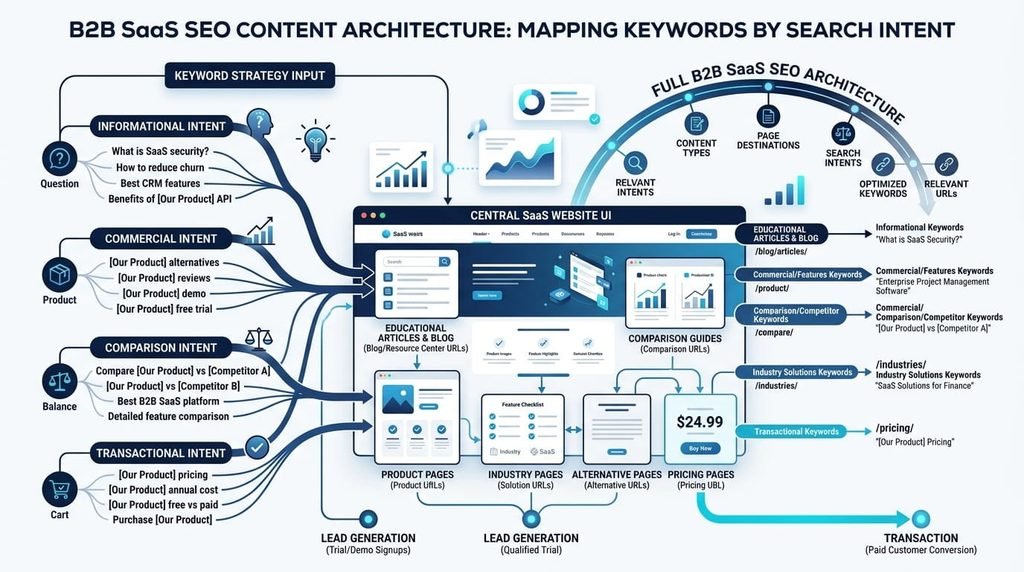
Map Keywords to the Right Pages
After researching keywords, don’t immediately start writing.
First, map the keywords to your website structure.
For example:
| Keyword | Intent | Recommended Page |
| sales engagement software | Commercial | Product/category page |
| how to improve sales follow-up | Informational | Educational article |
| best sales engagement software | Commercial investigation | Comparison guide |
| sales software for SaaS companies | Commercial | Industry/use-case page |
| sales engagement software pricing | Transactional | Pricing/product page |
| Outreach alternatives | Commercial investigation | Alternative page |
This process helps prevent keyword cannibalization.
If multiple pages are targeting essentially the same search intent, you may be creating unnecessary competition between your own URLs.
A clear keyword map gives every page a job.
That makes the website easier to manage and creates a much cleaner SEO architecture.
Don’t Choose Keywords Only Because They Have Low Difficulty
Keyword difficulty can be useful, but it should never become the entire strategy.
A keyword with a high difficulty score may be strategically important because it is directly connected to your product and target audience.
Likewise, an easy keyword can be practically worthless if the visitors it attracts have no reason to buy your software.
Instead of asking only whether you can rank, consider the business value of the traffic.
A keyword deserves more attention when it has strong product relevance, clear search intent, meaningful commercial potential, realistic ranking opportunity, and an audience that matches your ideal customers.
The easiest keyword isn’t necessarily the best keyword.
The most valuable keyword is the one where search demand and business relevance overlap.
Evaluate Keywords Based on Business Value
A B2B SaaS company should always connect keyword research to its broader commercial objectives.
Suppose your company sells enterprise workflow automation software.
A huge informational keyword about productivity may generate large amounts of traffic, but that traffic may not contain the buyers you need.
A smaller keyword focused on enterprise workflow automation may attract fewer people but produce significantly stronger leads.
This is why search volume should be interpreted alongside:
- Product relevance
- Audience fit
- Search intent
- Commercial intent
- Ranking opportunity
- Conversion potential
When those factors align, even relatively small keyword markets can become meaningful sources of growth.
Look at SERP Features and the Current Search Landscape
Modern search results contain much more than traditional blue links.
Depending on the query, users may see featured snippets, People Also Ask results, videos, product listings, comparison sites, forums, AI-generated answers, and other search features.
These elements can tell you a lot about the type of content that search engines consider useful.
For example, a query dominated by comparison pages suggests that users are evaluating options.
A query dominated by definitions and guides suggests that educational intent is stronger.
A query with extensive commercial features may indicate that searchers are closer to making a purchase.
The SERP is therefore not just a place where you compete.
It is also a source of research.
Don’t Create a Separate Page for Every Keyword Variation
One of the easiest ways to create a bloated SaaS website is to treat every keyword variation as a separate content opportunity.
Consider:
SaaS SEO strategy
SaaS SEO guide
SaaS SEO best practices
SaaS SEO tips
These phrases look different, but they may represent almost identical intent.
Creating four separate articles could lead to overlap without creating four times the value.
A better approach is to determine whether one comprehensive resource can naturally cover the related searches.
The same principle applies to long-tail keywords.
You should create a new page when there is a meaningful difference in intent, audience, use case, or business purpose not simply because the wording is different.
Build Topic Clusters Instead of Isolated Keyword Pages
Strong SaaS websites tend to organize related content into broader topic clusters.
Imagine the core topic is:
SaaS SEO
Around that pillar, the site might cover SaaS keyword research, SaaS content strategy, SaaS technical SEO, SaaS link building, SaaS digital PR, and SaaS SEO reporting.
Each page serves a specific purpose, but the content is connected.
This structure helps create a stronger topical ecosystem and gives users a logical path through related information.
It also creates opportunities for strategic internal linking.
The goal is to build a website where each page strengthens the relevance of other useful pages rather than a collection of articles that exist independently.
How to Prioritize Your Keyword Opportunities
Once you’ve built a list of potential keywords, you still need to decide which ones deserve attention first.
A simple framework can help.
| Evaluation Factor | Question to Ask |
| Relevance | Does this keyword closely relate to the product or problem we solve? |
| Audience Fit | Does the searcher resemble our ideal customer? |
| Intent | Can we create the type of page the searcher actually wants? |
| Commercial Value | Could this audience eventually become customers? |
| Competition | Can our website realistically compete for this query? |
| Content Opportunity | Can we provide something genuinely useful or distinctive? |
| Existing Coverage | Do we already have a page targeting this intent? |
You don’t need every keyword to score perfectly.
The purpose is to avoid making decisions based on one metric.
A keyword with moderate volume, high relevance, strong intent, and realistic competition may be a much better opportunity than a huge keyword with almost no commercial value.
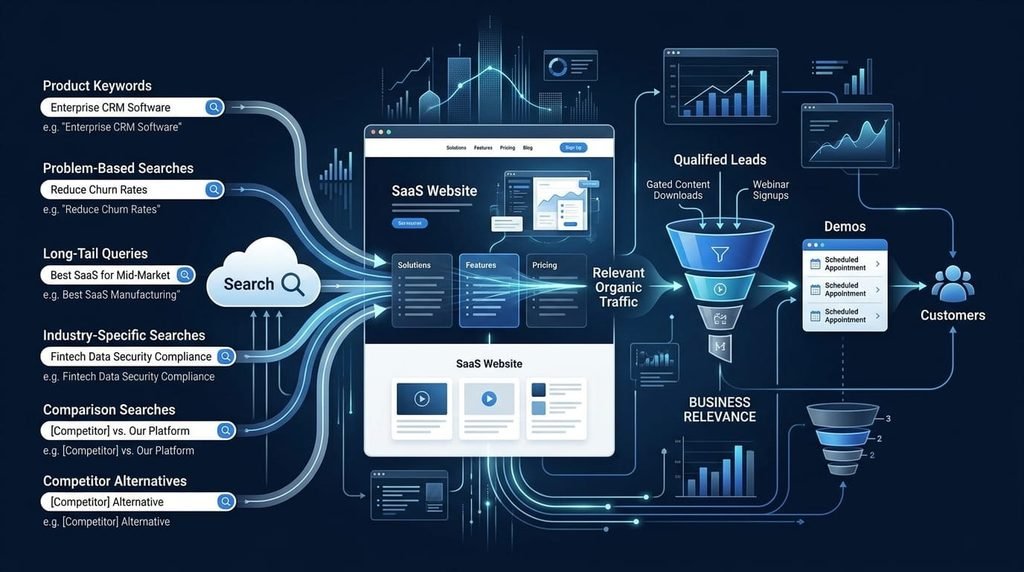
What a Strong B2B SaaS Keyword Mix Looks Like
A balanced keyword strategy usually includes several types of searches.
Product keywords describe the software category itself.
Problem keywords describe the challenges customers are trying to solve.
Use-case keywords describe the jobs they need to accomplish.
Industry keywords describe the business environment in which the software will be used.
Comparison keywords capture people evaluating different options.
Competitor and alternative keywords reach users who already know another product.
These different keyword groups should work together.
Problem-focused content can attract users early in the buying journey.
Use-case and industry pages can make the product more relevant.
Comparison and alternative pages can reach people who are actively evaluating solutions.
Product and pricing pages can capture stronger purchase intent.
The result is a keyword strategy that supports the entire funnel rather than a single stage.
Common B2B SaaS Keyword Research Mistakes
A few mistakes appear repeatedly across SaaS websites.
The first is choosing keywords purely because they have high search volume. Large numbers look attractive, but volume without relevance can produce large amounts of useless traffic.
Another mistake is creating multiple pages for keyword variations that have the same intent. This increases the size of the website without necessarily increasing its organic opportunity.
Some companies also focus too heavily on informational keywords and fail to build enough commercial content. Others go in the opposite direction and create a website full of sales pages that provides little value for people researching their problems.
Another problem is targeting audiences the product doesn’t actually serve. A keyword may look attractive, but if your software isn’t genuinely suitable for that audience, the traffic is unlikely to create meaningful results.
Finally, some teams treat keyword tools as the strategy itself.
They are not.
Keyword tools provide data.
Strategy comes from understanding the business, the audience, and the search landscape.
How Search Forge Digital Approaches B2B SaaS Keyword Strategy
At Search Forge Digital, keyword research should be treated as the foundation for a broader organic visibility strategy rather than a process for generating a long spreadsheet.
For B2B SaaS companies, the strongest opportunities often appear where customer problems, product capabilities, search intent, and commercial value overlap.
That means looking beyond obvious product keywords and exploring the questions potential customers ask before they know which software they need, the use cases they care about, the industries they operate in, and the alternatives they consider during the buying process.
Once those opportunities are identified, the next challenge is building enough authority around the pages that matter.
For competitive SaaS topics, a useful article may still struggle without strong internal connections and relevant external authority.
That is where off-page SEO can complement keyword strategy. Relevant editorial backlinks, industry mentions, guest publishing, digital PR, and other authority-building activities can help strengthen important pages and increase the credibility of the wider website.
The goal is not to chase rankings for their own sake.
The goal is to build search visibility that contributes to qualified traffic, stronger brand discovery, and sustainable business growth.
A Practical Process for Choosing SaaS Keywords
A practical B2B SaaS keyword research process can be summarized as:
Understand the product → Understand the audience → Identify customer problems → Discover search behavior → Analyze search intent → Evaluate business value → Map keywords to URLs → Prioritize opportunities → Create useful content → Strengthen authority → Measure performance
The important part is that the process doesn’t stop after publishing.
Search demand changes.
Products evolve.
Competitors launch new pages.
Search engines change how they interpret queries.
Customer priorities shift.
Your keyword strategy should therefore be reviewed periodically rather than treated as a one-time project.
Final Thoughts
Choosing SEO keywords for a B2B SaaS product is not about finding the largest search volumes or collecting the longest possible list of keyword suggestions.
It is about understanding what potential customers are trying to accomplish and identifying the searches that connect those needs with your product.
The strongest keyword strategy combines product relevance, customer problems, search intent, audience fit, commercial value, and realistic ranking opportunities.
Sometimes that will lead you toward a highly competitive product category.
Sometimes it will lead you toward a keyword with only a few hundred searches each month.
The important thing is not the size of the number on the keyword tool.
It is the value of the audience behind that number.
A SaaS company that understands its customers, maps keywords to the right pages, builds useful topic clusters, and strengthens the authority of important content is in a much better position to grow through organic search.
The objective is simple:
Don’t chase every search. Build visibility for the searches that matter to your business.