
Getting organic traffic is only the first step for a SaaS business.
A website can rank for hundreds of keywords and attract thousands of visitors every month, but if those visitors never start a trial, request a demo, or sign up for the product, the traffic alone has limited business value.
This is why SaaS companies need to think beyond rankings.
A successful SaaS SEO strategy should connect search visibility with the entire customer journey, from the first Google search to the moment a visitor becomes a product user.
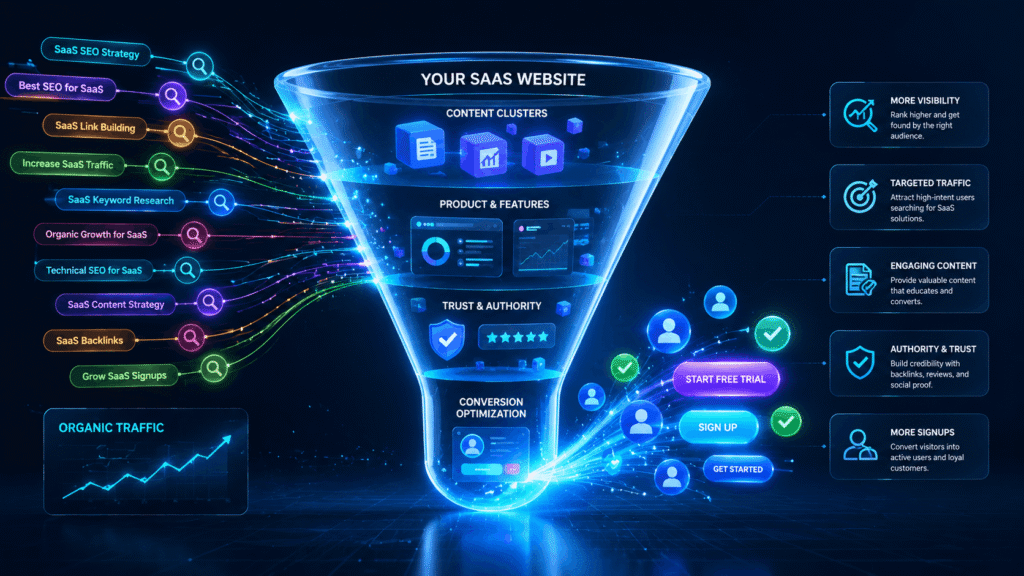
This process can be understood as a SaaS SEO funnel.
The funnel helps businesses attract the right visitors, educate them, build trust, and eventually turn organic traffic into product signups.
For a SaaS website such as Saasivo, this means creating content that doesn’t simply generate visitors but moves those visitors toward the product.
What Is a SaaS SEO Funnel?
A SaaS SEO funnel is the journey a potential customer takes after discovering a software company through organic search.
A typical funnel looks like this:
Search → Visit → Learn → Trust → Consider → Sign Up → Become a Customer
Each stage has a different purpose.
Someone searching for a basic definition may not be ready to buy anything. Another person searching for the “best SaaS tool” may already be comparing products. Someone searching for a specific feature or pricing information may be even closer to signing up.
The mistake many SaaS companies make is treating all organic visitors the same.
They aren’t.
The Top of the Funnel: Attract the Right Traffic
The first stage is attracting potential customers through search engines.
At this stage, users are usually researching a problem, learning about a topic, or trying to understand possible solutions.
For example, someone might search:
- What is SaaS automation?
- How does workflow automation work?
- How can businesses improve team productivity?
- What is the best way to manage recurring tasks?
These users may not be ready to purchase software yet.
That doesn’t make them useless.
If the content answers their question properly and introduces the problem your SaaS product solves, you can move them toward the next stage of the funnel.
The important part is targeting relevant informational searches, not simply chasing keywords with large search volumes.
A website can receive thousands of visitors from irrelevant keywords and still generate almost no signups.
Create Content Around Real Customer Problems
The best SaaS SEO funnels usually begin with customer problems rather than product features.
Instead of asking:
What keywords can we rank for?
Ask:
What problems are our potential customers searching for?
This can uncover topics that naturally connect to your product.
For example, if your SaaS product helps businesses automate repetitive workflows, you could create content around workflow automation, productivity problems, process management, software integrations, and related challenges.
The content should solve the immediate problem while making the reader aware that a software solution may exist.
That creates a natural bridge between informational content and your product.
The Middle of the Funnel: Turn Visitors Into Prospects
Once someone has discovered your website, the next objective is to move them from general research toward evaluating a solution.
This is where many SaaS websites lose potential customers.
They publish an excellent blog article, receive organic traffic, and then end the page with nothing more than another unrelated article.
That’s a missed opportunity.
A visitor who has just read about a problem should be given a logical next step.
Depending on the search intent, that next step could be:
- A product guide
- A feature page
- A comparison
- A case study
- A product demo
- A free tool
- A free trial
- A relevant product page
The CTA should match the visitor’s level of intent.
Someone reading an introductory article may not be ready for a hard “Buy Now” message.
A softer CTA such as “See how it works” may work better.
Build Topic Clusters Around Your Product
A SaaS website should not rely on isolated blog posts.
Instead, build connected topic clusters.
For example, suppose the core product is related to workflow automation.
The website could have a central topic page about workflow automation supported by articles covering:
- Workflow automation examples
- Workflow automation for small businesses
- Workflow automation tools
- Manual workflow problems
- Workflow automation best practices
- Workflow automation integrations
- Workflow automation vs manual processes
These articles can link naturally to relevant product and feature pages.
This creates a path from informational search to commercial intent.
It also helps establish broader topical relevance around the subject.
The Bottom of the Funnel: Capture Buying Intent
At the bottom of the funnel, users are much closer to taking action.
They may be searching for:
- Best software for a specific problem
- Software alternatives
- Product comparisons
- Pricing
- Product reviews
- Specific features
- Product integrations
- Competitor comparisons
These searches deserve a different type of content.
For example, someone searching:
Best workflow automation software for small businesses
has a different intent from someone searching:
What is workflow automation?
The first user may already be evaluating solutions.
That page should therefore make it easy to understand:
- What the software does
- Who it is designed for
- Key features
- Pricing
- Benefits
- Limitations
- Alternatives
- How to get started
The goal is to reduce uncertainty before the signup decision.
Product Pages Are SEO Landing Pages Too
SaaS companies sometimes treat SEO as something that happens only on their blog.
That’s a mistake.
Your product and feature pages can also attract organic traffic.
A feature page should clearly explain what the feature does, who needs it, what problem it solves, and how the product works.
For example, instead of creating a generic page titled:
Our Features
create specific pages around important customer needs.
A feature page can then target searches related to that feature while also providing a direct path toward the product.
This is where SEO and conversion optimization work together.
Use Comparison Content Carefully
Comparison keywords can be valuable because they often indicate strong commercial intent.
Potential topics include:
Product A vs Product B
Product A alternatives
Best alternatives to Product B
Product A pricing
But comparison content should be honest.
If every comparison page says your product is better in every category, readers will quickly recognize the bias.
A stronger comparison explains where each solution is useful, where it has limitations, and which type of customer might benefit from each option.
That makes the content more credible and can actually increase trust in your product.
Internal Linking Should Move Users Through the Funnel
Internal links shouldn’t be added randomly.
They should help users move from one stage of the funnel to another.
For example:
Informational article → Feature page → Product page → Signup
A reader might first discover your website through an educational article. That article can link to a relevant feature page. The feature page can explain how the product solves the problem and link to the signup page.
This creates a natural journey.
The same structure can be used across a larger SaaS website.
The important point is that every link should have a reason.
Don’t add ten internal links simply because you want to increase the number of links on the page.
Your CTA Should Match Search Intent
A common SaaS SEO mistake is using the same CTA everywhere.
That doesn’t make sense because visitors have different levels of intent.
For informational content, CTAs such as these may work well:
- Learn how it works
- Explore the solution
- See an example
- Read the complete guide
For commercial pages, stronger CTAs may be appropriate:
- Start your free trial
- Create an account
- Book a demo
- Get started
- Try the product
The closer the visitor is to making a purchase decision, the more direct the CTA can become.
Don’t Optimize Only for Traffic
Traffic is one of the easiest SEO metrics to celebrate and one of the easiest to misunderstand.
Suppose one article generates 10,000 monthly visitors but only two product signups.
Another article generates 800 visitors but produces 40 signups.
Which one is more valuable?
For a SaaS company, the second article may be dramatically more valuable.
That’s why SEO reporting should connect organic search performance with business outcomes.
Important metrics include:
- Organic traffic
- Keyword rankings
- Organic impressions
- Click-through rate
- Signup rate
- Free-trial conversions
- Demo requests
- Qualified leads
- Customer acquisition
- Revenue from organic traffic
The ultimate goal isn’t simply more visitors.
The goal is more qualified customers.
Create Content for Different Funnel Stages
A healthy SaaS SEO strategy should have content for different levels of awareness.
Awareness Content
These pages answer basic questions and introduce the problem.
Examples include:
- What is SaaS automation?
- How does workflow automation work?
- Why do businesses automate repetitive tasks?
Consideration Content
These pages help users evaluate possible solutions.
Examples include:
- Best workflow automation tools
- Workflow automation software comparison
- How to choose workflow automation software
- Workflow automation tools for small businesses
Decision Content
These pages target users who are close to taking action.
Examples include:
- Product pricing
- Product alternatives
- Product comparisons
- Feature pages
- Integration pages
- Customer case studies
The exact topics will vary depending on the SaaS product.
Use Case Pages Can Be Powerful
Use case pages can connect search intent directly to your product.
Instead of only describing what your software does, explain how it solves a specific problem for a specific audience.
For example:
Workflow Automation for Marketing Agencies
is more specific than:
Workflow Automation Software
The use case page can explain the workflows, problems, and requirements relevant to marketing agencies.
For a SaaS company, these pages can attract visitors who already understand their problem and are looking for a solution.
This type of content can be particularly valuable for a website like Saasivo, provided each use case represents a genuine audience and contains information that is actually different from the other pages.
Build Trust Before Asking for the Signup
People don’t automatically trust a SaaS product because it ranks on Google.
Before signing up, visitors may want to know whether the company is legitimate, whether the product works, whether it is secure, and whether it is worth their time.
Your website can build trust through:
- Customer testimonials
- Case studies
- Product screenshots
- Transparent pricing
- Detailed documentation
- Reviews
- Security information
- Clear company information
- Product demonstrations
- Useful educational content
Trust becomes particularly important when the product handles business data or forms part of an important workflow.
Make the Signup Process Simple
You can have excellent SEO and still lose conversions because the signup experience is bad.
If a visitor decides to try the product but encounters a long form, confusing navigation, unnecessary fields, or unclear instructions, they may leave.
Review the signup process from the perspective of a first-time visitor.
Ask:
What is stopping this person from creating an account right now?
Remove unnecessary friction wherever possible.
The SEO funnel doesn’t end when the visitor reaches the signup page.
The conversion experience is part of the funnel too.
Test the Pages That Already Receive Traffic
You don’t always need to publish more content.
Sometimes the better opportunity is improving pages that already rank and receive visitors.
Look at pages that generate organic traffic but have weak signup rates.
Then test changes such as:
- Better CTA placement
- Clearer product explanations
- Stronger internal links
- More relevant use cases
- Better screenshots
- Shorter signup paths
- More convincing social proof
- Improved comparison sections
This can produce more business value than publishing dozens of new articles.
A Simple SaaS SEO Funnel
A practical SaaS SEO funnel can look like this:
1. Attract
Create useful content around problems your potential customers search for.
2. Educate
Explain the problem and possible solutions clearly.
3. Connect
Introduce relevant product features, use cases, or resources.
4. Build Trust
Use evidence, case studies, reviews, documentation, and transparent information.
5. Convert
Give the visitor a clear and relevant reason to start a trial, request a demo, or sign up.
6. Improve
Measure conversions and improve the pages that already attract relevant traffic.
This process turns SEO from a traffic-generation activity into a customer-acquisition channel.
Final Thoughts
A SaaS SEO strategy shouldn’t end when someone clicks on your search result.
That click is only the beginning.
The real opportunity is creating a journey where the visitor moves naturally from discovering a problem to understanding the solution and eventually becoming a product user.
The strongest SaaS SEO funnels combine:
- Search intent
- Helpful content
- Topic clusters
- Product pages
- Use case pages
- Internal linking
- Relevant CTAs
- Trust signals
- Conversion optimization
- Business-focused measurement
For SaaS websites such as Saasivo, the focus should not simply be on attracting more organic visitors. The bigger opportunity is attracting the right visitors and giving them a clear path toward the product.
Because at the end of the day, ranking is useful.
But a visitor who becomes a customer is worth far more than a visitor who simply lands on your website.