
Getting organic traffic is only the beginning of SaaS SEO.
A page can rank on Google, attract thousands of visitors, and still generate very few customers. The problem is usually not traffic itself. The problem is the gap between search intent and conversion.
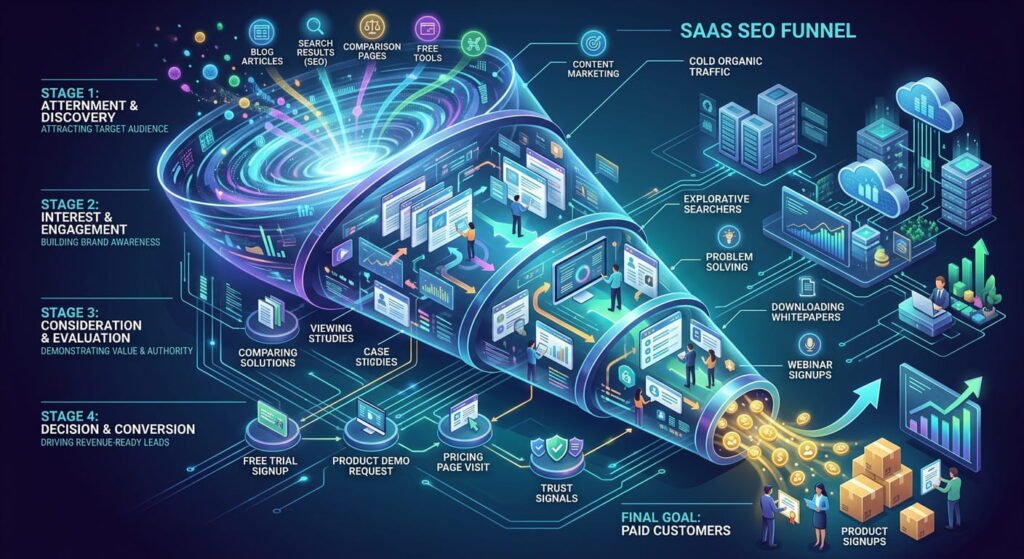
A successful SaaS SEO strategy should move users through a clear journey:
Search → Organic Visit → Relevant Page → Product Interest → Signup → Activation → Paying Customer
This is what a SaaS SEO funnel is designed to accomplish.
Instead of treating SEO as a simple traffic-generation channel, SaaS companies should build their organic strategy around the entire customer journey. Every stage needs the right keywords, content, landing pages, internal links, calls to action, and conversion experience.
What Is a SaaS SEO Funnel?
A SaaS SEO funnel is the process of turning people who discover your website through search engines into product users and eventually paying customers.
Traditional SEO often focuses on metrics such as:
- Rankings
- Impressions
- Organic traffic
- Keywords
Those metrics matter, but they are incomplete.
A SaaS business ultimately needs to know:
How many organic visitors became qualified leads, trials, activated users, and customers?
The SEO funnel connects search visibility with those business outcomes.
The SaaS SEO Funnel at a Glance
A simple SaaS SEO funnel can be divided into five stages.
| Funnel Stage | User Intent | Example Search | Best Content | Primary Goal |
| Awareness | Learning about a problem | How to reduce customer churn | Blog / Guide | Attract relevant visitors |
| Consideration | Researching solutions | Customer retention software | Solution page | Generate product interest |
| Evaluation | Comparing options | Best customer retention tools | Comparison / List page | Build preference |
| Decision | Ready to act | Customer retention software pricing | Product / Pricing page | Generate signup |
| Activation | Using the product | How to set up the software | Onboarding / Help content | Get user to value |
The important point is that not every visitor should see the same message.
Someone searching for a basic definition needs education. Someone searching for pricing needs a completely different experience.
Stage 1: Attract the Right Organic Traffic
The first stage is attracting people who have a problem your SaaS product can potentially solve.
This is where informational keywords can be valuable.
For example, a customer support platform might target:
- How to improve customer support
- How to reduce support response time
- How to manage customer tickets
- Customer service workflow
- How to organize support requests
These searches may not have strong purchase intent yet, but they can introduce your brand to potential customers.
The critical word is relevant.
There is no business value in generating huge amounts of traffic from people who have no reason to use your product.
Build Content Around Problems
Problem-focused content works well at the awareness stage because users often search for their problem before they search for software.
Suppose you sell accounting software.
Potential searches might include:
- How to track business expenses
- How to manage invoices
- How to automate bookkeeping
- How to prepare financial reports
These topics allow your SaaS brand to enter the conversation before the customer has chosen a specific product.
But do not force a sales pitch into every informational article.
The content should first solve the user’s problem.
Then, where relevant, introduce your product as one possible solution.
Stage 2: Capture Solution-Aware Users
After identifying a problem, users often start looking for solutions.
This is where solution-focused keywords become more important.
Examples include:
- Expense management software
- Invoice automation software
- Customer support software
- Sales reporting platform
- Project management software
These searches indicate stronger commercial intent.
The content should now shift from general education toward explaining how software can solve the problem.
Solution pages can include:
- The problem
- How the solution works
- Key features
- Benefits
- Use cases
- Integrations
- Customer examples
- FAQs
- Pricing information
- Product CTA
Stage 3: Help Users Evaluate Their Options
At the evaluation stage, users may already know what type of software they need.
Now they want to determine which product is right for them.
This is where comparison and commercial keywords become powerful.
Examples include:
- Best project management software
- Best CRM for startups
- HubSpot alternatives
- Salesforce vs HubSpot
- Best accounting software for agencies
- CRM with email automation
The content should help users make an informed decision.
Comparison pages can evaluate:
- Features
- Pricing
- Ease of use
- Integrations
- Support
- Scalability
- Target audience
- Limitations
Avoid making every comparison page a disguised advertisement.
If the comparison is obviously biased, users may not trust it.
Stage 4: Convert Searchers Into Signups
This is where SEO and conversion optimization become tightly connected.
A user searching for:
CRM software pricing
has a very different intent from someone searching:
What is a CRM?
The pricing searcher may be ready to take action.
Sending them to a generic educational article creates unnecessary friction.
Instead, send high-intent users to a page that provides:
- Pricing
- Plan differences
- Feature details
- Product benefits
- Customer proof
- FAQs
- Clear signup options
The objective is to remove uncertainty.
Create Dedicated Landing Pages
A common SaaS SEO mistake is trying to rank the homepage for everything.
Your homepage should communicate the overall product.
It should not be responsible for every search intent.
Create dedicated pages for important commercial opportunities such as:
- Product categories
- Features
- Industries
- Use cases
- Integrations
- Comparisons
- Alternatives
- Pricing
For example:
Search: CRM for Real Estate
→ Landing page: CRM Software for Real Estate Teams
Rather than:
Search: CRM for Real Estate
→ Homepage
A dedicated page can directly address the user’s requirements.
Stage 5: Turn Signups Into Activated Users
Getting a signup is not the end of the funnel.
For SaaS businesses, activation is often more important than the initial registration.
Someone who creates an account but never experiences the product’s value may never become a paying customer.
This means SEO strategy should connect with product onboarding.
For example, after signup, users might need to:
- Create their account
- Connect an integration
- Import data
- Create their first workflow
- Invite a team member
- Complete their first successful task
The exact activation event depends on the product.
The important point is to define what “activated” actually means for your SaaS.
Connect SEO Content With Product Onboarding
SEO content can continue helping users after they sign up.
Suppose a user discovers your product through an article about workflow automation.
After signup, they may need help creating their first workflow.
Useful resources could include:
- Setup guides
- Tutorials
- Integration documentation
- Templates
- Product walkthroughs
- Use-case guides
- Knowledge-base articles
This creates continuity between the search experience and the product experience.
Build a Strong Internal Linking Funnel
Internal links can help move users from informational content toward commercial pages.
For example:
How to Automate Sales Reporting
Sales Reporting Automation Guide
Sales Reporting Software
Pricing
Start Free Trial
Not every user will follow this exact path, and they should not be forced to.
But the website should make the next relevant step easy to discover.
Internal linking can also help search engines understand relationships between pages.
Use CTAs Based on Search Intent
Not every article needs the same call to action.
An informational visitor may respond better to:
Read the Complete Guide
See How It Works
A commercial visitor may respond better to:
Start Free Trial
Book a Demo
A pricing visitor may need:
Compare Plans
The CTA should match the user’s stage rather than interrupting the experience with aggressive sales messaging.
Don’t Hide the Product Connection
There is also an opposite problem.
Some SaaS companies publish large amounts of informational content but fail to connect that content to their product.
The result is traffic without meaningful conversions.
If an article discusses a problem your product solves, make the relationship clear.
For example:
Article: How to Automate Customer Support
Relevant product section:
How Our Platform Helps Automate Customer Support
Then explain the specific features and workflows.
The connection should be useful rather than forced.
Use Bottom-of-Funnel Keywords Strategically
BOFU keywords deserve special attention because they can bring users who are already close to a purchase decision.
Examples include:
- [Product] pricing
- [Product] alternatives
- Best [category] software
- [Competitor] alternatives
- [Category] software for [industry]
- [Category] with [feature]
- [Product A] vs [Product B]
- [Category] software free trial
These keywords may have less search volume than broad informational terms, but they can produce more qualified visitors.
For SaaS SEO, commercial intent often matters more than raw traffic volume.
Use Content to Remove Buying Objections
A prospect may be interested in your product but still have unanswered questions.
Your SEO and commercial content can address those concerns.
Common objections include:
- Is the software easy to use?
- Can I migrate my existing data?
- Does it integrate with my current tools?
- Is there a free trial?
- How much does it cost?
- Is it suitable for my team size?
- Can it scale with our business?
- What support is available?
- Is there an API?
Create content that answers these questions clearly.
Reducing uncertainty can increase conversion rates.
Add Proof to Commercial Pages
People are more likely to trust a SaaS product when claims are supported by evidence.
Useful proof can include:
- Customer testimonials
- Case studies
- Product screenshots
- Customer numbers
- Verified reviews
- Performance data
- Specific results
- Integration logos
Avoid fake testimonials or exaggerated claims.
If you say your product “reduces support costs by 50%,” you should have evidence for that claim.
Track the Entire Funnel
A SaaS SEO dashboard should go beyond organic traffic.
Track each stage of the journey.
For example:
Organic Impressions
→ Organic Clicks
→ Qualified Visitors
→ Signup
→ Activated User
→ Paid Customer
→ Revenue
This allows you to identify where the real problem exists.
If traffic is low, you may have an SEO or keyword problem.
If traffic is high but signups are low, you may have an intent or landing-page problem.
If signups are high but paid conversions are low, the problem may be onboarding, product value, pricing, or audience quality.
SEO cannot fix every problem in the funnel.
Important SaaS SEO Funnel Metrics
| Funnel Stage | Key Metrics | What It Tells You |
| Awareness | Impressions, clicks, rankings | Can users discover you? |
| Acquisition | Organic sessions, engaged visits | Are you attracting relevant users? |
| Consideration | Product page visits, feature-page engagement | Are users exploring the solution? |
| Conversion | Signup rate, demo rate | Are visitors taking action? |
| Activation | Activation rate, onboarding completion | Are new users experiencing value? |
| Revenue | Paid conversion, MRR, ARR | Is SEO generating business value? |
This approach gives you a much clearer picture than tracking rankings alone.
Calculate Organic Conversion Rates
Suppose your website receives:
20,000 organic visitors
and generates:
400 signups
Your visitor-to-signup rate is:
400 ÷ 20,000 × 100 = 2%
But do not stop there.
If only 80 of those 400 users become activated users, your activation rate is:
80 ÷ 400 × 100 = 20%
And if 20 eventually become paying customers:
20 ÷ 400 × 100 = 5% signup-to-customer conversion
These numbers tell you much more than organic traffic alone.
Identify Your Highest-Converting Pages
Not all SEO pages have the same commercial value.
One page might generate:
10,000 visits → 5 signups
Another might generate:
1,000 visits → 60 signups
The second page is clearly more commercially efficient.
Analyze which pages generate:
- Signups
- Qualified leads
- Activated users
- Customers
- Revenue
Then use those insights to guide future content production.
Avoid the Traffic Trap
Traffic is one of the easiest SEO metrics to celebrate because it always looks good when the graph goes up.
But traffic without business value can be misleading.
Imagine publishing hundreds of articles that rank for broad informational queries.
Your traffic increases.
Your SEO report looks better.
But if none of those users have any interest in your product, the business has gained very little.
The better question is:
Did organic search attract people who could realistically become customers?
Build Different Content for Different Funnel Stages
A healthy SaaS SEO strategy usually needs a mixture of content types.
Top-of-Funnel Content
Focus on:
- Problems
- Definitions
- Educational guides
- How-to searches
- Industry education
Middle-of-Funnel Content
Focus on:
- Solutions
- Features
- Use cases
- Industry applications
- Implementation guides
Bottom-of-Funnel Content
Focus on:
- Product comparisons
- Alternatives
- Pricing
- Best software
- Feature comparisons
- Product-specific searches
Conversion Content
Focus on:
- Product pages
- Pricing pages
- Demo pages
- Free trial pages
- Feature landing pages
Each stage has a different job.
Build a Balanced SaaS SEO Funnel
A strong funnel should not consist entirely of blog posts.
It should contain a connected ecosystem:
1 Educational Content
2 Solution Content
3 Commercial Content
4 Product Pages
5 Signup
6 Activation
7 Customer
This structure allows SEO to support both discovery and conversion.
Common SaaS SEO Funnel Mistakes
Focusing Only on Traffic
Traffic is not the final business objective.
Ranking Informational Content With No Conversion Path
Users need a logical next step when they are ready to explore the product.
Sending Every Visitor to the Homepage
Different search intents require different landing pages.
Using the Same CTA Everywhere
A beginner researching a problem may not be ready for a sales demo.
Ignoring BOFU Keywords
Commercial searches can be among the most valuable opportunities.
Measuring Only Signup Volume
A large number of low-quality signups is not necessarily a success.
Ignoring Activation
A signup has little value if the user never reaches the product’s core value.
Creating Content Without Product Alignment
Every major content cluster should have a logical relationship with what the SaaS product actually does.
A Practical SaaS SEO Funnel Strategy
Follow this process to build your funnel:
- Define your ideal customer.
- Identify the problems they search for.
- Research keywords across the buying journey.
- Separate informational and commercial intent.
- Create educational content for awareness.
- Build solutions and use-case pages for consideration.
- Create comparison, alternative, pricing, and feature pages for BOFU users.
- Connect pages with contextual internal links.
- Use intent-specific CTAs.
- Optimize product and signup pages for conversion.
- Improve onboarding and activation.
- Track organic traffic through signup, activation, and revenue.
- Invest more in content that produces qualified customers.
Final Thoughts
A successful SaaS SEO strategy is not simply about getting more people to visit your website.
It is about attracting the right people, giving them the information they need at the right stage, and creating a clear path toward your product.
The complete journey looks like this:
Search → Content → Solution → Product → Signup → Activation → Customer
Informational content creates awareness. Solution-focused content builds consideration. BOFU content helps users evaluate their options. Product and pricing pages remove friction and drive action. Onboarding then determines whether the new signup actually experiences the value of the software.
That is why SaaS SEO should be treated as a full-funnel growth channel, not just a traffic-generation tactic.
The ultimate KPI is not how many people found your website.
It is how many qualified organic visitors became active users and paying customers.