
Search is changing faster than it has in years. For a long time, businesses focused primarily on traditional search engine optimization (SEO) to improve their visibility on Google and other search engines. The goal was relatively straightforward: optimize a website, build authority, target relevant keywords, earn backlinks, and rank pages high enough to attract organic traffic.
That model is still important, but the way people discover information is becoming more complex. Instead of searching Google, opening several websites, and comparing the answers themselves, users are increasingly asking AI-powered search and conversational platforms to summarize information and provide a direct answer.
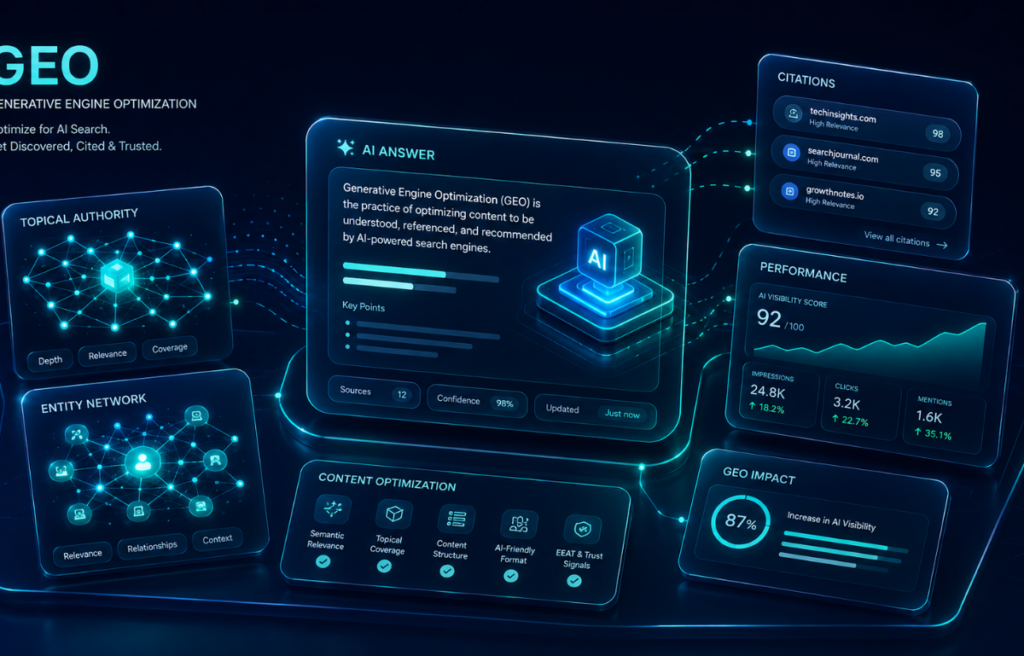
This shift has created a new optimization discipline known as GEO, or Generative Engine Optimization.
GEO focuses on improving the likelihood that a brand, business, website, product, or piece of content will be discovered, understood, mentioned, and cited by generative AI systems. These systems can include AI-powered search experiences and answer engines that generate responses based on information gathered from multiple sources.
The rise of GEO does not mean SEO is dead. That idea is exaggerated. Instead, GEO represents an evolution in how businesses need to think about online visibility. Search engines still matter, traditional rankings still matter, and backlinks still matter. But businesses now also need to consider how their content is interpreted and represented inside AI-generated answers.
What Is GEO?
Generative Engine Optimization (GEO) is the practice of optimizing digital content and brand information so that generative AI systems are more likely to understand, retrieve, mention, and cite that information when generating answers to users.
Traditional SEO primarily focuses on ranking web pages in search engine results pages. GEO focuses more heavily on visibility within AI-generated responses.
For example, imagine someone asks an AI search engine:
What are the best link building strategies for SaaS companies?
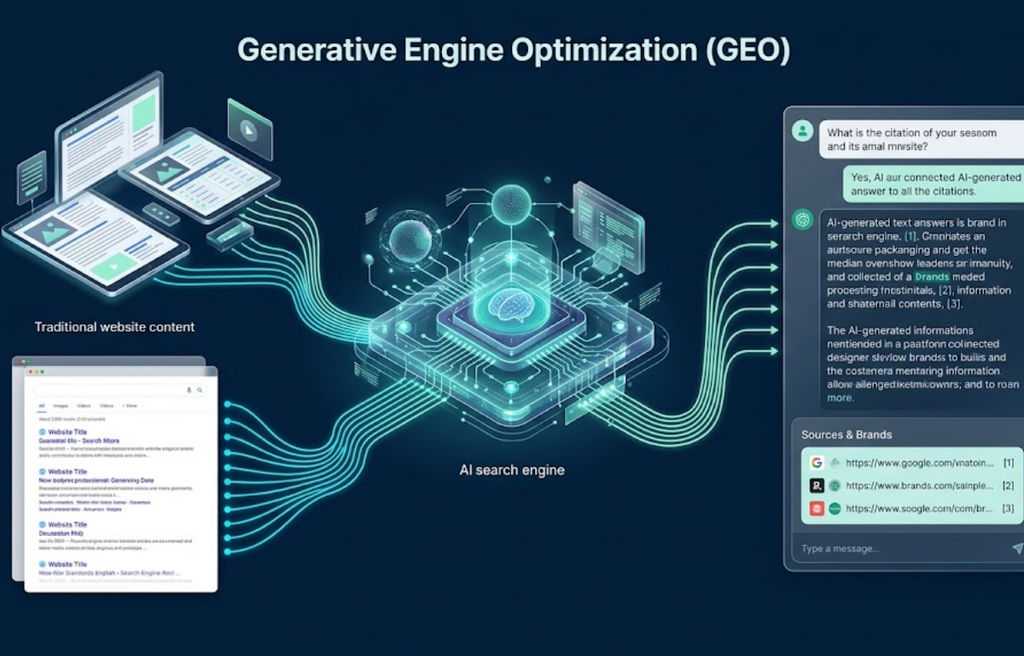
A traditional search engine might return a list of websites and articles.
A generative search engine may instead provide a synthesized answer explaining several strategies and mention specific companies, publications, or resources as supporting sources.
If your website is one of the sources that the AI system uses or cites, you have achieved a form of generative visibility.
This creates a new question for marketers:
How do we make our brand and content useful enough, credible enough, and understandable enough for AI systems to include in their answers?
That is where GEO comes in.
Why Is GEO Becoming So Important?
The biggest reason GEO is receiving so much attention is the changing behavior of users.
People increasingly want answers instead of lists of links. They may ask an AI system a complicated question and expect it to understand the context, compare different options, summarize information, and provide a useful recommendation.
This is fundamentally different from the traditional search experience.
Instead of searching:
best SaaS SEO tools
a user might ask:
Which SEO tools are best for a SaaS company with a small marketing team, and what are the advantages and disadvantages of each?
The second query requires significantly more interpretation.
Generative AI can process the question, identify relevant information, combine information from multiple sources, and produce a conversational response.
As these experiences become more common, being visible only in traditional search results may not be enough for some businesses.
GEO vs Traditional SEO
GEO and SEO overlap significantly, but they are not identical.
SEO generally aims to help search engines discover, crawl, understand, and rank web pages.
GEO goes further by considering whether the information is structured and authoritative enough to be selected as part of an AI-generated response.
| Factor | Traditional SEO | GEO |
| Primary goal | Improve search rankings | Improve visibility in AI-generated answers |
| Main environment | Search engine results | Generative search and AI answer systems |
| Main focus | Rankings and organic traffic | Mentions, citations, references, and inclusion |
| Content | Keyword-focused and search-intent driven | Context-rich, authoritative, answer-focused |
| Authority | Backlinks, content quality, reputation | Authority, corroboration, citations, entity recognition |
| User experience | Click through to a website | Often receives an answer before clicking |
| Measurement | Rankings, traffic, CTR, conversions | Mentions, citations, AI visibility, brand presence |
| Relationship | Established discipline | Emerging optimization layer |
The important point is that GEO should not be treated as a replacement for SEO.
A strong GEO strategy usually depends on many of the same fundamentals that make a website successful in traditional search.
How Does Generative Search Work?
Generative search systems do not simply behave like traditional search engines.
When a user asks a question, an AI system may interpret the intent, retrieve information from available sources, evaluate that information, and generate a response based on what it considers relevant.
The exact process differs between platforms and models, and businesses should not assume that every AI system uses the same ranking or retrieval process.
However, one thing is becoming increasingly important: AI systems need reliable information from identifiable sources.
If your website clearly explains who you are, what you offer, what you know, and why your information deserves trust, your content becomes easier for systems to interpret.
This is one reason why vague, generic, poorly structured content is becoming less valuable.
GEO Is More Than Adding Keywords
One of the biggest misconceptions about GEO is that it simply means adding AI-related keywords to existing content.
That is not how it works.
Adding phrases such as “AI search optimization” repeatedly throughout an article does not automatically make that article more likely to appear in AI-generated answers.
Generative systems need context.
They need to understand the relationship between concepts, entities, claims, sources, and topics.
For example, an article about SaaS link building becomes stronger when it explains:
- What SaaS link building is
- Why it matters
- Which strategies work
- Which strategies are risky
- How to evaluate backlinks
- How authority affects SEO
- How link building relates to topical authority
- How businesses can measure results
- Which sources support important claims
This creates a much stronger information environment than simply repeating the target keyword.
The Importance of Topical Authority in GEO
Topical authority has become particularly important in the age of AI search.
A website that publishes one article about a subject may provide useful information, but a website that consistently covers the subject from multiple relevant angles can demonstrate much deeper expertise.
Consider a website focused on SaaS SEO.
Instead of publishing only one article about SaaS SEO, the website could build a content ecosystem covering:
| Core Topic | Supporting Topics |
| SaaS SEO | SaaS keyword research |
| SaaS SEO | Programmatic SEO |
| SaaS SEO | SaaS link building |
| SaaS SEO | Bottom-of-funnel keywords |
| SaaS SEO | SaaS SEO funnel |
| SaaS SEO | Technical SEO for SaaS |
| SaaS SEO | SaaS content strategy |
| SaaS SEO | SaaS topical authority |
| SaaS SEO | SaaS competitor analysis |
| SaaS SEO | AI search optimization |
This gives search engines and AI systems more context about the website’s expertise.
The goal is not to publish hundreds of low-quality articles.
The goal is to build a coherent information network around a subject.
Why Brand Mentions Matter for GEO
Traditional SEO has historically placed significant emphasis on links.
Links remain valuable, but GEO introduces another important concept: brand mentions and contextual references.
A company can be discussed across industry publications, authoritative websites, communities, research articles, interviews, and other online sources.
Even when these references do not all produce traditional backlinks, they can contribute to a broader understanding of the brand across the web.
For example, suppose a SaaS company is consistently described by reputable industry publications as an expert in a particular area.
That broader web presence can help establish context around the company.
This is one reason modern off-page SEO increasingly intersects with digital PR, brand authority, entity optimization, and content distribution.
The Role of Backlinks in GEO
GEO does not make backlinks irrelevant.
That would be an oversimplification.
Backlinks can still help search engines discover and evaluate websites, and high-quality references from relevant websites can contribute to a site’s overall authority.
However, the quality and context of links matter more than simply accumulating large numbers of backlinks.
A website with hundreds of irrelevant or low-quality links is not necessarily more authoritative than a website with fewer but highly relevant editorial references.
A useful way to think about modern link building is:
Relevance + authority + context + credibility > raw backlink quantity
For GEO, the broader goal is to create a web presence where the brand is consistently associated with its area of expertise.
Content Quality Is Becoming More Important
AI systems can generate enormous amounts of text.
That means simply producing more content is no longer a meaningful competitive advantage.
If thousands of websites can publish a generic 1,500-word article about “what is link building,” producing another generic article does not necessarily create value.
Businesses need to create content that contains useful information, original insights, evidence, examples, data, expert perspectives, comparisons, and clear explanations.
Strong GEO content should answer the question directly rather than forcing users to search through unnecessary introductions.
For example, if an article asks:
What is GEO?
The definition should appear early.
The rest of the article can then provide context, examples, strategies, limitations, and practical implementation advice.
This structure benefits human readers as well as AI systems attempting to extract useful information.
First-Hand Experience Can Strengthen Content
Another important factor is first-hand experience.
Generic information is easy for AI systems to generate because it already exists everywhere.
Original experiences are harder to replicate.
For example, an SEO agency could publish:
- Results from actual campaigns
- Anonymized case studies
- Original research
- Link acquisition experiments
- Outreach response data
- Before-and-after traffic comparisons
- Lessons from failed campaigns
- Industry-specific observations
This type of content gives the website something unique.
Instead of repeating information that already exists, the company becomes a source of information.
That distinction can be extremely valuable for both SEO and GEO.
How to Optimize Content for GEO
GEO optimization should start with the fundamentals rather than gimmicks.
The first step is understanding what questions your audience is actually asking.
Traditional keyword research remains useful, but marketers should expand beyond short keywords.
Look for:
- Questions
- Comparisons
- Definitions
- Problems
- Recommendations
- “Best” queries
- “How to” queries
- Alternatives
- Pros and cons
- Cost-related questions
- Industry-specific questions
- Expert-level questions
The objective is to understand the entire information journey surrounding a topic.
For example, someone researching link building may progress through several questions:
What is link building?
Then:
Why are backlinks important?
Then:
How do I build backlinks?
Then:
Which link building strategies are safe?
Then:
How much does link building cost?
Then:
How can I measure whether backlinks are actually working?
A strong content ecosystem can address the entire journey.
Structure Content So Information Is Easy to Understand
Generative systems need to interpret information, and readers need to understand it.
Clear structure helps both.
Use descriptive headings, concise definitions, logical sections, tables where comparisons are useful, and direct answers to specific questions.
For example, instead of writing a long paragraph that attempts to explain five different concepts at once, separate the concepts into clear sections.
A strong article might follow this structure:
| Section | Purpose |
| Definition | Explain the concept immediately |
| Why it matters | Establish importance |
| How it works | Explain the process |
| Examples | Make the concept practical |
| Comparison | Differentiate related concepts |
| Strategy | Explain implementation |
| Mistakes | Identify what to avoid |
| Measurement | Explain how to evaluate results |
| Conclusion | Summarize the key takeaway |
This structure makes the content easier to navigate and easier to interpret.
Use Clear, Direct Answers
One of the simplest GEO improvements is to answer questions directly.
If the heading is:
What Is Generative Engine Optimization?
Do not spend five paragraphs talking about the history of SEO before answering.
Start with a clear definition.
Then expand.
This approach works because users can quickly find what they need, while information-retrieval systems can more easily identify the relationship between the heading and the answer.
Build Strong Entity Associations
Search engines and AI systems increasingly need to understand entities rather than just strings of keywords.
An entity can be a person, company, product, organization, location, concept, or other identifiable subject.
For businesses, this means your website should clearly communicate:
Who are you?
What do you do?
What industry are you in?
What topics are you associated with?
Which products or services do you provide?
Which people or organizations are connected to your brand?
The more consistently this information appears across credible sources, the easier it can become to establish a recognizable digital identity.
GEO and E-E-A-T
Google’s concept of E-E-A-T — Experience, Expertise, Authoritativeness, and Trustworthiness — is highly relevant to the broader discussion around AI search.
AI-generated systems need reliable information.
That makes credibility important.
A website should demonstrate expertise through useful content, experience through real-world examples, authority through credible references and recognition, and trust through transparent business information and accurate claims.
This does not mean there is a secret “GEO score” that guarantees AI citations.
There isn’t.
Businesses should be suspicious of anyone selling GEO as a simple checklist that guarantees inclusion in ChatGPT, Google AI results, or another generative system.
There is no legitimate optimization tactic that can guarantee that a particular AI system will cite a website for every query.
GEO vs AEO vs SEO
You may also hear another term: AEO, or Answer Engine Optimization.
These concepts overlap, which is why the terminology can become confusing.
SEO traditionally focuses on search engines and rankings.
AEO focuses on optimizing content to provide direct answers to questions.
GEO focuses specifically on visibility within generative AI-driven search and answer experiences.
| Concept | Main Objective |
| SEO | Improve organic search visibility |
| AEO | Increase visibility for direct answers |
| GEO | Improve visibility in generative AI responses |
| Digital PR | Build reputation and media visibility |
| Entity SEO | Improve understanding of people, brands, products, and concepts |
In practice, these disciplines increasingly overlap.
A company does not necessarily need five completely separate strategies.
A well-designed content and authority strategy can support all of them.
Common GEO Mistakes
Many businesses will approach GEO incorrectly.
The biggest mistake is treating it as a shortcut.
Some marketers may try to manipulaWhat Is GEOte AI systems with keyword stuffing, artificial mentions, spammy content, or mass-produced AI articles.
That is unlikely to create sustainable visibility.
Another mistake is focusing only on AI platforms while ignoring traditional search.
Google remains extremely important, and many AI systems depend on information that exists across the broader web.
Another problem is publishing generic AI-generated content without adding original value.
If the content could have been produced by thousands of other websites with the same prompt, it is unlikely to provide a meaningful competitive advantage.
GEO Mistakes to Avoid
| Mistake | Why It Is a Problem |
| Keyword stuffing | Creates unnatural content |
| Publishing mass AI content | Adds little original value |
| Buying irrelevant backlinks | Weakens authority and relevance |
| Creating fake brand mentions | Does not establish genuine credibility |
| Ignoring traditional SEO | Limits overall search visibility |
| Making unsupported claims | Reduces trust |
| Writing only for AI | Damages human experience |
| Chasing every new AI platform | Creates scattered strategy |
| Expecting guaranteed citations | AI visibility cannot be guaranteed |
| Ignoring brand authority | Limits recognition across the web |
How Link Building Fits Into a GEO Strategy
For companies focused on off-page SEO, GEO creates an interesting opportunity.
Link building should not be treated purely as a numbers game.
Instead, think about building authority around specific topics.
For example, if your company wants to become recognized for SaaS SEO, acquiring relevant editorial links from SaaS, marketing, technology, and business publications can strengthen the broader association between the company and that subject.
Guest posting can contribute when the placements are genuinely relevant and provide useful content.
Digital PR can help generate broader brand mentions.
Expert contributions can associate individuals and companies with specific subjects.
Resource links can connect a website to useful information.
The goal is to build a credible digital footprint rather than simply increase a backlink counter.
A Practical GEO Strategy
A practical GEO strategy can be built around five major areas: content, authority, entities, technical accessibility, and measurement.
1. Identify Your Core Topics
Start by identifying the topics your business wants to be known for.
Do not choose dozens of unrelated subjects.
Focus on areas closely connected to your products, services, expertise, and audience.
2. Build Topic Depth
Create supporting content that answers the major questions surrounding your core topics.
This builds topical depth instead of isolated articles.
3. Strengthen Off-Page Authority
Earn relevant backlinks, mentions, citations, editorial coverage, and expert references from credible websites.
The objective is to make your brand visible beyond your own website.
4. Improve Entity Clarity
Make your company, people, services, products, and expertise clearly identifiable across your website and external sources.
5. Monitor AI Visibility
Search your important topics across relevant AI-powered search experiences and track whether your brand appears.
Do not focus exclusively on whether you receive a link.
Track whether your brand is mentioned, which sources are cited, how competitors are represented, and what information AI systems associate with your company.
How to Measure GEO Performance
GEO measurement is still developing.
Traditional SEO has established metrics such as rankings, organic traffic, impressions, clicks, and conversions.
Generative search introduces additional metrics.
| Metric | What It Tells You |
| AI brand mentions | Whether your brand appears in generated responses |
| AI citations | Whether your website is referenced as a source |
| Share of AI visibility | How often you appear compared with competitors |
| Citation frequency | How frequently your content is used |
| Brand sentiment | How the brand is described |
| Topic association | Which subjects AI systems associate with your brand |
| Referral traffic | Whether AI platforms send users to your website |
| Conversions | Whether visibility produces business results |
The most important point is not to obsess over one metric.
A brand may receive many AI mentions but generate little revenue.
Another company may receive fewer mentions but appear consistently for high-intent commercial queries.
Business outcomes matter more than vanity metrics.
Does GEO Replace SEO?
No.
This is one of the most important points to understand.
SEO is not becoming useless simply because generative search is growing.
Search engines still crawl websites.
People still search Google.
Websites still need technical accessibility.
Pages still need useful content.
Authority still matters.
Links still matter.
Search intent still matters.
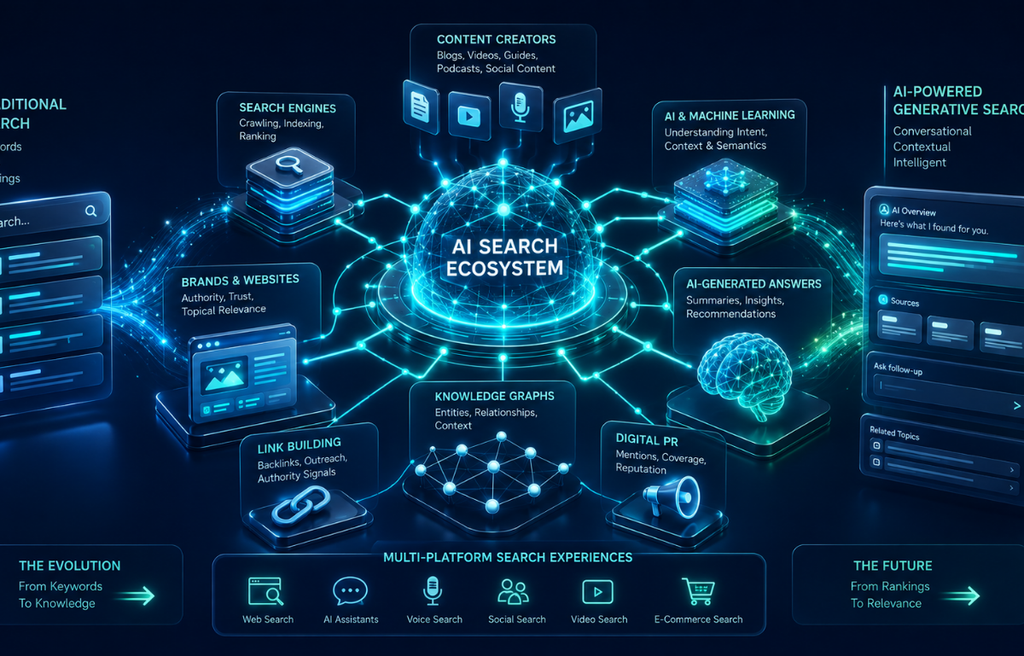
What is changing is the number of ways users can discover information.
The future is likely to involve traditional search results, AI-generated answers, conversational search, recommendation engines, social platforms, communities, and other discovery systems operating together.
That means businesses should think beyond a single ranking position.
The bigger objective is search visibility across the entire information ecosystem.
The Future of GEO
GEO is likely to become a more important part of digital marketing as AI-powered search becomes more sophisticated.
However, the fundamentals are unlikely to disappear.
AI systems still need information.
They still need reliable sources.
They still need context.
They still need signals that help them determine which information is useful and credible.
This means businesses that invest in genuinely valuable content, strong brand authority, expert knowledge, relevant backlinks, original research, and consistent digital presence are likely to be better positioned for the changing search landscape.
The biggest opportunity is not trying to trick AI into mentioning your company.
The opportunity is becoming a source that AI systems have a legitimate reason to reference.
Final Thoughts
Generative Engine Optimization is not a magic replacement for SEO, and businesses should avoid treating it like one.
GEO is better understood as a new layer of search visibility created by the growth of generative AI and answer-driven search experiences.
Traditional SEO helps your website become discoverable and competitive in search engines. GEO expands that objective by considering how your information, expertise, brand, and authority are represented inside AI-generated answers.
The strongest strategy is therefore not SEO versus GEO.
It is SEO + authoritative content + topical depth + strong off-page signals + brand authority + GEO awareness.
Businesses that build genuine expertise and a credible presence across the web will have more opportunities to appear wherever people are searching for information — whether that search happens through a traditional search engine or an AI-powered answer experience.
In the long term, GEO is likely to reward the same principle that has always mattered in sustainable SEO:
Become a genuinely useful and credible source of information, rather than trying to manipulate the system.