
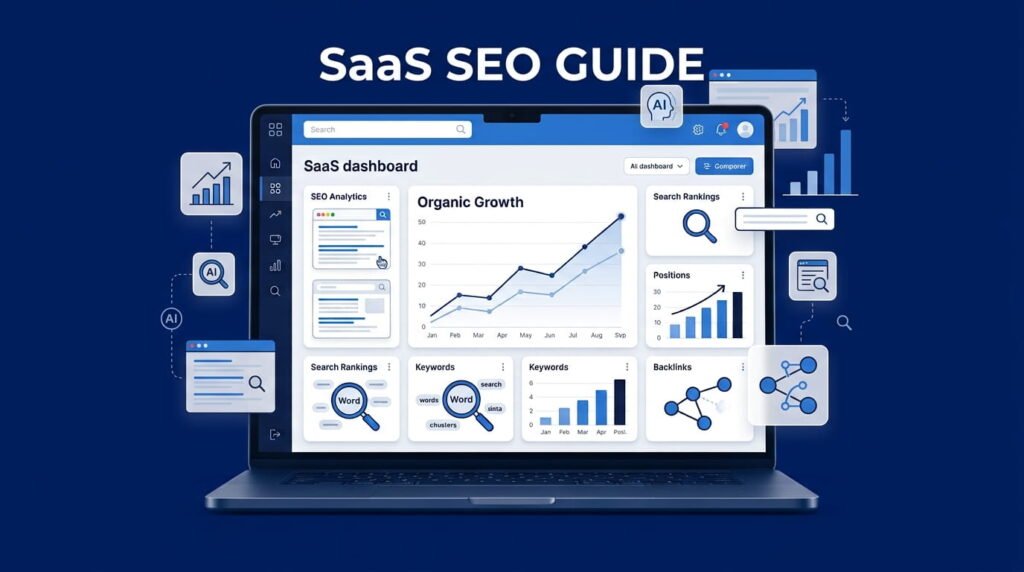
Search engine optimization is one of the most powerful long-term growth channels for SaaS companies, but it is also one of the hardest to execute properly.
Unlike many traditional businesses, SaaS companies are not always targeting obvious, high-volume keywords. A potential customer may not even know that a software solution exists for the problem they are experiencing. Even when people know what they need, search results can be crowded with established software companies, review platforms, comparison websites, directories, and publishers.
That makes SaaS SEO much more than simply adding keywords to a website.
A successful SaaS SEO strategy combines keyword research, search intent, content marketing, technical optimization, internal linking, authority building, conversion optimization, and continuous analysis.
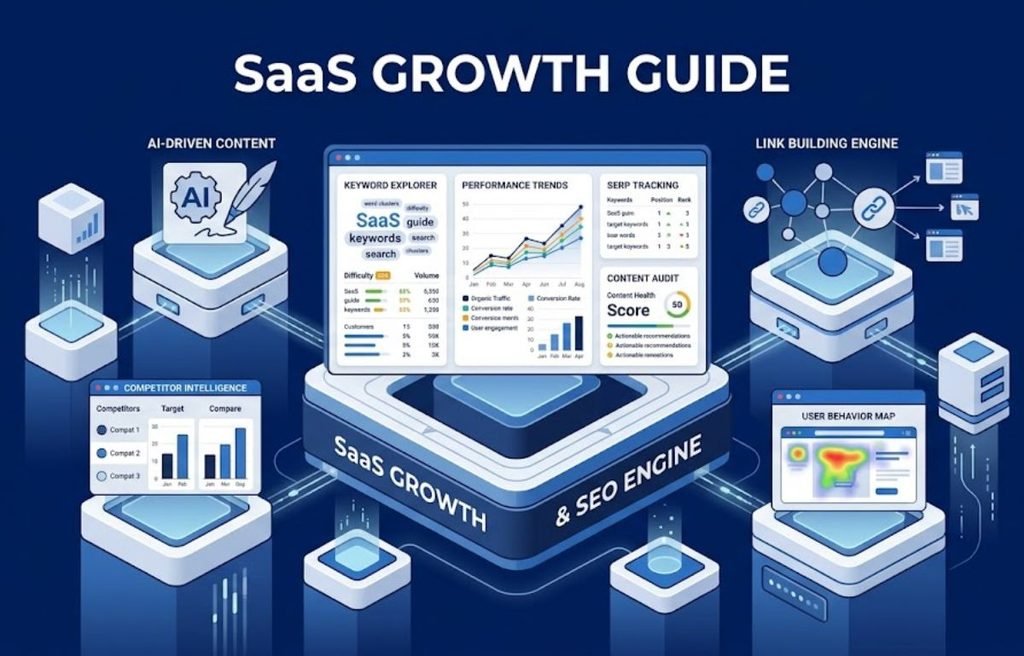
The goal is not simply to bring more visitors to your website. The real objective is to attract the right visitors, educate them, move them through the buying journey, and turn organic visibility into qualified leads, trials, demos, and paying customers.
In this guide, we will explain how SaaS SEO works, what makes it different from traditional SEO, which pages SaaS businesses should create, how content fits into the customer journey, and how to build a sustainable organic growth strategy.
What Is SaaS SEO?
SaaS SEO is the process of improving a software company’s website so that it can appear prominently in search engines for queries used by its target customers.
The strategy can involve several areas, including:
- Keyword and search-intent research
- Competitor analysis
- Technical SEO
- Product and feature page optimization
- Content development
- Internal linking
- Digital PR and link acquisition
- Conversion rate optimization
- Brand development
- Performance measurement
However, SaaS SEO should not be treated as a checklist of isolated tasks.
Every optimization should support a larger business objective.
For example, ranking for an informational keyword may introduce your company to a potential customer. A comparison page can help that person evaluate different solutions. A product page can demonstrate how your software solves their problem, while a pricing page can help them take the next step.
The strongest SaaS SEO campaigns connect these pages together so that organic visitors have a logical path from problem discovery to solution evaluation and eventually conversion.
Why SEO Matters for SaaS Companies
SaaS businesses often rely heavily on paid advertising, sales teams, partnerships, outbound campaigns, and product-led growth.
Those channels can be valuable, but they can also become expensive as a company scales.
Organic search offers another route to sustainable customer acquisition.
Once a page earns strong rankings for a valuable query, it can continue generating visitors without paying for every individual click. That does not mean SEO is free—creating content, improving the website, acquiring links, and maintaining rankings all require investment—but the economics can become increasingly attractive over time.
A strong organic presence can help SaaS businesses:
- Generate qualified website traffic
- Reduce dependence on paid acquisition
- Increase brand awareness
- Capture customers earlier in the buying process
- Build topical authority
- Support sales conversations
- Generate product trials and demo requests
- Create compounding organic growth
The important distinction is between traffic growth and business growth.
A website can receive thousands of additional visitors and still generate little revenue if those visitors are irrelevant. SaaS SEO should therefore prioritize commercial relevance and customer intent rather than traffic volume alone.
SaaS SEO vs. Traditional SEO
The fundamentals of SEO remain similar across industries, but SaaS websites have several characteristics that require a different strategic approach.
One major difference is the complexity of the buying journey.
Someone searching for a physical product may be able to compare prices and make a purchase within minutes. A business evaluating software may need to research multiple providers, compare features, check integrations, review pricing, speak with a sales representative, request a demonstration, and obtain approval from other decision-makers.
The process can take weeks or months.
This means SaaS SEO needs content for multiple stages of the customer journey rather than focusing exclusively on product keywords.
SaaS companies may need pages targeting:
- Problems
- Solutions
- Industries
- Features
- Use cases
- Comparisons
- Competitor alternatives
- Educational topics
- Integrations
- Pricing
- Product searches
Another difference is the level of competition.
A SaaS company may be competing against direct competitors and large publishers at the same time. Software directories and review websites can also dominate broad commercial queries.
Because of this, simply publishing a generic product page is rarely enough.
Understanding the SaaS Search Funnel
A useful SaaS SEO strategy begins by understanding what customers search for before they become customers.
Search behavior generally becomes more commercially focused as users move through the funnel.
Top of the Funnel: Problem Awareness
At the beginning, users may not be looking for software at all.
They may simply be researching a problem.
For example:
- How to manage remote employees
- How to automate customer support
- How to organize sales leads
- How to improve team collaboration
- How to reduce repetitive administrative work
These searches create an opportunity to introduce your audience to the problem and explain potential solutions.
Content at this stage should educate rather than aggressively sell.
Useful formats include:
- Educational guides
- Beginner tutorials
- Research articles
- Industry reports
- Statistics pages
- How-to content
- Glossaries
The objective is to build awareness and trust.
Middle of the Funnel: Solution Research
At this point, users understand their problem and are researching possible solutions.
Searches may look like:
- Best CRM for startups
- Project management tools for agencies
- CRM comparison
- Customer support software
- Email automation platforms
- Alternatives to [competitor]
Now the content can become more product-focused.
Comparison articles, solution pages, use-case content, and detailed guides can help users evaluate their options.
The objective is to demonstrate why your product deserves consideration.
Bottom of the Funnel: Purchase Intent
At the bottom of the funnel, the user is much closer to taking action.
Typical searches include:
- [Product] pricing
- [Product] demo
- [Product] free trial
- [Competitor] alternative
- [Product] vs [Competitor]
- Best [software category]
- [Product] features
These visitors should encounter pages that answer their commercial questions quickly.
Strong bottom-of-funnel pages should communicate:
- Product benefits
- Features
- Pricing
- Integrations
- Customer results
- Security information
- FAQs
- Implementation details
- Free trial or demo options
The purpose is to remove uncertainty and make the next step obvious.
Building a SaaS SEO Strategy
A sustainable SaaS SEO campaign should be built around the business rather than around random keyword lists.
1. Define Business Goals and SEO KPIs
Start by deciding what SEO needs to accomplish.
Possible objectives include:
- Increasing qualified organic traffic
- Generating more free trials
- Increasing demo requests
- Growing organic revenue
- Improving visibility for commercial keywords
- Expanding into new markets
- Increasing non-branded search traffic
Your KPIs should connect SEO activity with business outcomes.
Useful metrics include:
- Organic clicks
- Organic impressions
- Keyword visibility
- Qualified organic sessions
- Trial registrations
- Demo requests
- Organic conversion rate
- Pipeline generated from organic traffic
- Revenue attributed to organic search
Ranking improvements are useful, but rankings alone are not the final objective.
2. Build Detailed Customer Personas
Before researching keywords, understand who actually buys the software.
A SaaS product can have several audiences.
For example, the person searching for the product may not be the person approving the purchase.
You should understand:
- Job roles
- Business size
- Industry
- Main problems
- Existing solutions
- Buying objections
- Desired outcomes
- Technical requirements
- Budget concerns
- Decision-making process
Customer interviews, sales calls, support conversations, surveys, and product data can provide valuable insights.
These insights can then be converted into SEO topics and content opportunities.
3. Analyze the Search Landscape
Competitor research is essential in SaaS SEO.
Do not only look at businesses offering similar software.
Study the websites appearing for your target searches.
You may discover that the actual SERP competition includes:
- Software directories
- Review platforms
- Industry publications
- Blogs
- Forums
- Comparison websites
- Enterprise brands
- Individual experts
Analyze which types of pages Google is rewarding.
Look at:
- Search intent
- Content depth
- Page structure
- Internal links
- Backlink profiles
- Featured snippets
- Related searches
- Content formats
- Brand strength
The purpose is not to copy competitors.
The purpose is to identify what Google appears to consider useful and then determine where your website can provide something better or more specific.
4. Perform Keyword Research Based on Problems
Traditional keyword research often starts with a product category.
For SaaS, that is only one part of the opportunity.
Start with customer problems.
Imagine a company sells workflow automation software.
Instead of targeting only:
workflow automation software
the SEO strategy could also explore searches related to:
- Automating repetitive tasks
- Business process automation
- How to automate workflows
- Workflow management
- Reducing manual data entry
- Automated approval processes
- Team productivity tools
This approach creates a larger content ecosystem around the product.
Keyword research should therefore combine:
- Product keywords
- Feature keywords
- Problem keywords
- Use-case keywords
- Industry keywords
- Comparison keywords
- Competitor keywords
- Informational searches
- Long-tail queries
High-Value Landing Pages for SaaS Websites
A SaaS website should not depend on one homepage and a single product page to rank for everything.
Different search intents deserve different landing pages.
Product Pages
Your core product pages should explain exactly what the software does and who it is for.
A strong product page should include:
- Clear value proposition
- Main features
- Benefits
- Product screenshots
- Videos or demonstrations
- Customer proof
- Integrations
- FAQs
- Relevant internal links
- Strong calls to action
Avoid turning the page into a wall of generic marketing copy.
Users should be able to understand the product quickly.
Feature Pages
If your software provides multiple important features, individual feature pages can target more specific searches.
For example, an email marketing platform might have separate pages for:
- Email automation
- Marketing segmentation
- Email analytics
- Campaign management
- Customer journey automation
Feature pages can capture users who know exactly what capability they need.
They also create additional opportunities for internal linking between the product ecosystem.
Industry Pages
Industry-specific pages are useful when the software serves multiple sectors.
For example:
- CRM for real estate
- CRM for healthcare
- Project management for agencies
- Accounting software for freelancers
- Scheduling software for salons
These pages should not simply replace the industry name throughout the same template.
They need genuinely useful information about how the software addresses that industry’s specific workflows, problems, regulations, or requirements.
Use-Case Pages
Use-case pages focus on what customers want to accomplish.
For example:
- Automate lead follow-up
- Manage remote projects
- Track customer conversations
- Automate employee onboarding
- Create recurring reports
These pages can connect problem-focused searches with your actual product.
Comparison and Alternative Pages
Comparison searches are extremely valuable because the user is already evaluating solutions.
Potential page types include:
- Product A vs Product B
- Alternatives to Product A
- Best tools for [specific use case]
- Product A alternatives for small businesses
- Product A vs Product B vs Product C
A good comparison page should be objective and useful.
Do not create thin pages that simply declare your product better.
Explain differences in:
- Features
- Pricing
- Ease of use
- Integrations
- Target customers
- Support
- Strengths
- Limitations
Honest comparison content can be more convincing than exaggerated marketing claims.
The Role of Content in SaaS SEO
Content is one of the biggest growth opportunities for SaaS companies.
But publishing more articles does not automatically produce better SEO.
The important question is:
Does the content satisfy a real search need?
A strong SaaS content strategy should create a connected ecosystem rather than a collection of unrelated blog posts.
For example, a project management platform could build a topic cluster around project management.
A central guide might explain project management fundamentals.
Supporting articles could cover:
- Project planning
- Project scheduling
- Resource management
- Project risk management
- Agile project management
- Project management templates
- Project management software comparisons
These articles can then link naturally to relevant product, feature, and use-case pages.
This creates topical depth and gives search engines clearer context about the website.
Evergreen Content
Evergreen content addresses topics that remain useful over a long period.
Examples include:
- Complete guides
- Definitions
- Tutorials
- Frameworks
- Checklists
- Best practices
- Industry fundamentals
Evergreen pages can become long-term organic assets.
However, “evergreen” does not mean “publish once and forget.”
Industries change.
Products change.
Search results change.
Competitors publish better content.
Statistics become outdated.
Successful SaaS companies regularly review important pages and update them when necessary.
Blog Content Should Have a Purpose
One of the biggest SaaS SEO mistakes is publishing blog posts simply to maintain a publishing schedule.
A better approach is to give every article a clear purpose.
Before publishing, ask:
- Who is searching for this?
- What problem are they trying to solve?
- What search intent does the query represent?
- Can our company provide a genuinely useful answer?
- Which product or service does this topic relate to?
- What should the reader do after reading?
- Are there existing pages we should link to?
If these questions cannot be answered, the topic may not deserve an article.
Technical SEO for SaaS Websites
Great content cannot perform properly if search engines cannot efficiently crawl, understand, and index the website.
Technical SEO should therefore be treated as a foundation.
Website Architecture
A logical website structure helps users and search engines navigate the site.
Important pages should not be buried several clicks deep.
A typical SaaS structure might look like:
Homepage → Solutions → Product → Features → Use Cases → Industries → Resources
The exact architecture depends on the business, but the principle remains the same:
Important pages should be easy to discover.
Page Speed
Slow websites create friction.
Review:
- Image sizes
- JavaScript
- CSS
- Third-party scripts
- Server response time
- Caching
- Font loading
- Unnecessary plugins
Performance should be considered from both SEO and conversion perspectives.
A faster site can create a better experience for users who are evaluating your product.
Mobile Experience
Many SaaS websites focus heavily on desktop design while treating mobile as an afterthought.
That is a mistake.
Make sure mobile visitors can:
- Navigate easily
- Read content comfortably
- Access pricing
- Watch product demonstrations
- Complete forms
- Start trials
- Request demos
Mobile usability should be tested on real devices rather than assumed from a desktop browser.
HTTPS and Security
SaaS companies often deal with sensitive business information.
A secure HTTPS implementation is therefore essential for both user trust and technical best practice.
Security should also extend beyond simply installing an SSL certificate.
URL Structure
URLs should be simple, descriptive, and understandable.
Avoid unnecessarily complicated URL structures.
A clean structure helps users understand what a page is about before clicking it.
On-Page SEO for SaaS
On-page optimization helps search engines understand a page while making the content more useful for visitors.
Important areas include:
- Title tags
- Meta descriptions
- H1 headings
- Subheadings
- Content structure
- Image optimization
- Internal links
- Anchor text
- Entity and topic coverage
- Calls to action
Do not force keywords into every sentence.
Modern SEO is not about repeating the same phrase as many times as possible.
Instead, create content that naturally covers the subject and answers the user’s underlying questions.
Internal Linking
Internal linking is often underestimated by SaaS companies.
A strong internal linking structure can help distribute authority, improve crawling, and guide users toward relevant commercial pages.
For example, an educational article about customer retention might naturally link to:
- Customer retention software
- Customer analytics
- CRM features
- Relevant case studies
The links should make sense in context.
Avoid creating large blocks of artificial links just for SEO.
Link Building for SaaS
Authority still matters in competitive search results.
A SaaS website can build backlinks through several legitimate approaches.
Data-Driven Research
Original research can be extremely linkable.
Examples include:
- Industry surveys
- Market reports
- SaaS statistics
- Original datasets
- Customer research
- Industry benchmarks
When other publications reference your findings, your research can naturally attract links.
Digital PR
Digital PR can connect your company with journalists, publications, industry websites, and relevant media.
Potential campaigns include:
- Original research
- Expert commentary
- Industry predictions
- Surveys
- Data studies
- Product trends
The objective should be meaningful exposure rather than collecting random links.
Guest Contributions
Contributing genuinely useful content to relevant publications can help establish expertise and earn referral traffic and links.
The quality and relevance of the publication matter more than simply obtaining a large number of links.
Unlinked Brand Mentions
Sometimes websites mention a SaaS company without linking to it.
Finding these mentions and requesting a relevant citation can create additional opportunities.
Measuring SaaS SEO Performance
SEO should be measured as a business channel rather than simply a ranking exercise.
Important metrics include:
Organic Visibility
Monitor impressions, clicks, rankings, and overall search visibility.
Organic Traffic
Look at traffic trends while separating branded and non-branded searches where possible.
Engagement
Review whether organic visitors actually interact with the website.
Conversions
Track actions such as:
- Demo requests
- Free trials
- Account registrations
- Contact forms
- Product signups
Revenue
Ultimately, the most useful question is whether organic search contributes to revenue and qualified pipeline.
A keyword ranking in position one is not particularly valuable if it generates visitors who will never become customers.
SEO Forecasting for SaaS
SEO forecasting can help SaaS companies estimate the potential value of organic growth before committing significant resources.
A forecast can consider:
- Existing organic traffic
- Search demand
- Expected ranking improvements
- Click-through rates
- Conversion rates
- Average customer value
For example, if a group of commercial keywords receives substantial monthly search demand, a company can estimate potential clicks at different ranking positions and then model possible conversions.
Forecasts should never be presented as guaranteed results.
Search behavior, competitors, algorithms, content quality, and conversion rates can all change.
Forecasting is most useful as a planning tool for prioritizing opportunities and allocating resources.
SaaS SEO and Conversion Optimization
Getting someone to your website is only half the job.
The next challenge is convincing them to take action.
Organic landing pages should therefore include clear conversion paths.
Depending on the business model, CTAs may include:
- Start a free trial
- Book a demo
- Get started
- Create an account
- Request pricing
- See the product
- Talk to sales
The CTA should match the visitor’s level of intent.
A person reading a beginner’s guide may not be ready for a sales call.
A person searching for your pricing page probably is.
This is why SaaS SEO and conversion optimization should work together.
Brand Building and SaaS SEO
Brand strength can make SEO significantly easier.
When users repeatedly encounter your company across search results, social media, industry publications, communities, and other channels, they become more familiar with the brand.
Brand recognition can influence:
- Click-through rates
- Search behavior
- Direct traffic
- Branded searches
- Conversion rates
- Trust
For newer SaaS companies, building credibility is particularly important.
Strong customer testimonials, detailed case studies, expert content, transparent information, and reputable mentions can all contribute to a stronger brand presence.
Common SaaS SEO Mistakes
Targeting Only Product Keywords
Many SaaS companies focus entirely on phrases such as “[category] software.”
These keywords can be valuable, but they are often highly competitive.
Ignoring informational, problem-focused, industry, and use-case searches leaves significant opportunities untouched.
Publishing Thin AI Content
Producing hundreds of generic articles with little original value is not a sustainable SEO strategy.
Content needs expertise, useful information, unique perspectives, examples, evidence, or practical guidance.
Ignoring Search Intent
A page can target the correct keyword and still fail because it does not satisfy what searchers actually want.
Always inspect the search results before creating important pages.
Buying Low-Quality Links
Large quantities of irrelevant or manipulative backlinks can create more problems than benefits.
Focus on relevance, authority, editorial value, and genuine relationships.
Measuring Only Traffic
Traffic is a vanity metric when it does not contribute to the business.
Measure leads, trials, pipeline, and revenue alongside traffic.
A Practical SaaS SEO Roadmap
If you are starting SEO for a SaaS website, the process can be organized into several stages.
Phase 1: Research
- Understand the product
- Identify customer personas
- Analyze competitors
- Research search demand
- Map search intent
- Identify content gaps
Phase 2: Technical Foundation
- Audit crawling and indexing
- Improve site architecture
- Fix important technical issues
- Improve performance
- Check mobile usability
- Review internal linking
Phase 3: Commercial Pages
Build and optimize:
- Product pages
- Feature pages
- Industry pages
- Use-case pages
- Integration pages
- Comparison pages
- Alternative pages
Phase 4: Content Expansion
Develop:
- Pillar content
- Supporting articles
- Tutorials
- Guides
- Research content
- FAQs
- Industry resources
Phase 5: Authority Building
Work on:
- Digital PR
- Relevant guest contributions
- Original research
- Brand mentions
- Industry relationships
- High-quality link acquisition
Phase 6: Measurement and Improvement
Regularly review:
- Rankings
- Organic clicks
- Search impressions
- Conversions
- Organic revenue
- Backlink growth
- Content performance
Then update the strategy based on actual data.
Final Thoughts
SaaS SEO is not a shortcut to instant traffic.
It is a long-term acquisition strategy that requires a combination of technical excellence, useful content, strong website architecture, relevant authority, and a deep understanding of customer behavior.
The biggest mistake SaaS companies can make is treating SEO as a simple keyword-ranking exercise.
The companies that build sustainable organic growth think beyond individual keywords.
They create content around customer problems, build pages around different search intents, establish authority within their industry, optimize the user journey, and continuously improve their website based on real performance data.
A successful SaaS SEO strategy should ultimately answer one question:
Can your website consistently reach people who need your solution and give them enough value and confidence to become customers?
If the answer is yes, SEO can become far more than a traffic channel. It can become a scalable source of leads, customers, brand visibility, and long-term business growth.