
If you’ve been watching your paid acquisition costs creep up while your leads get harder to close, you’re not imagining it. PPC has gotten more expensive, third-party tracking keeps getting less reliable, and B2B buyers are taking longer than ever to make a decision. Betting the whole growth plan on ads is a shakier position every quarter.
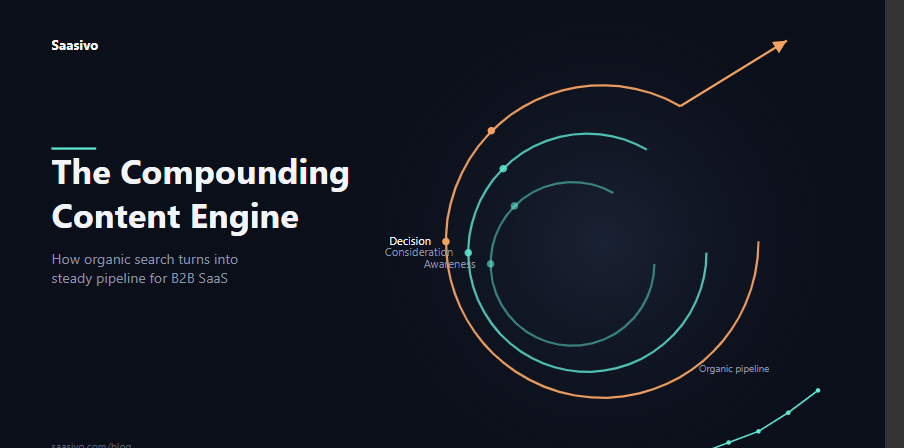
The alternative — and the one that actually compounds over time — is building an organic content engine. Done right, it’s the most capital-efficient way for Saasivo.com to show up for the people who are already looking for a solution like ours, and to move them toward a trial without paying for every single click.
That means going beyond the occasional blog post. It takes real search intent mapping, solid technical foundations, a plan for owning entire topic areas, and a clear, low-friction path from “just reading” to “signed up.”
1. Get the Technical Foundation Right First
No amount of great content will rank if the site underneath it is slow or hard to crawl. Search engines are evaluating real performance signals — page speed, crawl efficiency, and how cleanly the site is structured — before they even get to what the content says.
Where to focus:
- Core Web Vitals — clean code, efficient JavaScript loading, and fast Largest Contentful Paint on both desktop and mobile.
- Clear site architecture — logical subfolders like /blog/, /integrations/, and /comparisons/ so search engines (and humans) can tell what lives where.
- Structured data — schema markup (SoftwareApplication, Article, FAQPage) so pages have a shot at rich snippets in search results. Google’s structured data guidelines are the best reference here.
2. Map Keywords to Where Buyers Actually Are
Not all search volume is created equal. A high-volume, top-of-funnel query builds awareness; a low-volume, specific query is often the one that actually converts.
| Funnel Stage | What They’re Searching | Example | What You Offer Them |
| Top (TOFU) | Broad, informational | “how to reduce SaaS churn rate” | Newsletter signup or lead magnet |
| Middle (MOFU) | Category / solution research | “best subscription analytics software” | Whitepaper or webinar |
| Bottom (BOFU) | Comparative, ready to decide | “[Competitor A] vs [Competitor B]” | Free trial or demo |
The mistake most teams make is pouring all their effort into TOFU content because it has the biggest volume numbers, while the BOFU content — the stuff that actually closes deals — gets an afterthought.
3. Own the Bottom-of-Funnel Comparison Searches
Someone typing “[Competitor] vs [Competitor]” into Google is about as close to ready-to-buy as organic traffic gets. If Saasivo.com isn’t showing up for those searches, a competitor is.
Worth building:
- Honest comparison pages — feature-by-feature breakdowns against the alternatives people are actually considering.
- “Best Alternatives” pages — think “Best [Category] Alternatives in 2026,” written to be genuinely useful rather than obviously self-serving.
- Migration guides — practical, step-by-step help for someone switching over from legacy tools.
4. Build Real Authority With Content Clusters
Search engines increasingly reward sites that clearly know a subject inside and out, rather than ones with a handful of scattered posts. The way to demonstrate that is through topic clusters: one strong pillar page supported by a network of related articles.
- Pillar page — a thorough overview of a big topic (e.g., “The Complete Guide to SaaS Revenue Operations”).
- Cluster content — focused pieces on the subtopics underneath it (e.g., “Calculating Net Revenue Retention,” “Handling Involuntary Churn”).
- Internal linking — every cluster piece links back to the pillar, so authority flows through the whole group. Ahrefs has a solid breakdown of how this works in practice.
5. Turn Readers Into Trial Users Without Being Pushy
Traffic that never converts isn’t worth much. The goal is to build natural, contextual paths from “reading an article” to “trying the product” — not a wall-to-wall popup campaign.
Low-friction ways to do that:
- Drop free interactive tools (mini calculators, diagnostic quizzes, template generators) right inside the article.
- Use contextual CTAs tied to the specific section someone’s reading, instead of a generic sidebar ad.
- Gate genuinely useful assets — benchmarking reports, checklists, templates — behind a work email, when the value clearly justifies the ask.
6. Scale Up With Programmatic SEO
If Saasivo.com has a lot of integrations, use cases, or location-based variants, programmatic SEO lets you generate strong landing pages at scale instead of writing every one by hand.
- Structure your data — a clean dataset of every integration, template, or use case you support.
- Build one solid template — designed well for UX and mobile, then applied across the dataset.
- Link it all together — automated internal linking so none of these pages end up orphaned with no path leading to them. Search Engine Land’s programmatic SEO primer is a good starting point if this is new territory.
7. Write for AI Search, Not Just Google’s Blue Links
AI-driven search results now summarize content directly in the response box, before anyone even clicks through. That changes what “good content” needs to do.
- Answer clearly and early — definitions, steps, and summary tables right under the relevant heading, not buried three paragraphs down.
- Publish original data — proprietary benchmarks and case studies are exactly the kind of thing AI models tend to cite, because they can’t get it anywhere else.
- Show real expertise — detailed author bios and credentials matter more now, not less. Google’s E-E-A-T guidance is worth revisiting with this lens.
8. Don’t Let Good Content Die on One Page
Publishing on the blog is step one, not the finish line. The best-performing pieces deserve a second life across the channels where your actual customers spend time.
- LinkedIn — turn data points and frameworks into posts your team (and execs) can share.
- Email — package the sharpest insights into a newsletter drop.
- Communities — adapt technical sections into genuinely useful answers on relevant forums and subreddits, not just a link drop.
9. Measure What Actually Matters
Traffic is a vanity metric if it’s not tied to revenue. Leadership isn’t going to get excited about pageviews — they want to see pipeline.
Track instead:
Pipeline value vs. CAC — total ARR sourced from organic, weighed against what it cost to produce and support.
Share of voice — how much organic visibility you own on your highest-intent keywords versus competitors.
Trial and demo conversions — signups directly attributable to organic pages.