

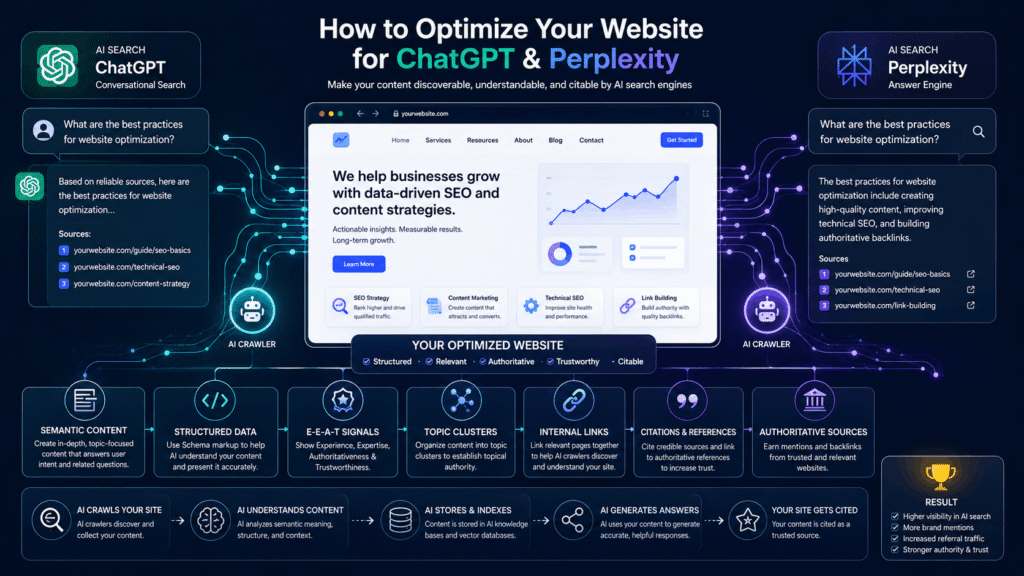
Modern search habits are shifting rapidly. Users now rely on AI tools to find quick answers, summaries, and reliable data. Learning how to optimize websites for chat GPT and perplexity is the next logical step in your digital marketing journey.
These platforms scan your pages to build accurate responses. When your content is clear, structured, and authoritative, these systems are more likely to reference your brand. Visibility in this new era depends on being discoverable by machine learning models.

how to optimize website for chat GPT and perplexity
While no strategy guarantees a top spot, you can improve your chances significantly. Focus on providing high-quality information that helps users solve problems. By making your data easy to parse, you help AI assistants deliver better value to their audience.
Key Takeaways
- AI search tools prioritize clear, factual, and well-structured content.
- Building topical authority helps AI models trust your domain as a source.
- Technical accessibility ensures bots can crawl and index your pages effectively.
- Citations often go to sites that provide direct, concise answers to queries.
- Focusing on user intent remains the best way to stay relevant in AI results.
Why AI Search Visibility Matters for Your Website
The way people find information online is changing rapidly as users shift from simple keywords to complex, conversational questions. Instead of scanning pages of blue links, users now expect immediate, accurate responses from intelligent systems. This shift makes AI search optimization a vital priority for any brand that wants to stay relevant in the digital age.
How ChatGPT and Perplexity Discover Online Information
Platforms like ChatGPT and Perplexity rely on massive datasets gathered from the web to train their models and provide real-time answers. These systems use advanced crawlers to index content, much like traditional search engines, but they process this data differently. They look for patterns, context, and authority to build a comprehensive understanding of a topic.
When a user asks a question, the AI synthesizes information from multiple sources to create a unique response. This means your content must be structured in a way that is easy for these systems to parse and interpret. Clarity and logical flow are essential for ensuring your information is included in the final output.
How AI Search Differs From Traditional Google Search
Traditional search engines focus on ranking individual pages based on relevance and authority. In contrast, AI search focuses on providing AI-generated answers that summarize the best available information. While Google might send a user to your website, an AI platform might provide the answer directly within the chat interface.
This fundamental difference changes how we measure success. You are no longer just competing for a top-ten ranking; you are competing to be the primary source of truth for the AI. Achieving high AI search visibility requires a focus on providing deep, factual, and well-structured content that an AI can confidently reference.
What Visibility, Mentions, and Citations Mean
In the world of AI, success is defined by how often your brand is referenced or used to support a response. AI citations act as a digital stamp of approval, signaling to the system that your content is trustworthy. When an AI mentions your brand or links to your site as a source, it validates your expertise to the user.
Understanding these metrics helps you track your influence in a new search landscape. The following table highlights the key differences between traditional search and AI-driven discovery:
| Feature | Traditional Search | AI Search |
| Primary Goal | Driving clicks to site | Providing direct answers |
| User Interaction | Scanning search results | Conversational dialogue |
| Success Metric | Organic traffic/rankings | Mentions and citations |
| Content Format | Keywords and meta tags | Contextual, factual depth |
How to Optimize Website for ChatGPT and Perplexity
Optimizing for AI models like ChatGPT and Perplexity is about building a bridge between your expertise and user needs. Rather than trying to trick algorithms, you should focus on providing clear, high-quality answers that these systems can easily process and share with their users.
Align Content With Real User Questions
Modern search is conversational. To succeed, you must anticipate the specific questions your audience asks when they interact with AI tools. Instead of targeting broad keywords, focus on solving problems and providing direct, helpful responses to common inquiries.
When you align your content with user intent, you improve your chances of being cited as a primary source. This approach is the foundation of effective ChatGPT SEO and Perplexity SEO strategies.
Make Important Information Easy for AI Systems to Extract
AI models function best when they can quickly identify the core message of a page. You should use clear headings, bulleted lists, and concise summaries to highlight your most important points. By structuring your data logically, you help the AI understand exactly what your content offers.
Avoid burying your answers in long, complex paragraphs. When information is easy to parse, the system is much more likely to extract and present your content as a reliable answer to a user query.
Build Trust Through Accuracy, Expertise, and Transparency
Trust is the currency of the AI age. Implementing E-E-A-T (Experience, Expertise, Authoritativeness, and Trustworthiness) principles is essential for long-term visibility. AI systems are designed to favor content that demonstrates deep knowledge and verifiable accuracy.
Show authorship and relevant qualifications
Users and AI models alike want to know who is behind the information. Clearly display author bios, professional credentials, and relevant experience on every page. This transparency signals to search systems that your content is authored by a credible expert rather than an anonymous source.
Support claims with reliable sources
You should always back up your statements with data, research, or links to reputable organizations. When you provide reliable sources, you strengthen your E-E-A-T profile and make your site a more attractive candidate for citations. This commitment to accuracy is a core component of successful ChatGPT SEO and Perplexity SEO efforts.
Research Prompts Instead of Relying Only on Keywords
If you want to rank in ChatGPT and Perplexity, you need to start researching prompts instead of just keywords. Modern search engines are moving away from static phrases toward a more dynamic understanding of user intent. By focusing on how people actually ask questions, you can create content that feels like a natural answer to their specific needs.
Identify Conversational Search Questions
To capture traffic from AI platforms, you must identify the actual questions your audience asks. Conversational search is not about hitting a specific search volume; it is about providing the most helpful response to a query. When you align your content with these questions, you demonstrate that you truly understand the user intent behind the search.
Map Follow-Up Questions and Related Topics
Users rarely stop at the first answer they receive. They often follow up with deeper questions to clarify their understanding or explore related concerns. Mapping these follow-up paths allows you to build comprehensive content that keeps the user engaged. By anticipating these secondary queries, you position your website as a trusted authority in your niche.
Study the Language Used by Your Target Audience
The best way to optimize for AI is to speak the same language as your customers. When you use the exact terminology and phrasing your audience uses, you make it easier for AI systems to match your content to their queries. This approach ensures your information feels authentic and accessible to real people.
Use customer support conversations and sales calls
Your customer support team and sales representatives are gold mines of information. They hear the specific concerns, objections, and questions that potential customers raise every day. Reviewing these transcripts helps you uncover the natural language that your audience uses when they are ready to make a decision.
Review Google Search Console query data
Google Search Console provides a wealth of data regarding the actual queries that bring people to your site. Look for long-tail, question-based queries that indicate a high level of interest. Analyzing this data helps you refine your content to better address the specific problems your visitors are trying to solve.
Plan Content Around Complete Search Journeys
To truly succeed with AI search engines, you must map out the entire path a user takes from curiosity to purchase. When you organize your website around these journeys, you make it easier for systems like ChatGPT to identify your site as a comprehensive authority. By anticipating what a user needs next, you provide a seamless experience that keeps them engaged.
Connect Broad Topics With Specific User Needs
Start by identifying the core pillars of your business. These broad topics serve as the foundation for your educational content. You can then branch out into specific articles that address the unique questions your audience asks during their research phase.
This approach ensures that you are not just writing random posts. Instead, you are building a logical progression that guides the reader from a general interest to a specific solution. This structure helps AI models understand the relationship between your various pages.
Create Topic Clusters With Clear Internal Links
The most effective way to organize this information is through topic clusters. By grouping related content around a central hub page, you create a clear hierarchy that search engines love. Internal linking acts as the glue that holds this structure together.
When you link from your broad pillar page to specific sub-topics, you signal to AI systems that your site covers the subject in depth. This strategy prevents your content from feeling fragmented. It also helps users navigate your site more naturally as they seek answers to their follow-up questions.
Match Content Depth to Search Intent
Understanding user intent is vital for creating content that actually converts. You must tailor the depth of your writing to match where the user is in their decision-making process.
Cover informational, commercial, and transactional intent
Your content should address different stages of the buyer’s journey. Informational pages should focus on education, while commercial pages should help with evaluation. Finally, transactional pages must make the path to purchase as clear as possible.
Prevent overlapping pages from competing with one another
Each page on your site should have a distinct purpose. If two pages cover the same material, they may compete for the same AI visibility. By clearly defining the goal of every article, you ensure that your internal linking strategy remains focused and effective.
| Intent Type | Primary Goal | Content Focus |
| Informational | Education | Broad guides and definitions |
| Commercial | Evaluation | Comparisons and reviews |
| Transactional | Conversion | Product pages and checkout |
Write Answers That ChatGPT and Perplexity Can Understand
Mastering answer engine optimization requires a shift in how you structure your digital content. When AI models crawl your site, they look for information that is easy to parse, summarize, and verify. By refining your content structure, you make it much simpler for these systems to identify your expertise and present it to users.
Answer the Main Question Near the Beginning
Users and AI systems alike appreciate efficiency. Place the direct answer to a query in the first few sentences of your page. This immediate clarity helps AI models extract the core value of your content without needing to scan the entire document.
Use Clear Headings, Short Paragraphs, and Scannable Lists
Organize your information using descriptive headings that act as a roadmap for the reader. Keep your paragraphs brief to ensure that each point remains distinct and easy to digest. Using bulleted lists helps break up dense text, making it easier for automated systems to categorize your key takeaways.
Define Specialized Terms in Plain American English
Avoid using jargon that might confuse both your human audience and AI algorithms. When you must use technical language, provide a simple definition immediately. This practice ensures that your content remains accessible and authoritative across various search contexts.
Turn complex explanations into concise answer blocks
Break down difficult concepts into small, manageable chunks. A well-structured block of text provides a clear summary that AI can easily reference. Focus on the who, what, when, and why to provide maximum value in a minimal amount of space.
Use examples, comparisons, and practical context
Context helps AI understand the relevance of your information. Use comparisons to highlight differences between products or ideas. Providing real-world examples makes your content more useful and increases the likelihood that it will be cited as a reliable source.
| Feature | Traditional SEO | Answer Engine Optimization |
| Primary Goal | Keyword Ranking | Direct Information Retrieval |
| Content Style | Long-form Narrative | Concise, Scannable Blocks |
| Structure | Hierarchical Links | Semantic Data Clarity |
| User Benefit | Click-through Rate | Instant Knowledge Access |
Strengthen Factual Accuracy and Citation Potential
Establishing your brand as a reliable source starts with rigorous verification of every claim. When AI systems process your content, they look for signals that indicate high-quality information. Prioritizing fact-checking ensures that your site remains a preferred destination for AI models seeking reliable answers.

fact-checking and AI citations
Use Verifiable Data and Current References
AI models prioritize information that is supported by empirical evidence. You should ensure that all statistics and claims are backed by up-to-date data points. Avoid using outdated information that could lead to hallucinations or incorrect summaries by search systems.
Link to Primary Sources, Research, and Official Documentation
Linking to authoritative sources acts as a vote of confidence for your content. By connecting your claims to primary research or official government documentation, you provide a clear path for AI to verify your assertions. This practice significantly boosts your potential for earning AI citations in search results.
“Trust is the currency of the digital age. When you provide transparent, verifiable links, you empower both the reader and the machine to validate your expertise.”
Separate Facts, Expert Interpretation, and Opinion
Clarity is essential for machine understanding. You should clearly distinguish between objective facts and your own professional analysis. Using distinct sections or clear headings helps AI systems categorize your content accurately.
Display publication and update dates responsibly
Search systems value content that is current and maintained. Always display clear publication dates and update timestamps to show that your content undergoes regular editorial review. This simple step proves that your information is not stagnant.
Explain methodology for original research and statistics
If you publish original data, transparency is your best asset. Briefly explain your methodology to show how you arrived at your conclusions. This level of detail builds credibility and makes your work much more likely to be cited by advanced search tools.
Improve Technical Accessibility for AI Crawlers
If you want AI models to understand your content, you must first make it easy for them to find. Strong technical SEO practices ensure that your site remains open and readable for automated systems. By focusing on these foundations, you improve your overall AI crawler accessibility and ensure your best information reaches the right audience.
Check Robots.txt and Meta Robots Directives
Your robots.txt file acts as a map for crawlers, telling them which parts of your site are off-limits. It is vital to review this file regularly to ensure you are not accidentally blocking AI bots from accessing your most valuable pages. Similarly, meta robots tags on individual pages should be set to “index” to allow these systems to process your content effectively.
Keep Important Content Available in Crawlable HTML
AI systems perform best when they can parse standard HTML text. While modern crawlers are becoming more advanced, they still struggle with content hidden behind complex interactions or non-text formats. Always prioritize clear, semantic HTML to ensure your core message is visible and easy to interpret.
Improve Page Speed, Mobile Usability, and Core Web Vitals
Search systems prioritize sites that provide a fast and smooth user experience. High-performing websites are more likely to be crawled frequently and indexed accurately. You should monitor your Core Web Vitals to ensure your pages load quickly and remain stable for all visitors.
Reduce JavaScript barriers and unnecessary page elements
Heavy reliance on JavaScript can sometimes prevent crawlers from seeing your content in time. To improve AI crawler accessibility, consider these steps:
- Minimize the use of complex scripts that hide critical text.
- Remove unnecessary code that slows down page rendering.
- Use server-side rendering where possible to provide static content to bots.
Use XML sitemaps and consistent canonical URLs
An updated XML sitemap is a powerful tool for guiding crawlers to your most important pages. When combined with consistent canonical URLs, you prevent duplicate content issues that might confuse AI systems. These technical SEO habits help maintain a clean and authoritative presence across the web.
Use Structured Data to Clarify Page Meaning
Structured data acts as a bridge between your website and AI-driven search platforms. By providing machine-readable context, you help systems like ChatGPT and Perplexity interpret the specific intent and details of your content. This process ensures that your information is categorized correctly, making it easier for AI to retrieve and present your data to users.
Choose Schema Markup That Matches the Visible Content
The most important rule for schema markup is that it must reflect what a human visitor actually sees on the page. If your code describes a product that is not visible to the user, you risk creating a poor experience. Always ensure that the data provided to the machine aligns perfectly with the text, images, and prices displayed on your site.
Apply Article, Product, Organization, Person, and LocalBusiness Schema Correctly
Different types of content require specific vocabulary to be understood by AI. Using the correct structured data types—such as Article for blog posts, Product for e-commerce items, or LocalBusiness for physical storefronts—provides the necessary framework for search systems. Consistency is key when defining your organization or the people behind your content, as this builds a reliable profile for your brand.
Validate Structured Data Without Creating False Signals
Validation is a critical step in the implementation process. You should regularly test your code to ensure it is free of errors and follows the latest standards. This practice prevents the accidental transmission of misleading information that could confuse AI crawlers.
Keep schema properties accurate and up to date
Information on your website changes frequently, and your markup must keep pace. If you update a price, a business hour, or an author bio, you must update the corresponding properties immediately. Outdated data can lead to incorrect search results and a loss of trust with both users and AI systems.
Avoid adding markup solely to influence search features
It is tempting to add extra tags to try and force a specific search appearance, but this is a dangerous strategy. You should only use markup that provides genuine value and context to the reader. Focusing on transparency ensures that your site remains a high-quality source of information that AI systems can confidently recommend.
Build the Authority Signals AI Search Systems Look For
Building authority in the age of AI requires more than just technical SEO; it demands a reputation that machines can verify. AI models prioritize sources that demonstrate deep expertise and a consistent history of providing value to users.
Earn Relevant Mentions From Trusted Websites
When reputable platforms discuss your business, they provide a powerful signal of credibility to AI systems. These brand mentions act as digital endorsements that help algorithms understand your standing within your specific industry.
Focus on securing coverage in publications that your target audience already trusts. Quality matters far more than quantity when it comes to building a lasting reputation online.

brand mentions
Publish Original Research, Expert Commentary, and Useful Resources
AI systems are designed to synthesize information, making original data a highly valuable asset. By publishing unique research or proprietary insights, you provide the raw material that these systems need to cite your brand as a primary source.
“True authority is not claimed; it is earned through the consistent delivery of unique, verifiable, and helpful information that solves real problems for the reader.”
Creating high-quality resources, such as white papers or expert guides, establishes your site as a go-to destination. This approach encourages others to reference your work, further strengthening your authority profile.
Maintain Consistent Business Information Across the Web
Consistency is the foundation of trust for both human users and automated crawlers. Ensure that your name, address, and contact details remain uniform across every platform, from social media profiles to industry directories.
Strengthen author and organization profiles
Clearly defined author bios and organizational pages help AI systems attribute content to real experts. Use schema markup to link your content to specific people or entities, which helps build a clearer picture of your brand’s expertise.
Use digital public relations without manipulative link schemes
Digital PR should focus on building genuine relationships and earning coverage through newsworthy stories. Avoid shortcuts like paid link schemes, as these can damage your credibility and trigger negative signals in AI search results.
Instead, prioritize authentic outreach that highlights your team’s unique perspective. When you provide value to journalists and industry peers, you naturally attract the brand mentions that solidify your authority in the long run.
Optimize Pages for Brand, Local, and Product Discovery
Consistent data across your digital footprint helps AI platforms connect users with your business. When your information is uniform, it becomes much easier for systems to categorize your brand and improve your overall product discovery potential. By maintaining a clear identity, you ensure that users find exactly what they need without confusion.
Make Your Brand Identity Clear Across Every Page
Your brand identity should be unmistakable on every single page of your website. Use consistent logos, tone of voice, and mission statements to help AI models build a reliable profile of your organization. When your messaging remains steady, it reinforces trust and authority in the eyes of both users and search algorithms.
Improve Local Business Information for Nearby Recommendations
Effective local SEO relies on providing precise geographic data that AI can easily parse. Ensure your city, state, and service regions are clearly stated in your header, footer, and dedicated contact pages. This clarity helps systems associate your business with specific physical areas, making you a top choice for nearby searchers.
Describe Products and Services With Specific, Comparable Details
AI systems perform best when they can compare your offerings against others. Providing structured, granular data allows these tools to present your products accurately in conversational results.
Include pricing, availability, limitations, and service areas
Transparency is a major factor in how AI evaluates your content. You should clearly list the following details to help users make informed decisions:
- Current pricing models or starting rates.
- Real-time stock status or service availability.
- Specific limitations or exclusions for your services.
- Defined geographic service areas or shipping zones.
Keep contact information and business hours current
Outdated information can lead to frustration and lower trust scores. Regularly audit your site to ensure that your phone numbers, email addresses, and operating hours are always accurate. Keeping this data fresh is a simple yet powerful way to maintain your standing in local search results.
Measure Mentions, Citations, and Traffic From AI Platforms
Understanding how your brand appears in AI-generated responses is the next frontier for digital growth. Because these systems function differently than traditional search engines, you need a fresh approach to monitoring your performance.
Create a Baseline for ChatGPT and Perplexity Visibility
Before you can improve, you must establish a clear starting point. Start by auditing your current presence across major AI platforms to see where your brand is already being referenced.
You should document which queries trigger your brand name or website content. Establishing this baseline allows you to identify growth trends over time and understand how your authority is perceived by these systems.
Track Referral Traffic and Conversions in Analytics
While AI platforms often provide direct answers, they can still drive valuable visitors to your site. You must configure your analytics software to capture AI referral traffic effectively.
Look for patterns in your referral data that correlate with spikes in AI activity. By tagging your campaigns and monitoring specific landing pages, you can better attribute ChatGPT traffic to your overall conversion goals.
Test Representative Prompts on a Consistent Schedule
AI responses are dynamic and change based on location, context, and time. Because of this, you cannot rely on a single snapshot to understand your visibility.
Implement a recurring testing schedule to see how your brand appears for your most important keywords. This consistency helps you spot shifts in how Perplexity citations are generated for your specific industry topics.
Record cited URLs, competitors, and missing topics
Keep a structured log of your findings to identify patterns in how AI models prioritize information. Use a simple tracking system to note the following:
- Cited URLs: Which of your pages are being referenced most often?
- Competitors: Who else is appearing in the same AI-generated answers?
- Missing Topics: What questions are users asking that your current content does not fully address?
Use findings to update content rather than chase isolated rankings
Avoid the temptation to optimize for a single, fleeting AI response. Instead, use your data to create more comprehensive and helpful content that serves the user’s needs.
When you notice a gap in your coverage, update your existing pages to provide better, more accurate information. This strategy ensures that your ChatGPT traffic remains sustainable and that your brand remains a trusted source for future AI queries.
Conclusion
Adapting your digital presence for ChatGPT and Perplexity requires a shift in how you view online visibility. A successful AI search strategy focuses on providing direct, accurate, and helpful answers to user questions. By prioritizing clarity and technical accessibility, you ensure that your brand remains a trusted source for both human readers and automated systems.
Building this foundation does not mean abandoning traditional search engine optimization. Instead, your efforts to improve structured data and content authority strengthen your overall search footprint. These practices create a better experience for every visitor who lands on your website.
Start by testing your content against common conversational prompts to see how your brand appears in AI responses. Use these insights to refine your messaging and keep your information current. Consistent updates and a commitment to factual accuracy will help you maintain a competitive edge in this evolving landscape.
Focus on the long-term value of your content rather than chasing quick algorithmic wins. A thoughtful AI search strategy serves as a guide for your audience, helping them find exactly what they need when they need it. Stay curious and keep refining your approach as these platforms continue to grow.
FAQ
What exactly is Generative Engine Optimization (GEO)?
Generative Engine Optimization (GEO) is an extension of modern SEO that focuses on making your website visible within AI-generated answers. Unlike traditional search that focuses on blue links, optimization for platforms like ChatGPT and Perplexity involves ensuring your content is discoverable, authoritative, and easy for Large Language Models (LLMs) to summarize and cite.
How do AI search engines like Perplexity discover my website’s information?
These systems use advanced Natural Language Processing (NLP) to crawl the web and interpret content. They discover information by accessing crawlable HTML, reading XML sitemaps, and following internal links. To ensure discovery, you must check your robots.txt file and meta robots directives to allow bots like OAI-SearchBot to access your most valuable pages.
Why should I focus on conversational prompts instead of just traditional keywords?
Modern users are moving away from short keyword fragments and toward complete, conversational questions. By researching real-world customer support conversations, sales calls, and Google Search Console query data, you can identify the exact language your audience uses. This helps you map out follow-up questions and specific pain points that ChatGPT is likely to address in a chat session.
How does the structure of my content affect AI search visibility?
Structure is everything for AI search visibility. You should place direct answers to main questions near the beginning of your page. Using clear headings, short paragraphs, and scannable lists makes it easier for an AI to extract “answer blocks.” Additionally, organizing your site into topic clusters helps engines understand the relationship between broad topics and specific user needs.
What role does E-E-A-T play in ChatGPT and Perplexity optimization?
Trust is a major factor in whether an AI will cite your site. By demonstrating E-E-A-T (Experience, Expertise, Authoritativeness, and Trustworthiness), you prove your content is reliable. This includes showing clear authorship, listing relevant qualifications, and supporting your claims with primary sources and official documentation. Transparently displaying publication dates and research methodologies further strengthens these signals.
Can Schema markup help my brand appear in AI-generated product recommendations?
Yes! Structured data provides machine-readable context that clarifies your page’s meaning. Using Product, LocalBusiness, Organization, and Article schema helps AI systems identify specific details like pricing, availability, and service areas. This increases the likelihood that Perplexity or GPT-4o will include your business when a user asks for nearby recommendations or product comparisons.
How can I improve the technical accessibility of my site for AI crawlers?
You should focus on reducing JavaScript barriers and unnecessary page elements that might hinder a crawler’s ability to “read” your text. Prioritize Core Web Vitals, such as page speed and mobile usability, to ensure a smooth crawling experience. Using consistent canonical URLs also prevents AI systems from getting confused by duplicate versions of your content.
How do I measure if my optimization efforts for AI search are actually working?
Since traditional ranking reports don’t apply here, you should track referral traffic from AI platforms in your web analytics. It is also helpful to establish a baseline by testing representative prompts on a consistent schedule. Record which URLs are cited, which competitors appear, and identify any missing topics where your brand should have been the preferred answer.
Does my brand identity need to be consistent across the web for AI visibility?
Absolutely. AI systems look for authority signals across the entire web. Maintaining consistent business information, earning relevant mentions from trusted websites, and utilizing digital public relations without manipulative link schemes helps build a “knowledge graph” around your brand. This makes it easier for AI to identify your organization as a credible source for specific industry queries.