

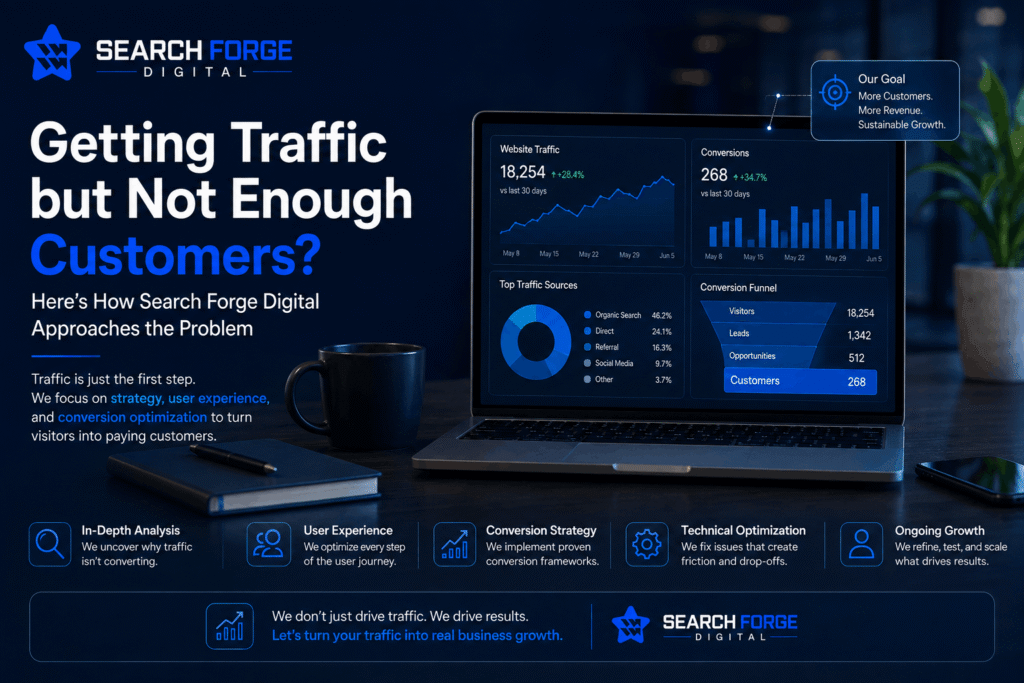
It’s one of the most frustrating positions a business can be in: the website is getting visitors, the analytics dashboard shows steady traffic, maybe even a nice upward trend — but the phone isn’t ringing and the inquiry form is quiet. More traffic was supposed to mean more customers. So what’s going wrong?
At Search Forge Digital, this is one of the most common problems businesses bring to the table. And in almost every case, the answer isn’t “get more traffic.” It’s “get the right traffic, and give it a reason to convert.”
It’s an easy trap to fall into. Traffic is visible, measurable, and satisfying to watch grow. Customers, on the other hand, depend on dozens of smaller decisions happening correctly behind the scenes, decisions most business owners never think to question because the traffic numbers look fine. That’s exactly why this problem tends to go unnoticed for months, sometimes years, while ad spend and content budgets keep climbing without a matching return.
A Familiar Scenario
Picture a local home services business. Over the past year, organic traffic has doubled. The blog is publishing consistently, rankings have improved for several keywords, and the marketing report looks impressive. Yet the owner is asking the same question every month: “Where are the customers?”
This is rarely a coincidence, and it’s almost never bad luck. Somewhere between the search result and the final decision to call or fill out a form, the visitor is losing interest, confidence, or clarity. Search Forge Digital’s job in a situation like this isn’t to celebrate the traffic chart it’s to find the exact point where interested visitors stop becoming paying customers, and fix that specific breakdown.
Why Traffic and Customers Aren’t the Same Thing
Traffic is a vanity metric until it’s qualified. A spike in visitors from a viral post, a broad keyword, or an unrelated backlink can look great on a report and mean nothing for the business. Someone searching “history of plumbing” is not the same as someone searching “emergency plumber open now” even though both might land on a plumbing website.
When traffic and revenue don’t move together, it’s usually one (or more) of these issues:
The traffic isn’t the right audience. Ranking for broad or loosely related keywords brings in visitors who were never going to buy; they were researching, comparing, or simply curious.
The intent doesn’t match the page. Someone ready to purchase gets sent to a blog post instead of a service page. Someone still researching gets hit with a hard sales pitch too early.
The site doesn’t build trust fast enough. Visitors decide within seconds whether a business looks credible. Slow load times, outdated design, unclear pricing, or missing reviews send people right back to the search results.
There’s no clear next step. A page can have great content and still fail to convert if it’s not obvious what the visitor should do next.
The offer isn’t compelling for that stage of the journey. Not every visitor is ready to buy today. Without something to capture interest, a guide, a quote, a consultation that traffic just leaves and doesn’t come back.
The competition looks more convincing. Even when a visitor lands on the right page with the right intent, they’re usually comparing three or four other options in separate tabs. If a competitor’s site answers questions faster, looks more established, or makes pricing clearer, that visitor is gone in seconds and the traffic report will never show why.
The Psychology Behind Why Visitors Leave Without Converting
Most businesses think about SEO as a technical problem: rankings, keywords, backlinks. But once a visitor actually arrives on the site, the game shifts to something closer to psychology than technology. People decide, often without realizing it, whether they trust a business within the first few seconds of landing on a page.
A few things quietly influence that decision:
- Cognitive friction. If a visitor has to think too hard to find pricing, understand the service, or figure out how to contact the business, they disengage rather than push through.
- Social proof gaps. Visitors instinctively look for evidence that other people have trusted this business before reviews, testimonials, case studies, recognizable logos. Its absence quietly raises doubt.
- Mismatched expectations. If an ad or search snippet promises one thing and the landing page delivers something slightly different, visitors feel misled, even unintentionally, and bounce.
- Decision fatigue. Too many options, too much text, or too many competing calls to action can overwhelm a visitor into doing nothing at all.
Search Forge Digital treats these psychological signals as seriously as technical SEO factors, because ranking a page higher only matters if the page can actually hold a visitor’s attention once they arrive.
How Search Forge Digital Diagnoses the Real Problem
Rather than assuming more content or more backlinks will fix things, Search Forge Digital starts by looking at where the funnel is actually breaking:
1. Traffic quality audit Reviewing which keywords, pages, and channels are driving visits and whether those visitors match the business’s actual customer profile.
2. Intent mapping Matching each page to where a visitor likely is in their decision process, so informational content, comparison content, and ready-to-buy content each do their job instead of competing with each other.
3. On-page conversion review Looking closely at page speed, mobile experience, calls to action, trust elements (reviews, credentials, guarantees), and anything creating friction between interest and action.
4. Funnel and tracking check Confirming that forms, calls, and chat interactions are actually being tracked properly. Sometimes the “missing customers” problem is really a missing data problem.
5. Targeted content and keyword realignment Shifting focus toward keywords and content that reflect real buying intent, rather than optimizing purely for search volume.
6. Competitive benchmarking Comparing the site’s messaging, trust signals, and user experience directly against the businesses visitors are likely comparing it to not in theory, but page by page.
7. Behavioral analysis Looking at scroll depth, click paths, and drop-off points to see exactly where visitors lose momentum, rather than guessing based on assumptions.
Turning the Diagnosis Into Action
A diagnosis is only useful if it leads to real changes. Once the breakdown points are identified, Search Forge Digital works through a structured set of fixes rather than a scattered list of tweaks:
Rebuilding pages around a single clear goal. Every page gets one primary job to inform, compare, or convert instead of trying to do all three at once and confusing the visitor.
Strengthening trust elements where they’re missing. This might mean adding verified reviews, clarifying guarantees, showing real team members, or simply making credentials easier to find.
Simplifying the path to action. Fewer form fields, clearer buttons, faster load times, and calls to action that match exactly where the visitor is in their decision.
Realigning content with buying intent. Shifting editorial focus away from broad, low-intent topics and toward the specific questions people ask right before they’re ready to reach out.
Testing and refining, not guessing once and moving on. Conversion improvements rarely come from a single change. Search Forge Digital treats this as an ongoing process — measuring, adjusting, and refining based on real visitor behavior rather than one-time assumptions.
This is usually where businesses see the shift they were actually hoping for when they first invested in SEO not just a bigger number on the analytics dashboard, but a phone that rings and a form that gets filled out.
Traffic Is a Means, Not the Goal
A high-traffic website that doesn’t generate business isn’t a marketing win — it’s a signal that something in the strategy needs adjusting. Search Forge Digital’s approach treats every visitor as a potential customer with a specific need, and builds the site experience, content, and SEO strategy around actually meeting that need.
The goal was never just more visitors. It’s more of the right visitors, arriving on the right page, at the right moment with a clear reason to take the next step.
If a business is watching its traffic numbers climb while its customer count stays flat, that’s not a reason to pull back from SEO, it’s a signal that the strategy needs to look deeper than rankings alone. Search Forge Digital’s approach is built around that exact gap: connecting visibility to real business outcomes, so that growth in traffic actually shows up where it matters most in new customers, booked appointments, and closed sales.