

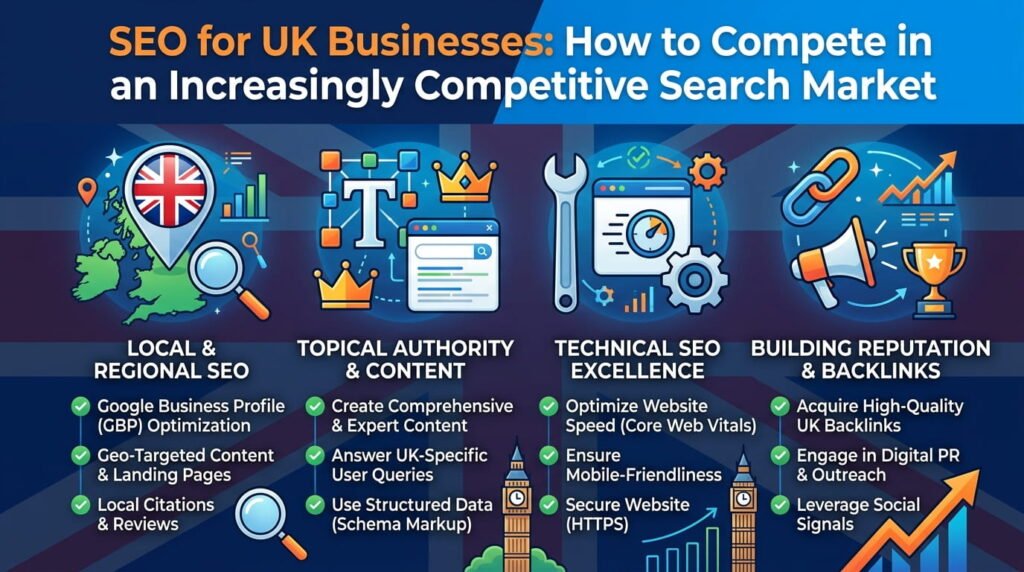
SEO for UK Businesses: How to Compete in an Increasingly Competitive Search Market
For businesses in the UK, being visible on Google is no longer simply about having a website and adding a few keywords to important pages. Search has become more competitive, customers have become more selective, and businesses in almost every industry are fighting for the same limited space on the first page.
A strong SEO strategy can help a business attract potential customers who are already searching for its products or services. But achieving consistent visibility requires more than chasing rankings. It requires building authority, earning trust, creating useful content and developing a website that deserves to appear in front of the right audience.
Why SEO Is Becoming More Competitive in the UK
The UK has a mature digital market, which means many businesses have already invested in SEO. Established companies often have years of content, backlinks, brand recognition and domain authority behind them.
This creates a difficult situation for newer or smaller businesses. Simply publishing articles or targeting broad keywords may not be enough to compete with websites that have already built strong authority.
There is also greater competition at the local level. A company targeting customers in London, Manchester, Birmingham, Leeds or other major UK locations may be competing against national brands as well as established local businesses.
The solution is not to abandon SEO. It is to become more strategic about where and how you compete.
Focus on the Search Terms That Can Actually Drive Business
One of the biggest mistakes businesses make is focusing entirely on high-volume keywords.
A keyword with thousands of monthly searches may look attractive, but it can also be extremely difficult to rank for. More importantly, high search volume does not automatically mean high commercial value.
A better approach is to identify keywords based on search intent.
Someone searching for general information may not be ready to buy anything. Another person searching for a specific service, provider or solution may already be close to making a decision.
UK businesses should therefore build their SEO strategy around keywords that connect search demand with genuine business opportunities.
Build Authority Instead of Just Collecting Backlinks
Links still play an important role in SEO, but the quality and relevance of those links matter.
A large number of low-quality links will not automatically make a website authoritative. In some cases, poor link-building practices can create more problems than benefits.
Businesses should focus on earning links from relevant, trustworthy websites. Guest contributions, digital PR, industry publications, partnerships and useful resources can all contribute to a stronger backlink profile when handled properly.
The objective should not be to collect as many links as possible.
The objective should be to build a website that other credible websites have a reason to reference.
Content Needs a Purpose
Publishing content simply because a business needs a blog is not a strategy.
A successful SEO content plan should answer questions that potential customers actually have. It should help them understand a problem, compare solutions, evaluate options or make a purchasing decision.
For example, a UK home improvement company could create content explaining common renovation costs, material choices and project considerations. A B2B software company could publish practical guides addressing specific problems faced by its target customers.
Useful content has a better chance of attracting organic traffic, earning backlinks and supporting commercial pages.
Local SEO Can Give Smaller Businesses an Advantage
Smaller UK businesses do not necessarily need to compete with national brands for every keyword.
Local search can provide a more realistic opportunity.
A business serving a specific city or region can build visibility around location-specific searches, local business listings, relevant directories, customer reviews and locally useful content.
The key is consistency. Business information should be accurate across important platforms, while the website should clearly communicate the locations and services being offered.
For service-based businesses, strong local visibility can be more valuable than ranking nationally for a broad keyword with little commercial intent.
Competitor Research Should Influence the Strategy
SEO decisions should not be made in isolation.
Looking at competitors can reveal which websites are already ranking, what topics they cover, where they earn links and which opportunities they may be overlooking.
This does not mean copying competitors.
Instead, businesses can use competitor research to identify weaknesses and opportunities. If competitors have strong rankings but weak supporting content, that may create an opening. If they have numerous backlinks from a particular industry publication, similar relevant opportunities may exist.
The goal is to understand the competitive landscape before investing resources.
SEO Is a Long-Term Business Investment
One of the biggest misconceptions about SEO is that it should produce immediate results.
In reality, meaningful organic growth usually takes time. Search engines need to discover, evaluate and reassess websites, while authority develops gradually.
This is why businesses should avoid constantly changing their strategy because rankings did not improve within a few weeks.
A stronger approach is to establish clear goals, monitor meaningful metrics and make decisions based on data.
Traffic is useful, but businesses should also pay attention to qualified visitors, enquiries, leads, sales and other actions that contribute directly to growth.
Why UK Businesses Need a More Focused SEO Strategy
Competition in the UK search market is not going away. If anything, businesses will continue to compete for increasingly valuable search positions.
The companies most likely to succeed are not necessarily those with the biggest budgets. They are the ones that understand their audience, choose realistic search opportunities, build genuine authority and consistently provide useful information.
SEO should not be treated as a shortcut to Google rankings.
It should be treated as a long-term method of building visibility and trust with people who are already looking for what a business offers.
For UK businesses willing to take that approach, search can become more than a source of website traffic. It can become a reliable channel for generating qualified leads, attracting new customers and creating sustainable online growth.