
Not every keyword is equally valuable for a SaaS business.
Some keywords bring visitors who are only looking for information, while others bring people who are actively comparing products, checking prices, or looking for a solution they can start using immediately.
These are bottom-of-funnel SaaS keywords.
They are important because the people searching for them are often much closer to becoming customers. Instead of simply learning about a problem, they are trying to decide which product or solution they should choose.
For SaaS companies, targeting these searches can help turn organic traffic into trials, demos, signups, and eventually paying customers.
The goal is not to rank for every keyword with high search volume.
The goal is to rank for searches that have a strong connection to your product and buying intent.
What Are Bottom-of-Funnel SaaS Keywords?
Bottom-of-funnel keywords are search queries used by people who are further along in the buying journey.
At the top of the funnel, someone might search:
What is project management software?
They are still learning.
Further down the funnel, they might search:
Best project management software for small businesses
Now they are evaluating solutions.
At the bottom of the funnel, the search could become:
Project management software pricing
or:
Project management software free trial
At this point, the person may already be close to making a decision.
This doesn’t mean every bottom-of-funnel search will immediately produce a customer. However, these queries generally give you a much stronger opportunity to connect organic search with commercial outcomes.
Why Bottom-of-Funnel Keywords Matter for SaaS
SaaS companies often invest heavily in informational content because those keywords can generate significant traffic.
The problem is that traffic isn’t the same as revenue.
A blog post can generate thousands of visitors while producing very few product signups. Meanwhile, a page targeting a much smaller commercial keyword may generate fewer visitors but significantly more customers.
For example, imagine two pages.
The first ranks for:
What is CRM software?
The second ranks for:
Best CRM software for small businesses
The first keyword may attract a larger audience, but many visitors are simply researching the subject.
The second audience is more likely to be evaluating products.
This is why SaaS SEO should not focus only on traffic volume. Search intent and conversion potential matter just as much.
Types of Bottom-of-Funnel SaaS Keywords
There isn’t one single formula for finding high-intent keywords. However, several keyword patterns repeatedly appear near the bottom of the SaaS buying funnel.
1. Pricing Keywords
Pricing searches are often strong commercial signals.
Examples include:
- [Product] pricing
- [Product] cost
- [Product] plans
- [Product] subscription
- How much does [Product] cost?
Someone searching for pricing is usually no longer asking what the product is. They are trying to determine whether it fits their budget.
A SaaS company should have a clear pricing page that directly answers these questions rather than forcing users to search through the website.
2. Free Trial Keywords
Free-trial searches can indicate even stronger intent.
Examples include:
- [Product] free trial
- Try [Product]
- [Product] trial
- [Product] demo
- [Product] free account
The searcher may already know the product and simply want to test it.
These searches should generally lead to a page where the next step is obvious.
3. Alternative Keywords
Alternative searches happen when users are already familiar with another product but are considering different options.
Examples include:
- [Competitor] alternatives
- Alternatives to [Competitor]
- Best [Competitor] alternatives
- [Competitor] vs [Your Product]
These searches can be valuable because the user is already in the evaluation stage.
However, comparison content needs to be honest. A page that simply declares your product the winner without providing meaningful evidence can damage trust.
A useful alternative page should explain differences in:
- Features
- Pricing
- Ease of use
- Integrations
- Target customers
- Strengths
- Limitations
4. Comparison Keywords
Comparison searches are another strong commercial signal.
Examples include:
- Product A vs Product B
- Product A or Product B
- Product A alternatives
- Best tools like Product A
The person searching these terms is usually trying to make a decision.
This gives SaaS companies an opportunity to create detailed comparison pages that help users understand which solution is appropriate for their needs.
5. Best Software Keywords
Searches containing words such as “best” can indicate commercial research.
Examples include:
- Best SaaS project management software
- Best CRM for startups
- Best accounting software for agencies
- Best email marketing software for small businesses
These searches can be highly competitive, so simply publishing a generic list of products isn’t enough.
A strong page should explain why each option is suitable for a particular audience and provide useful information that helps the reader make a decision.
6. Feature-Based Keywords
Feature searches can also have commercial intent when the user is looking for a specific capability.
For example:
- CRM with WhatsApp integration
- Project management software with time tracking
- Email marketing software with automation
- SaaS analytics with real-time reporting
These queries are valuable because the user already understands what they need.
If your product provides that feature, create a dedicated page explaining how it works and why it matters.
7. Use-Case Keywords
Use-case searches connect a software product with a specific business problem or audience.
Examples include:
- CRM for real estate agencies
- Project management software for remote teams
- Accounting software for freelancers
- Marketing automation for SaaS companies
These keywords can be particularly valuable because they combine product intent with a specific customer need.
For a SaaS website such as Saasivo, this type of keyword research can help identify opportunities where a product, feature, or resource directly matches a specific audience or use case.
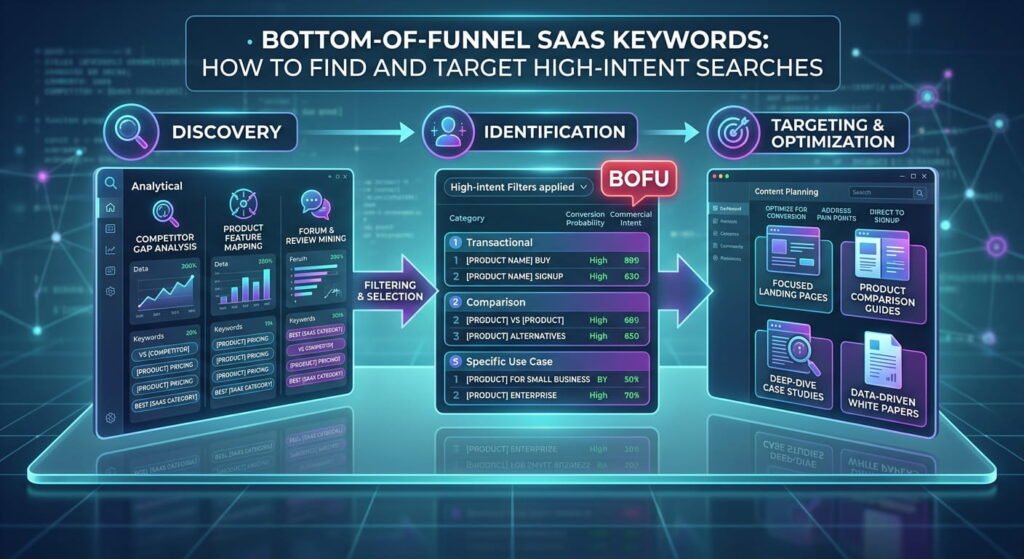
How to Find Bottom-of-Funnel SaaS Keywords
Finding high-intent keywords starts with understanding your product.
Before opening a keyword research tool, write down the problems your SaaS product solves, the people who use it, the alternatives they consider, and the features they care about.
Then build keyword groups around those areas.
For example, start with your core product and expand into:
Product → Feature → Use case → Audience → Competitor → Alternative → Pricing
This gives you a much better starting point than randomly searching for high-volume keywords.
Look at Your Competitors
Competitor websites can reveal commercial search opportunities you may have overlooked.
Study their:
- Pricing pages
- Feature pages
- Integration pages
- Comparison pages
- Alternative pages
- Use-case pages
- Product landing pages
Look for pages that rank for commercial queries and determine whether you can create something more useful.
Don’t copy the competitor’s page.
Use it to understand the market and identify gaps.
Use Search Results to Understand Intent
Keyword tools can tell you about search volume and competition, but they don’t fully explain intent.
The search results themselves provide valuable information.
Search the keyword and look at what Google is ranking.
If most results are:
- Product pages
- Pricing pages
- Comparison pages
- Software directories
- Review websites
The query is probably commercially focused.
If the results are mostly:
- Definitions
- Beginner guides
- Wikipedia-style resources
- Educational articles
the search may be more informational.
This simple SERP analysis can prevent you from targeting the wrong keywords with the wrong type of content.
Don’t Ignore Long-Tail Commercial Keywords
High-intent keywords don’t always have a huge search volume.
A keyword with 50 searches per month can be more valuable than one with 5,000 searches if the smaller keyword attracts people who are ready to buy.
For example:
CRM software
is broad and highly competitive.
A more specific search such as:
CRM software for small real estate agencies with WhatsApp integration
may have considerably lower search volume, but the person searching it has a much clearer requirement.
For SaaS SEO, specificity can be an advantage.
Create Dedicated Landing Pages
Once you’ve identified a valuable bottom-of-funnel keyword, don’t automatically send that traffic to your homepage.
Create a page that directly satisfies the search intent.
For example, a pricing keyword should lead to pricing information.
A feature keyword should lead to a feature page.
A competitor alternative keyword should lead to a comparison or alternative page.
A use-case keyword should lead to a page explaining how your product solves that particular problem.
The closer the landing page matches the searcher’s intent, the easier it becomes to move that visitor toward conversion.
Optimize SaaS Landing Pages for Conversions
Ranking is only half the job.
Once someone reaches your page, you need to make the next step clear.
A strong SaaS landing page should quickly communicate:
- What the product does
- Who it is for
- What problem it solves
- Why it is different
- What the key benefits are
- What the product costs, when appropriate
- What the visitor should do next
The CTA should be obvious without being aggressive.
Depending on the business model, this could be:
Start Free Trial
Book a Demo
Create Your Account
Get Started
See Pricing
The correct CTA depends on the user’s intent and the SaaS sales process.
Use Internal Links to Move Visitors Toward Conversion
Informational content can support bottom-of-funnel pages through internal links.
For example:
Educational article → Feature page → Use-case page → Signup page
A user might first discover your website through an informational article. After learning about the problem, they can move to a relevant feature page and then toward the product.
This creates a natural SEO funnel.
For Saasivo, the same principle can be applied by connecting educational SaaS content with relevant commercial pages rather than leaving informational articles disconnected from the product journey.
Don’t Force Commercial Keywords Into Every Article
A common SEO mistake is trying to turn every blog post into a sales page.
That can make content feel unnatural.
An informational article should primarily answer the question the user asked.
Commercial content should focus on helping the user evaluate a solution.
Different search intents deserve different page types.
Instead of forcing a “Start Your Free Trial” CTA into every paragraph, create logical transitions between informational and commercial content.
That usually produces a better user experience.
Measure Revenue, Not Just Rankings
Bottom-of-funnel SEO should be measured against business outcomes.
Track:
- Organic clicks
- Keyword rankings
- Conversion rate
- Free-trial signups
- Demo requests
- Qualified leads
- Customer acquisition
- Revenue from organic search
A keyword ranking in position one isn’t necessarily a success if it produces no business value.
Likewise, a keyword ranking in position five can be extremely valuable if it consistently generates qualified customers.
The goal is to understand which searches contribute to the SaaS growth funnel.
Common Mistakes When Targeting High-Intent Keywords
Many SaaS businesses make the same mistakes when targeting commercial searches.
They focus entirely on search volume, create generic landing pages, ignore competitor intent, target keywords that don’t match the product, and send every visitor to the homepage.
Another mistake is making comparison content overly promotional.
Users searching for alternatives and comparisons are looking for information they can trust. If the page reads like an advertisement, they may simply return to the search results.
The best commercial SEO content helps people make decisions rather than forcing them into a decision.
A Simple Bottom-of-Funnel Keyword Strategy
If you want to build a practical strategy, start with five keyword groups:
1. Product keywords
Searches containing your product or brand name.
2. Pricing keywords
Searches related to cost, plans, and subscriptions.
3. Alternative keywords
Searches involving competitor alternatives.
4. Feature keywords
Searches for specific capabilities your product provides.
5. Use-case keywords
Searches connecting your product category with a specific audience or problem.
Build dedicated pages around the strongest opportunities and connect them through internal links.
Then measure which pages generate actual signups and leads.
Final Thoughts
Bottom-of-funnel SaaS keywords are valuable because they connect SEO with purchasing intent.
You don’t need to rank for every keyword in your industry.
You need to understand what your potential customers search when they are moving from research to decision.
The strongest approach combines search intent, competitor research, commercial landing pages, internal linking, clear calls to action, and conversion tracking.
For SaaS businesses such as Saasivo, the opportunity is not simply to attract more organic visitors. It is to attract visitors who have a genuine reason to evaluate and use the product.
Because in SaaS SEO, 1,000 visitors with no signups can be less valuable than 100 visitors with strong buying intent.
The objective isn’t maximum traffic.
It’s maximum relevant traffic that has a path to becoming a customer.