
SaaS SEO used to be relatively simple: find valuable keywords, create optimized content, build backlinks, and work toward the first page of Google.
That model still matters, but it is no longer the complete picture.
People increasingly discover software through AI-generated answers, conversational search, recommendation engines, and platforms such as ChatGPT, Perplexity, and Google’s AI-powered search experiences. Instead of clicking through ten blue links, a potential customer may simply ask an AI system which SaaS tools are best for their needs.
That changes what SaaS companies need to optimize for.
The goal is no longer just “How do I rank?” It is becoming “How do I become a trusted source that search engines and AI systems recognize, mention, and cite?”
Traditional SaaS SEO Was Built Around Rankings
For years, SaaS companies measured organic success primarily through keyword rankings.
A typical strategy looked like this:
- Identify commercial and informational keywords
- Publish optimized blog content
- Improve technical SEO
- Build backlinks
- Increase organic traffic
- Move important pages toward the top of Google
- Convert that traffic into trials, demos, or subscriptions
This approach remains valuable because search engines still use organic rankings to connect users with relevant websites.
The problem is that rankings alone don’t capture every way customers now discover SaaS products.
A company could rank well for hundreds of keywords and still have limited visibility when a buyer asks an AI system for a recommendation.
Search Behavior Is Becoming More Conversational
Traditional searches are often short and keyword-focused.
For example:
best project management software
An AI-oriented search might look more like:
“What project management software is best for a 20-person remote marketing agency that needs client collaboration and time tracking?”
The second query contains more context, preferences, and intent.
AI systems can use that information to generate a tailored answer rather than simply displaying a list of webpages.
For SaaS brands, this creates a new challenge: being discoverable isn’t enough. The brand also needs to be considered relevant and trustworthy enough to appear in the answer.
What Is AI Visibility?
AI visibility refers to how often and how prominently a company, product, or website appears in AI-generated search experiences.
Depending on the platform and query, visibility can involve:
- Brand mentions
- Product recommendations
- Citations to company content
- Inclusion in software comparisons
- References to product features
- Appearance in category-level answers
- Visibility for specific use cases
This is closely related to what is often called Generative Engine Optimization (GEO).
But SaaS companies should avoid treating GEO as a completely separate replacement for SEO.
The two increasingly overlap.
Why Authority Matters More in AI Search
AI systems need signals that help them determine which information is reliable.
That makes brand authority increasingly important.
A SaaS company that is consistently mentioned across reputable industry publications, software directories, expert articles, relevant communities, and other authoritative sources can build a stronger digital footprint than a company that only publishes content on its own website.
This is one reason off-page SEO still matters in an AI-driven search environment.
Backlinks aren’t simply about passing ranking signals from one webpage to another. High-quality third-party coverage can also help establish that a company exists, operates in a particular category, serves a particular audience, and is associated with specific topics or capabilities.
Content Needs to Become More Useful and Specific
Publishing 100 generic articles isn’t necessarily better than publishing 20 genuinely useful resources.
Modern SaaS content should answer specific questions that real buyers have.
For example, instead of writing:
What Is CRM Software?
a SaaS company might create:
How Should a 10-Person Sales Team Choose a CRM Without Overpaying for Enterprise Features?
The second topic demonstrates stronger commercial context.
Useful SaaS content can include:
- Detailed product comparisons
- Integration guides
- Industry-specific use cases
- Original research
- Data studies
- Implementation guides
- Expert opinions
- Customer case studies
- Alternatives pages
- Feature comparisons
- Troubleshooting resources
The objective is to create information that people—and potentially AI systems—have a reason to reference.
Third-Party Mentions Can Strengthen SaaS Authority
One of the biggest changes in the search landscape is the increasing importance of brand mentions beyond your own website.
Imagine two SaaS companies competing in the same category.
Company A has a website with hundreds of blog posts but almost no independent coverage.
Company B has fewer articles but is consistently mentioned by relevant technology publications, industry websites, software directories, comparison websites, and expert resources.
Company B may have a stronger overall authority footprint.
This doesn’t mean companies should chase random backlinks.
In fact, that is exactly the wrong lesson.
Relevance and quality matter more than simply increasing link volume.
A link from an irrelevant website created only for SEO purposes is far less valuable than a genuine editorial mention from a publication that is actually relevant to the SaaS company’s market.
SaaS Companies Should Think Beyond Backlinks
Backlinks remain an important part of SEO, but a broader concept is more useful:
digital authority.
Digital authority can come from multiple sources, including:
- Editorial backlinks
- Brand mentions
- Industry publications
- Expert interviews
- Digital PR
- Research citations
- Software directories
- Relevant partnerships
- Thought leadership
- Original research
- Customer stories
The stronger and more consistent these signals become, the easier it can be for search ecosystems to understand what the brand does and why it matters.
Brand Entity Matters
SaaS companies also need to build a recognizable brand entity.
If an AI system encounters a company repeatedly across different trusted sources, it can develop a clearer understanding of that company.
For example:
Brand → SaaS category → target audience → features → use cases → competitors → industry
The more consistently those relationships appear across credible sources, the stronger the brand’s overall search presence can become.
This is why SaaS SEO shouldn’t focus exclusively on individual keywords.
The bigger objective is to build topical and brand-level authority.
How SaaS SEO and GEO Work Together
SEO and GEO shouldn’t be treated as competing strategies.
A strong SaaS strategy can combine both.
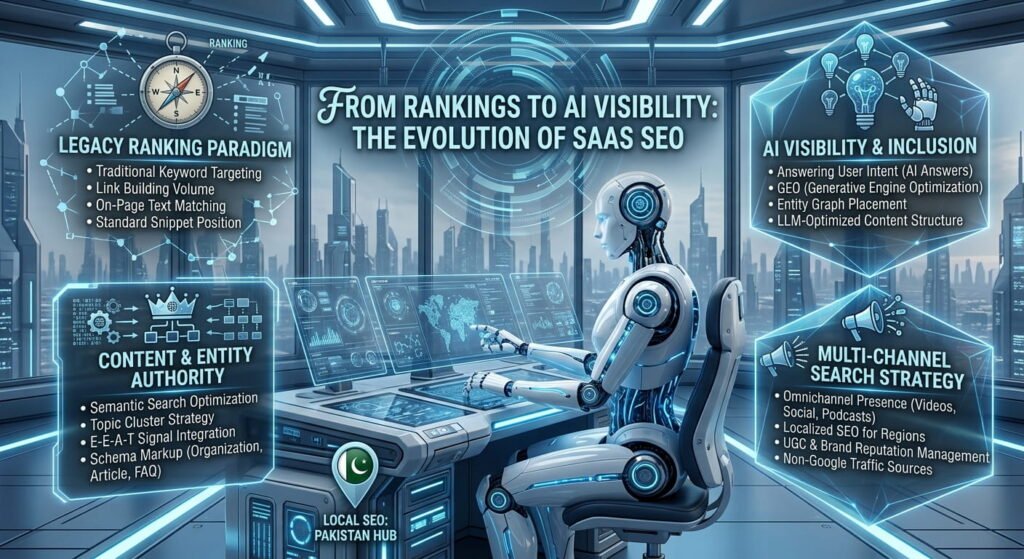
| Traditional SEO | AI Visibility / GEO |
| Keyword rankings | AI mentions |
| Organic traffic | AI-driven discovery |
| Backlinks | Citations and authoritative mentions |
| Search snippets | AI-generated answers |
| Keyword targeting | Entity and topic relevance |
| Website optimization | Broader digital authority |
| SERP visibility | Brand visibility across AI search |
There is significant overlap between the two.
Technical SEO, useful content, strong internal linking, structured information, authoritative backlinks, and a recognizable brand can support visibility across multiple search environments.
What SaaS Companies Should Do Now
SaaS businesses don’t need to abandon traditional SEO.
They need to expand it.
A practical strategy should include:
1. Build Strong Topic Authority
Create comprehensive resources around the problems your product solves rather than publishing content solely because a keyword has search volume.
2. Strengthen Off-Page Authority
Earn relevant editorial links and mentions from trustworthy websites within your industry.
3. Invest in Digital PR
Original research, expert commentary, data studies, and useful industry insights can create reasons for other websites to mention your brand.
4. Create Comparison and Use-Case Content
Buyers frequently evaluate multiple software options. Helpful comparison and alternative content can capture users further down the buying journey.
5. Develop a Recognizable Brand
Make it easy for search engines, users, publishers, and AI systems to understand what your company does, who it serves, and what makes it different.
6. Track AI Visibility Separately
Don’t rely exclusively on Google rankings.
Monitor whether your brand appears when users ask AI systems questions related to your category, competitors, use cases, and product features.
The Future of SaaS SEO Is Not “SEO vs. AI”
The biggest mistake would be assuming that AI search makes traditional SEO obsolete.
It doesn’t.
Instead, the definition of search visibility is expanding.
A SaaS company may be discovered through a Google result, an AI-generated recommendation, a third-party comparison, an industry publication, or a citation inside an AI answer.
That means the winning strategy is increasingly about being present across the information ecosystem not just ranking for a keyword.
How Search Forge Digital Can Help
For SaaS companies and technology brands, Search Forge Digital focuses on the authority side of modern search.
Our approach combines relevant link acquisition, editorial placements, and digital PR opportunities to help brands strengthen their off-page authority and build a more credible presence across the web.
If your SaaS brand already has strong content and technical SEO but isn’t building enough authority outside its own website, off-page SEO may be the missing piece.
The future of SaaS SEO isn’t simply about getting a higher position in Google.
It’s about becoming a brand that search engines, publishers, users, and AI systems have enough evidence to recognize and trust.