
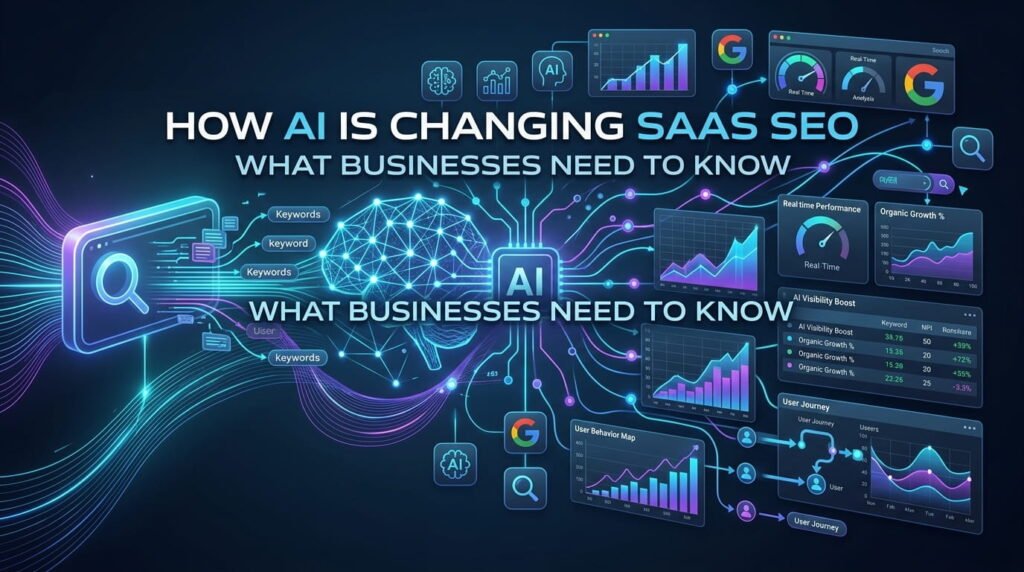
Artificial intelligence is changing the way people search for information, compare software, and make purchasing decisions. For SaaS companies, this means traditional SEO strategies are no longer enough on their own. Businesses now need to understand how AI-powered search, content generation, user behavior, and search engine algorithms are changing the SEO landscape.
The good news is that AI does not make SEO irrelevant. Instead, it is making quality, authority, relevance, and user experience more important than ever.
The Rise of AI-Powered Search
Search engines are increasingly using artificial intelligence to understand the intent behind a search rather than simply matching keywords with webpages.
Users can now ask complex questions and receive summarized answers, recommendations, comparisons, and explanations without visiting multiple websites.
For SaaS businesses, this creates both an opportunity and a challenge.
A company that previously ranked for a keyword such as “best project management software” may now need to appear in AI-generated recommendations and summaries as well as traditional search results.
This means SaaS SEO is moving from simply ranking pages to building a strong digital authority footprint across the web.
Why Traditional Keyword Strategies Are Changing
Keyword research remains important, but focusing exclusively on individual keywords is becoming less effective.
AI systems are better at understanding relationships between topics, entities, questions, and search intent. As a result, SaaS businesses should build content around broader topic areas rather than publishing dozens of disconnected articles targeting slightly different keywords.
For example, a project management SaaS company could create a comprehensive content ecosystem covering:
- Project management software
- Team collaboration
- Task management
- Workflow automation
- Project planning
- Productivity
- Remote team management
- Project reporting
- Software integrations
- Project management best practices
This approach helps establish topical relevance while giving users useful information at different stages of the buying journey.
AI Is Increasing the Importance of High-Quality Content
AI can generate articles quickly, but publishing large amounts of generic AI-generated content is not a sustainable SEO strategy.
The internet is already full of repetitive content. SaaS companies need to provide something more valuable.
Effective SaaS content should include:
- Original insights
- Real examples
- Expert opinions
- Product experience
- Case studies
- Data and research
- Clear explanations
- Useful comparisons
- Practical solutions
AI can help with research, outlining, editing, and content production, but human expertise should remain at the center of the strategy.
The goal should not be “How much content can AI create?”
The better question is “How much useful information can we provide that competitors don’t?”
SaaS Websites Need Stronger Authority Signals
As AI-powered search becomes more sophisticated, brand authority becomes increasingly important.
Search engines and AI systems need reliable signals to determine whether a company is trustworthy and relevant to a particular topic.
This is where digital PR, brand mentions, backlinks, expert contributions, reviews, partnerships, and authoritative publications can become valuable.
For SaaS companies, earning relevant backlinks from respected technology, business, marketing, finance, or industry-specific websites can strengthen the overall authority of the brand.
However, quantity alone is not enough.
One relevant, editorially earned backlink from a respected website can be more valuable than dozens of irrelevant or low-quality links.
Backlinks Are Still Important — But Quality Matters More
AI does not mean backlinks are dead.
In fact, as search engines become better at understanding entities and relationships, authoritative references can help reinforce a company’s credibility.
SaaS businesses should focus on acquiring links through strategies such as:
- High-quality guest posting
- Digital PR
- Expert interviews
- Industry research
- Original studies
- Linkable assets
- Resource pages
- Relevant niche edits
- Partner relationships
- Data-driven content
The key is relevance.
A backlink from a website that is genuinely related to software, technology, business, or the SaaS company’s industry is generally more meaningful than a random link simply created to manipulate rankings.
AI Can Improve SaaS SEO Efficiency
While AI creates new SEO challenges, it also provides powerful opportunities.
SEO teams can use AI to accelerate many repetitive tasks, including:
- Keyword clustering
- Search intent analysis
- Content outlines
- Competitor research
- Content gap analysis
- Internal linking suggestions
- Meta title brainstorming
- Content optimization
- Data analysis
- Reporting
This allows SEO professionals to spend more time on strategy, outreach, digital PR, testing, and original research.
The important distinction is between using AI as an assistant and using AI as a replacement for expertise.
Companies that automate everything without quality control can easily produce mediocre content at scale.
User Experience Is Becoming More Important
Getting visitors to a SaaS website is only part of the job.
If visitors arrive and cannot quickly understand the product, its benefits, pricing, use cases, or next steps, rankings alone will not create a successful acquisition channel.
SaaS websites should make important information easy to find.
Visitors should quickly understand:
What does the product do?
Who is it for?
What problem does it solve?
Why is it better or different?
How much does it cost?
What should I do next?
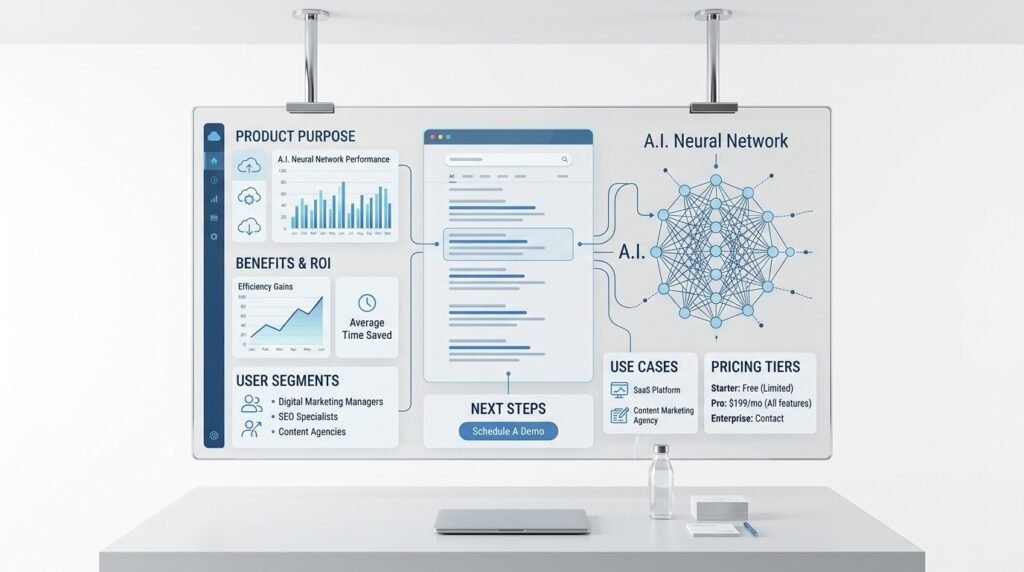
Clear navigation, fast performance, useful product pages, transparent information, and strong calls to action all contribute to a better search experience.
SaaS SEO Is Becoming More Intent-Focused
Not every search represents the same level of buying intent.
Someone searching for “what is CRM software” is probably still researching.
Someone searching for “Salesforce alternatives” has a different intent.
A user searching for “CRM software for small business pricing” is much closer to making a purchasing decision.
SaaS companies should therefore build content for different stages of the customer journey.
Awareness
Educational content answers basic questions and introduces the problem.
Consideration
Comparison articles, alternatives, guides, and solution-focused content help users evaluate options.
Decision
Product pages, pricing pages, case studies, demos, reviews, and implementation information help users make a purchase.
A strong SaaS SEO strategy connects all three stages rather than focusing exclusively on informational keywords.
Brand Searches Matter More
Building a recognizable brand can become a major SEO advantage.
If users repeatedly search for a SaaS company by name, read its content, mention it on other websites, and interact with its brand across different platforms, the company develops a broader online presence.
This is one reason SaaS businesses should not treat SEO as an isolated marketing channel.
SEO can work alongside:
- Content marketing
- Digital PR
- Social media
- Email marketing
- Product marketing
- Partnerships
- Community building
- Customer advocacy
The stronger the overall brand presence, the more opportunities there are for users and search systems to discover the company.
What SaaS Businesses Should Do Now
SaaS companies do not need to panic about AI. They need to adapt.
A practical strategy includes:
- Build topical authority around the problems your product solves.
- Create original content instead of mass-producing generic articles.
- Use AI for efficiency, but maintain human review and expertise.
- Invest in high-quality backlinks and digital PR.
- Strengthen branded search demand through broader marketing activities.
- Optimize content for search intent, not just keywords.
- Improve product and landing pages so organic visitors can easily take action.
- Publish original research and data that other websites want to reference.
- Monitor AI-powered search visibility alongside traditional rankings.
- Continuously test and adapt as search behavior changes.

Final Thoughts
AI is not killing SaaS SEO. It is changing what successful SEO looks like.
The old approach of targeting keywords, publishing generic articles, and building as many backlinks as possible is becoming increasingly weak.
The future belongs to SaaS companies that combine technical SEO, authoritative content, genuine expertise, strong digital PR, quality backlinks, and a recognizable brand.
AI can make SEO teams faster, but it cannot replace the need for useful information, credibility, originality, and strategic thinking.
For SaaS businesses, the real opportunity is not simply to optimize for search engines. It is to become one of the most useful and trustworthy sources of information in their industry.