
For years, SaaS companies focused heavily on one question:
How do we rank higher on Google?
That question still matters. Organic search remains one of the most important ways for potential customers to discover software, compare solutions, and research products.
But the way people discover information is changing.
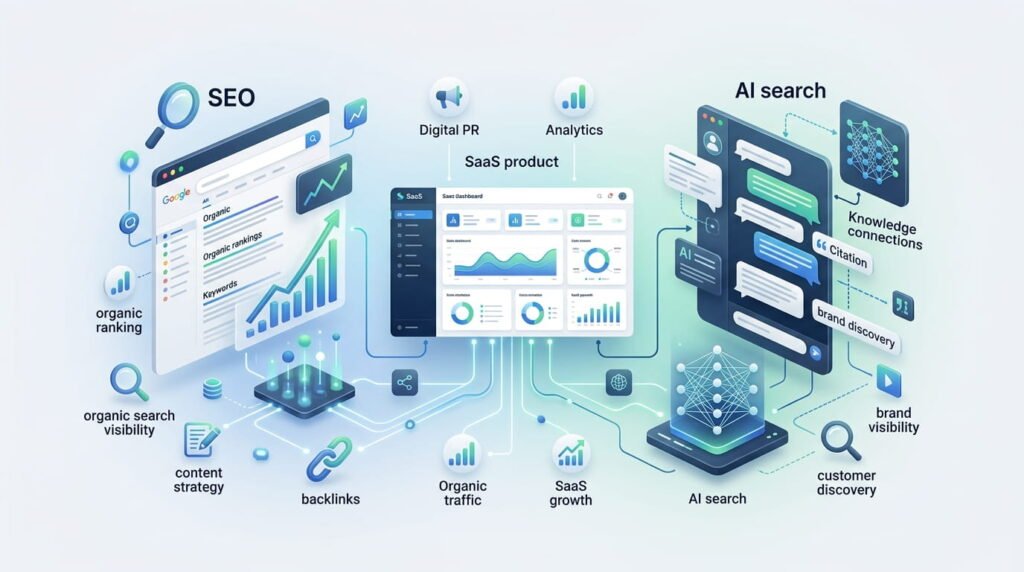
Today, a potential SaaS customer might search Google, compare software on review platforms, ask ChatGPT for recommendations, explore an AI-powered search engine, read an industry publication, or ask an AI assistant to explain which tools are best for a particular use case.
This creates a new challenge for SaaS companies.
It is no longer enough to optimize a website only for traditional search rankings.
SaaS brands need to build visibility across search engines, AI-powered discovery platforms, industry websites, communities, and other digital channels where potential customers research products.
The fundamentals of SEO still matter. But the broader objective is becoming clear:
Don’t just optimize pages for rankings. Build a brand that search engines, AI systems, publishers, and customers can understand, trust, and reference.
Search Visibility and AI Visibility Are Connected
It is tempting to treat Google SEO and AI visibility as two completely different marketing strategies.
They aren’t.
Both depend heavily on the availability of useful, understandable, authoritative information about your company.
If your SaaS website clearly explains:
- What your product does
- Who it is designed for
- Which problems it solves
- Which industries it serves
- How it compares with alternatives
- Which platforms it integrates with
- What customers think about it
- What makes it different
then you are giving both traditional search systems and AI-powered systems more information to understand your brand.
The goal should therefore be to create a strong information ecosystem around your SaaS business.
1. Build a Strong Foundation for Search and AI Discovery
Before worrying about AI recommendations, make sure your website can be properly discovered and understood.
Technical SEO remains essential.
Your website should have:
- Crawlable pages
- Logical site architecture
- Clear internal linking
- Indexable content
- Descriptive page titles
- Useful headings
- Clean URLs
- XML sitemaps
- Mobile-friendly design
- Strong page performance
- Proper canonicalization
- Structured data where appropriate
Technical problems can prevent valuable information from being discovered regardless of whether the final user is searching through Google or an AI-powered interface.
Think of technical SEO as the infrastructure underneath your visibility strategy.
If search engines cannot reliably access your information, you have a problem.
2. Create Content That Answers Specific Customer Questions
Generic content is becoming less useful.
A SaaS company doesn’t need another 2,000-word article that explains a broad topic without providing anything original.
Instead, create content around the actual questions potential customers ask.
For example, instead of only targeting:
Project Management Software
build useful content around questions such as:
- What is the best project management software for agencies?
- How can small teams manage client projects?
- What should startups look for in project management software?
- How does project management software compare with spreadsheets?
- What features matter most for remote teams?
- How can agencies automate project reporting?
This creates a deeper content ecosystem around your product.
It also gives search engines and AI systems more context about where your product fits.
3. Build Topic Authority Instead of Publishing Random Articles
One article rarely establishes authority.
A stronger SaaS content strategy builds interconnected coverage around a topic.
For example, a SaaS company selling CRM software could create a topic cluster around customer relationship management:
Core Page
CRM Software
↓
Supporting Topics
- CRM Software for Startups
- CRM Software for Agencies
- CRM vs Spreadsheets
- CRM Implementation Guide
- CRM Automation
- CRM Lead Management
- Best CRM Features
- CRM Integrations
- CRM Reporting
- CRM Alternatives
This structure gives your website broader topical coverage.
Internal links can then connect related pages and help users—and search engines—understand the relationship between them.
4. Create Comparison and Alternative Pages
When people are close to purchasing software, they often compare options.
That makes comparison content particularly valuable for SaaS companies.
Useful page types include:
| Page Type | Example | Search Intent |
| Product vs Competitor | SaaSivo vs Competitor X | Direct comparison |
| Alternative Page | Competitor X Alternatives | Evaluating alternatives |
| Category Page | Best SaaS SEO Platforms | Commercial research |
| Feature Comparison | SEO Platform With Backlink Tracking | Feature-driven research |
| Use-Case Page | SaaS SEO for B2B Companies | Solution discovery |
| Industry Page | SEO Software for SaaS Companies | Industry-specific |
| Integration Page | CRM + Marketing Automation | Integration research |
These pages can capture users who have already moved beyond general research and are actively evaluating solutions.
But comparison pages must be useful.
If every competitor page says:
We are better than everyone else.
it won’t provide much value.
Explain the differences clearly, acknowledge limitations, and help users decide whether your product is actually suitable.
5. Make Your Brand Easy to Understand
AI systems and search engines need context.
A company with unclear messaging creates unnecessary ambiguity.
Your website should make the following information obvious:
Company → Product → Category → Audience → Use Case → Differentiator
For example:
Saasivo → SaaS SEO → Organic Growth → SaaS Companies → Search Visibility → Integrated Growth Framework
The exact positioning will differ by business, but the principle remains the same.
Don’t make users or systems guess what your company does.
6. Strengthen Your Brand’s External Presence
Your own website is only one source of information about your company.
A SaaS brand can become much easier to discover and understand when it is consistently represented across credible external sources.
These may include:
- Industry publications
- SaaS directories
- Review platforms
- Technology websites
- Business publications
- Expert interviews
- Podcasts
- Founder profiles
- Relevant communities
- Partner websites
- Guest contributions
- Digital PR coverage
This is where off-page SEO and Digital PR become especially useful.
A strong external presence can create additional references to your company, product, expertise, and achievements.
The objective isn’t to create artificial mentions everywhere.
It is to build a credible digital footprint.
7. Earn Relevant Backlinks
Backlinks remain an important part of an organic search strategy.
But the goal should not be to collect links from as many websites as possible.
A better approach is to prioritize:
Relevance + Authority + Editorial Context + Real Audience
For example, a contextual mention from a respected SaaS or technology publication can be considerably more meaningful than a random backlink from an unrelated website.
Useful link-building opportunities can come from:
- Original research
- Digital PR
- Expert commentary
- Guest contributions
- Industry resources
- Data studies
- Partnerships
- Product integrations
- Useful tools
- Linkable assets
Strong backlinks can support traditional SEO while also increasing the number of credible places where your brand appears online.
8. Publish Original Data and Research
This is one of the strongest ways for a SaaS company to become a source rather than simply another publisher.
Suppose a SaaS company conducts research involving thousands of businesses.
Instead of publishing a generic article about the industry, it could publish:
The 2026 SaaS Marketing Benchmark Report
The report could contain original statistics, charts, trends, and expert analysis.
Other websites may then reference those findings.
That creates opportunities for:
Original Research → Media Coverage → Brand Mentions → Editorial Links → Referral Traffic → Increased Authority
The same research can also be repurposed into social posts, newsletters, videos, sales material, and additional articles.
One strong research asset can therefore support an entire content campaign.
9. Optimize Content for Human Readers First
There is a danger in trying too hard to “optimize for AI.”
Don’t write content that sounds like it was created for a machine.
Write content that is:
- Clear
- Specific
- Well-structured
- Factually accurate
- Easy to scan
- Original
- Helpful
- Supported by credible information
Use descriptive headings.
Answer questions directly.
Explain terminology.
Provide examples.
Use tables when they improve understanding.
Link to relevant supporting resources.
Most importantly, don’t add unnecessary words just to make an article longer.
A 1,500-word useful article can be more valuable than a 4,000-word article that repeats the same ideas.
10. Build Entity and Brand Recognition
SaaS companies should think beyond individual keywords.
You want people to associate your brand with a specific category and set of problems.
For example:
Brand → Category → Expertise → Use Cases
The more consistently this relationship appears across your website and reputable external sources, the easier it becomes for users to understand your positioning.
Keep your company information consistent across:
- Website
- Business profiles
- Industry directories
- Author profiles
- Review platforms
- Media coverage
- Partner websites
Consistency matters.
If one page describes your company as an SEO platform, another describes it as a marketing agency, and another describes it as an AI company, you create unnecessary confusion.
11. Use Structured Data Where It Makes Sense
Structured data can help search engines better interpret certain types of information on your website.
Depending on the site, relevant structured data may include information associated with:
- Organization
- Software application
- Product
- Article
- Breadcrumbs
- Reviews
- FAQ content where applicable
Structured data is not a magic ranking button.
Adding schema does not automatically make a SaaS company visible in AI answers.
Its value is in helping machines interpret information more consistently when the markup is accurate and supported by the content on the page.
12. Measure Visibility Beyond Rankings
If your only KPI is keyword position, you’re missing part of the picture.
Modern SaaS visibility should be evaluated across multiple channels.
| Visibility Area | What to Monitor | Why It Matters |
| Google Search | Rankings, impressions, clicks | Measures traditional organic visibility |
| Brand Search | Branded queries | Shows growing awareness |
| AI Discovery | Mentions and product references where measurable | Indicates presence in AI-driven research |
| Referrals | Referral sessions | Measures external audience acquisition |
| Backlinks | Relevant referring domains | Indicates authority and discoverability |
| Digital PR | Media mentions | Builds brand credibility |
| Content | Engagement and conversions | Shows whether content attracts the right audience |
| Conversions | Trials, demos, sign-ups | Connects visibility with business outcomes |
The exact measurement capabilities of AI platforms vary, so don’t pretend that every AI mention can be tracked as precisely as a Google Search Console click.
Instead, combine measurable search data with brand monitoring, referral analytics, customer research, and periodic visibility checks.
13. Don’t Abandon Traditional SEO
The rise of AI doesn’t mean traditional SEO is dead.
That would be a bad conclusion.
Technical SEO still matters.
Search intent still matters.
Content quality still matters.
Internal linking still matters.
Page experience still matters.
Authority still matters.
The difference is that SaaS companies should now think beyond a single search-result page.
Your content may be discovered through traditional search, referenced by a publication, shared on social media, found through an AI interface, or visited directly after someone hears about your brand elsewhere.
SEO is becoming part of a broader organic discovery strategy.
A Practical Search + AI Visibility Framework
A SaaS company can organize its strategy around five connected layers:
| Layer | Main Objective | Key Activities |
| Foundation | Make the website discoverable | Technical SEO, indexing, site architecture, Core Web Vitals |
| Relevance | Show what the company solves | Search-intent content, use cases, product pages |
| Authority | Build external credibility | Backlinks, Digital PR, research, expert contributions |
| Brand | Strengthen recognition | Consistent positioning, media mentions, reviews, profiles |
| Conversion | Turn visibility into revenue | CRO, demos, trials, onboarding, trust signals |
This is more realistic than treating “AI SEO” as a completely separate discipline.
The strongest strategy improves the underlying information and authority of the business.
Common Mistakes SaaS Companies Should Avoid
Publishing Content Without a Strategy
More articles don’t automatically mean more visibility.
Every major piece of content should have a clear audience, search intent, purpose, and connection to the product.
Creating Hundreds of Thin Programmatic Pages
Programmatic SEO can scale efficiently, but low-value pages can create a poor user experience and add little genuine value.
Scale useful pages not URLs.
Chasing Every AI Trend
Not every new AI optimization tactic deserves your attention.
If someone tells you that adding a particular phrase, formatting trick, or “secret AI schema” guarantees citations in AI answers, be skeptical.
There are no reliable shortcuts to guaranteed AI visibility.
Ignoring Off-Page Authority
A website can publish excellent content and still struggle to compete if stronger competitors dominate the external authority landscape.
Content and authority need to grow together.
Measuring Traffic Instead of Business Results
Traffic is not the final objective.
For SaaS businesses, the important question is whether visibility produces:
Qualified Visitors → Product Interest → Sign-Ups → Customers → Revenue
Final Thoughts
SaaS SEO is expanding beyond the traditional goal of ranking individual pages.
The broader objective is to make your company discoverable, understandable, credible, and useful wherever potential customers research software.
That means building a technically strong website, creating content around real customer questions, developing topic authority, earning relevant backlinks, investing in Digital PR, publishing original research, and maintaining a consistent brand presence across the web.
AI-powered discovery doesn’t eliminate SEO.
It makes strong SEO fundamentals and broader brand authority even more important.
The SaaS companies that adapt best will not be the ones chasing every new AI optimization trick.
They will be the companies building genuinely useful information, strong digital authority, recognizable brands, and websites that clearly demonstrate why their product deserves consideration.
For SaaS businesses looking to build this type of organic visibility, Saasivo provides a growth-focused approach that brings together technical SEO, high-intent content, authority building, and conversion optimization.
The future of SaaS visibility isn’t simply about ranking higher.
It’s about becoming easier to find, understand, trust, and choose.