
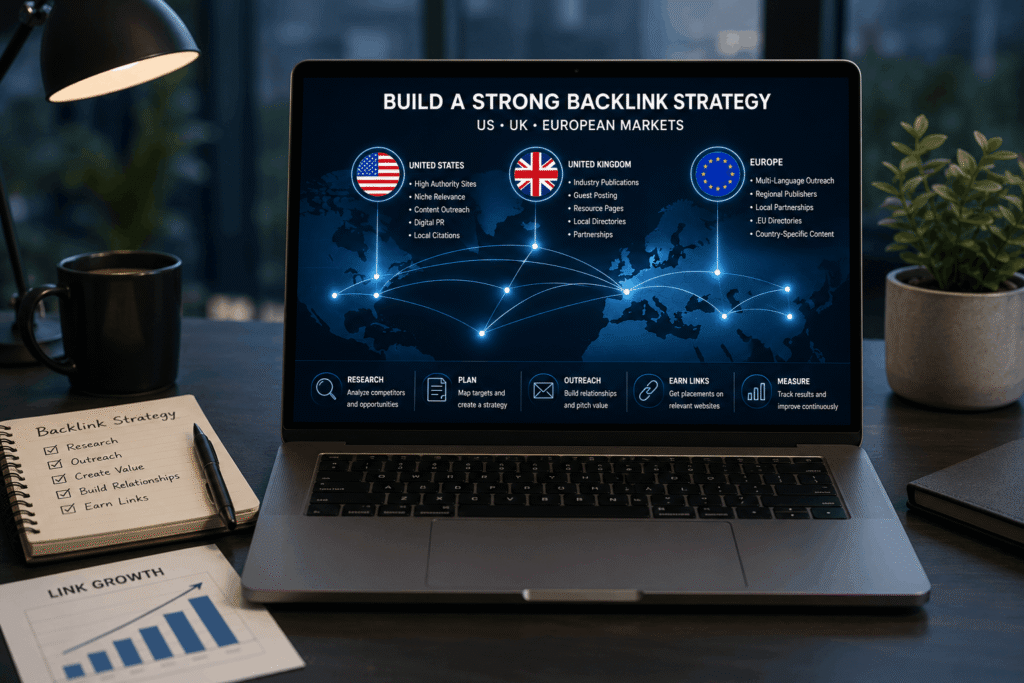
Building backlinks is still an important part of SEO in 2026 but international link building requires much more than collecting links from websites with high Domain Rating.
If your business is targeting customers in the United States, United Kingdom, or European markets, your backlink strategy needs to consider relevance, geography, language, industry authority, editorial quality, brand reputation, and search intent.
The objective isn’t to build the largest backlink profile.
It is to build a backlink profile that makes your business look credible, relevant, authoritative, and genuinely useful within the markets you want to reach.
Google confirms that links are used to discover pages and understand relationships between pages, while its spam policies specifically prohibit manipulative link-building practices such as buying links for ranking purposes, excessive link exchanges, automated link creation, and low-quality directory links.
So what does a strong international backlink strategy look like?
Let’s break it down.
Why International Backlink Building Is Different
A backlink from a website in the United States isn’t automatically valuable simply because it has a high authority score.
Imagine you’re a UK-based SaaS company.
A relevant backlink from a respected UK technology publication may be more commercially meaningful than an unrelated link from a random high-authority website in another country.
The same principle applies to European markets.
For international SEO, you need to consider:
- Country relevance
- Language
- Industry relevance
- Audience relevance
- Website quality
- Editorial standards
- Local reputation
- Topical authority
- Link placement
- Brand relevance
Think about backlinks as recommendations from different parts of the web.
The best recommendations come from sources that are trusted by the same audience you want to reach.
1. Start With Market Segmentation
Don’t create one generic backlink campaign for the entire world.
Separate your strategy into market segments.
United States
Focus on:
- US industry publications
- American business websites
- Local publications
- US associations
- Industry podcasts
- US statistics and research
- Expert commentary
- Business communities
United Kingdom
Focus on:
- UK publications
- British industry organizations
- Local business media
- UK universities and research organizations where relevant
- Industry associations
- Regional publications
- UK-focused podcasts and publications
Europe
Europe requires additional segmentation because it isn’t one unified search market.
Depending on your target audience, you may need separate strategies for:
- Germany
- France
- Spain
- Italy
- Netherlands
- Sweden
- Denmark
- Norway
- Belgium
- Austria
- Switzerland
- Other European markets
Language and local relevance become especially important.
A backlink from a German publication can be highly useful for German visibility, while a French publication may be more relevant for French-language campaigns.
2. Build Country-Specific Link Prospect Lists
Before outreach begins, create separate prospect databases.
For example:
| Market | Target Sources |
| US | Publications, SaaS blogs, business media, associations |
| UK | Publications, business media, local organizations |
| Germany | German industry publications, business portals |
| France | French publications, industry websites |
| Netherlands | Dutch business and technology websites |
| Spain | Spanish publications and industry websites |
For every prospect, evaluate:
- Domain quality
- Topical relevance
- Country relevance
- Organic traffic
- Editorial quality
- Existing outbound links
- Content quality
- Spam signals
- Audience relevance
- Contact information
Don’t approve a website simply because a third-party SEO tool gives it a high authority score.
Metrics are useful for filtering. They should not make the final decision for you.
3. Prioritize Relevance Over Raw Authority
A common mistake in link building is chasing websites solely because they have high DA or DR.
Authority matters.
But relevance matters too.
Consider two potential backlinks:
Website A
- DR 80
- Completely unrelated industry
- Little connection to your audience
Website B
- DR 50
- Highly relevant industry
- Strong editorial content
- Real audience
- Relevant country
For an international campaign, Website B may be the more strategically valuable opportunity.
The best backlink is usually one that makes sense to a real reader.
4. Create Link-Worthy Assets
The easiest way to earn high-quality backlinks is to create something worth referencing.
Instead of starting with:
Who can give us a backlink?
Start with:
What can we create that other websites will want to reference?
Excellent linkable assets include:
Original Research
Publish proprietary research such as:
2026 US SaaS SEO Benchmark Report
or:
European Ecommerce Search Trends 2026
Industry Statistics
Create carefully researched statistics pages that journalists and bloggers can reference.
Original Surveys
Survey businesses or consumers and publish the findings.
Interactive Tools
Examples:
- SEO calculators
- ROI calculators
- Cost estimators
- Marketing assessment tools
- Industry benchmarks
Original Data Visualizations
Turn complex data into useful charts, graphs, and infographics.
Expert Reports
Interview industry professionals and publish the findings.
These assets can become natural link magnets.
5. Use Digital PR to Earn Authority
Digital PR is one of the strongest approaches for international link acquisition.
Instead of directly asking hundreds of websites to publish a guest post, create stories that publications actually want to cover.
For example:
Original Research
↓
PR Campaign
↓
Journalist Interest
↓
Editorial Coverage
↓
Brand Mention + Link
↓
Authority + Referral Traffic + Visibility
Potential targets include:
- Business publications
- Technology publications
- Industry magazines
- News websites
- Regional media
- Podcasts
- Expert interviews
- Research publications
This approach also strengthens your brand beyond traditional SEO.
6. Build Relationships With Journalists
International link building becomes much easier when you stop treating publishers as backlink targets.
Treat them as professional relationships.
Research journalists who regularly cover your industry.
Then provide useful information.
For example:
We recently analyzed 2,000 ecommerce websites and found an interesting change in organic search visibility. I thought the data might be useful for your upcoming ecommerce coverage.
That’s much stronger than:
“Can you publish my guest post with a backlink?”
Journalists need:
- Data
- Experts
- Quotes
- Original research
- Industry insights
- Case studies
- Trends
- Predictions
If your business can consistently provide those things, your outreach becomes more valuable.
7. Develop Different Outreach Strategies for Each Market
Don’t send exactly the same outreach email to US, UK, and European publishers.
Cultural expectations and editorial preferences can differ.
US Outreach
Generally emphasize:
- Data
- Business outcomes
- Original research
- Expert commentary
- Strong value proposition
UK Outreach
Focus on:
- Editorial relevance
- Useful commentary
- Local context
- Industry expertise
- Clear and concise communication
European Outreach
Pay close attention to:
- Local language
- Country-specific terminology
- Regional regulations
- Local market data
- Cultural context
For European campaigns, translating an English pitch word-for-word isn’t always enough.
The outreach should feel native to the market.
8. Use Localized Content to Earn Local Links
If you want links from a particular country, create content specifically useful to that country’s audience.
For example:
US
US Ecommerce SEO Benchmarks for 2026
UK
UK Small Business SEO Trends for 2026
Germany
SEO Trends for German B2B Companies in 2026
France
French Ecommerce Search Behavior: 2026 Market Analysis
Local content gives publishers a reason to reference your research.
It also strengthens your site’s relevance for that market.
9. Don’t Ignore Industry Associations
Industry organizations can be valuable sources of relevant visibility.
Look for:
- Professional associations
- Trade organizations
- Chambers of commerce
- Business networks
- Industry events
- Professional communities
- Conference websites
However, don’t join an organization solely because it provides a backlink.
The relationship should have genuine business or professional value.
Google’s guidance specifically warns against link schemes designed primarily to manipulate rankings.
10. Use Guest Contributions Carefully
Guest contributions can still be useful when they’re genuinely editorial.
The problem is when guest posting becomes a scalable link-building scheme.
Avoid:
- Mass guest-post campaigns
- Exact-match anchor text everywhere
- Low-quality publishing networks
- Irrelevant websites
- Thin articles
- Repeated content
- Paid links that pass ranking credit
Google explicitly identifies optimized-anchor guest posts and similar paid placements intended to pass ranking credit as examples of link spam.
If a placement is paid or sponsored, use the appropriate sponsored or nofollow qualification.
11. Build a Natural Anchor Text Profile
Anchor text should describe the destination naturally.
Google recommends descriptive, concise, relevant anchor text and specifically warns against keyword stuffing.
For example, instead of forcing:
best SEO agency USA
use natural variations such as:
- Search Forge Digital
- SEO strategy
- this SEO guide
- learn more about technical SEO
- the company’s SEO research
- their latest study
Your backlink profile should look like something that developed naturally.
Not something manufactured by an SEO spreadsheet.
12. Combine Brand Links With Deep Links
Don’t send every backlink to your homepage.
A strong international backlink profile can naturally include links to:
- Homepage
- Service pages
- Research
- Blog articles
- Case studies
- Tools
- Guides
- Industry reports
- Location pages
For example:
US campaign
→ SaaS SEO guide
→ Ecommerce research
→ Homepage
UK campaign
→ UK SEO research
→ Local service page
→ Case study
European campaign
→ Country-specific guide
→ Industry report
→ Relevant service page
This creates a more diversified backlink profile.
13. Build Local Citations Where Appropriate
For businesses with physical locations, local citations can support geographic relevance.
Depending on the market, consider:
- Business directories
- Local chambers
- Industry directories
- Professional associations
- Local publications
- Regional business websites
But avoid submitting your business to hundreds of low-quality directories.
Google specifically lists low-quality directory and bookmark links among examples of link spam.
Quality and relevance matter more than quantity.
14. Reclaim Existing Brand Mentions
One of the easiest link-building opportunities is often already sitting on the web.
Search for:
- Unlinked brand mentions
- Company name mentions
- Founder mentions
- Product mentions
- Research references
- Images used without attribution
- Old URLs
- Broken backlinks
If a reputable publication already mentions your company but doesn’t link to your website, a polite outreach email can sometimes convert that mention into a useful link.
This is particularly valuable when expanding internationally because established mentions can help strengthen your presence in specific markets.
15. Reclaim Broken and Lost Links
Monitor your backlink profile regularly.
Look for:
- Broken backlinks
- Deleted pages
- Changed URLs
- Redirect chains
- Lost high-quality links
- Links pointing to outdated resources
If an important external link points to a page that no longer exists, consider whether you can:
- Restore the original page.
- Redirect it to the most relevant replacement.
- Contact the publisher with an updated destination.
This can recover value from links you’ve already earned.
16. Build Links Around Business News
Your company doesn’t have to wait for journalists to discover you.
Create legitimate newsworthy events:
- New research
- New product launch
- Major partnership
- Industry report
- New market expansion
- Significant company milestone
- Original survey
- New technology
- Community initiative
Then pitch the story to relevant publications.
The key is newsworthiness, not simply putting a press release online and expecting rankings.
17. Track Backlinks by Country
International SEO requires international reporting.
Create a backlink dashboard with columns such as:
| Metric | What to Track |
| Country | US / UK / Germany / France etc. |
| Domain | Referring website |
| Industry | Technology / Finance / Healthcare etc. |
| Link Type | Editorial / PR / Citation / Resource |
| Target URL | Page receiving the link |
| Anchor | Link text |
| Follow Status | Follow / Nofollow / Sponsored |
| Traffic | Referral traffic |
| Quality | High / Medium / Low |
| Status | Active / Lost |
This allows you to see whether your authority-building efforts are actually expanding into your target markets.
18. A Practical International Backlink Allocation
For a business targeting all three major regions, you could structure your campaign like this:
United States — 40%
Focus on:
- Digital PR
- Industry publications
- SaaS and technology media
- Research
- Podcasts
- Expert commentary
United Kingdom — 25%
Focus on:
- UK business publications
- Industry media
- Regional publications
- Professional associations
- Expert contributions
Europe — 35%
Split the European budget according to commercial priorities.
For example:
- Germany
- France
- Netherlands
- Spain
- Italy
- Scandinavia
Don’t automatically divide resources equally.
Allocate more effort to the markets that generate the greatest business opportunity.
19. A 90-Day International Link-Building Plan
Days 1–30: Research & Foundation
Week 1
- Analyze competitors
- Identify referring domains
- Identify link gaps
- Segment target countries
Week 2
- Build prospect lists
- Categorize publishers
- Identify journalists
- Find relevant organizations
Week 3
- Create linkable assets
- Prepare research
- Build outreach campaigns
Week 4
- Begin outreach
- Start digital PR
- Reclaim existing mentions
- Recover broken links
Days 31–60: Authority Building
Focus on:
- Digital PR
- Expert commentary
- Guest contributions
- Resource link outreach
- Journalist relationships
- Industry partnerships
- Original research promotion
At this stage, prioritize quality over volume.
Days 61–90: Scale What Works
Analyze:
- Which countries produced links?
- Which publishers responded?
- Which content earned links?
- Which outreach campaigns performed best?
- Which pages attracted authority?
- Which links generated referral traffic?
- Which markets produced leads?
Then increase investment in the channels producing the strongest results.
What Not to Do
A sustainable backlink strategy should avoid:
❌ Buying backlinks specifically to manipulate rankings
❌ Automated backlink software
❌ Private link networks
❌ Mass directory submissions
❌ Spam comments
❌ Forum link spam
❌ Excessive reciprocal links
❌ Exact-match anchor manipulation
❌ Irrelevant guest posts
❌ Large-scale low-quality link campaigns
Google’s current spam policies explicitly identify several of these practices as link spam and note that violations can lead to lower rankings or removal from search results.
The 2026 International Backlink Formula
A strong international backlink strategy can be summarized as:
Relevant Content
Local Expertise
Digital PR
Industry Relationships
Original Research
Quality Editorial Links
Brand Mentions
=
International Search Authority
The objective isn’t to make your backlink profile look artificially perfect.
It is to build a web presence that makes sense.
A US publication should have a reason to mention you.
A UK industry website should have a reason to reference you.
A German publication should have a reason to cite your research.
And a French business website should have a reason to recommend your expertise.
That’s what makes international link building sustainable.
Final Thoughts
Building backlinks across the US, UK, and Europe requires a shift from link quantity to market-specific authority.
The best international campaigns don’t ask:
“How many backlinks can we build this month?”
They ask:
Which trusted websites influence the audience we want to reach—and what can we create that makes those websites want to mention us?
That mindset produces a stronger backlink profile, better referral opportunities, greater brand visibility, and a more sustainable SEO foundation.
In 2026, the future of link building isn’t about manipulating Google’s ranking systems.
It’s about earning genuine recommendations from relevant, trusted sources across the markets where your business wants to grow.