

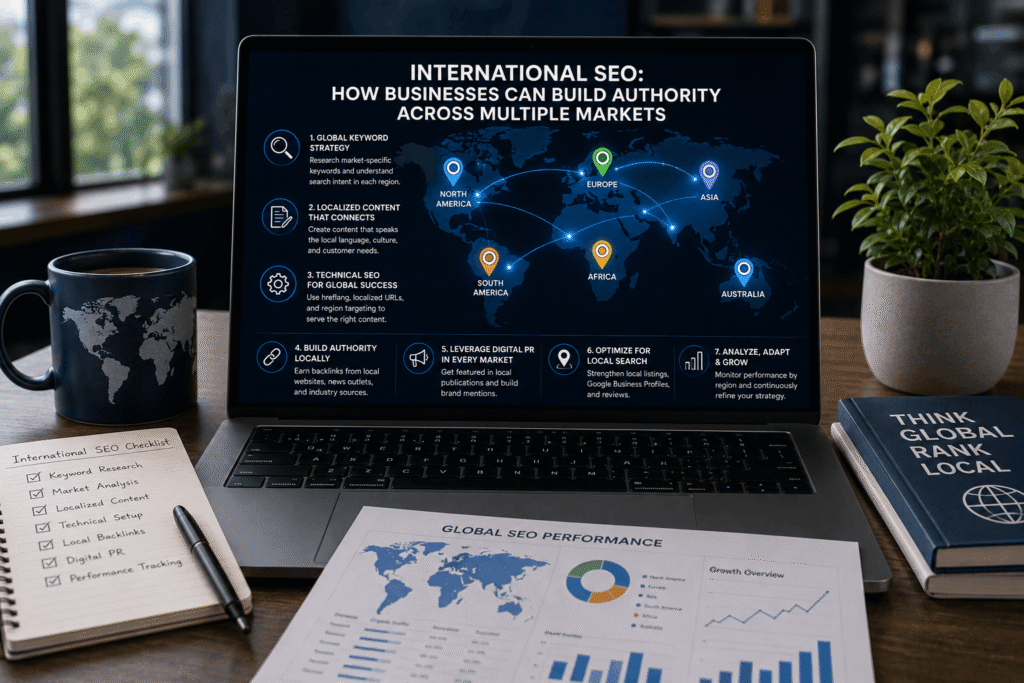
Expanding into international markets can open the door to millions of new customers.
But simply translating your website and adding a few country pages isn’t an international SEO strategy.
When a business enters the US, UK, European, or other global markets, it faces a much more complex search environment. Customers may use different languages, search terms, currencies, buying habits, and expectations. Search engines also need clear signals about which version of a page is intended for which audience.
The result?
A website can have excellent content and strong backlinks and still struggle internationally if its localization, technical SEO, content strategy, and authority signals are not aligned.
International SEO is ultimately about becoming relevant and trustworthy in each market you want to serve.
Google’s guidance distinguishes between multilingual websites, which provide content in different languages, and multi-regional websites, which target users in different countries or regions. Many international businesses are both.
KEY INSIGHT
International SEO is not “SEO translated into another language.”
It is a market-by-market strategy that combines technical infrastructure, localized content, regional relevance, authority, and user experience.
What Is International SEO?
International SEO is the process of optimizing a website so search engines can understand which content should appear to users in different countries, regions, and languages.
For example, an ecommerce company might have:
- US English pages
- UK English pages
- German pages
- French pages
- Spanish pages
- Italian pages
The content doesn’t necessarily need to be completely different in every market. But the experience should make sense for the people you’re targeting.
That can include differences in:
- Language
- Currency
- Pricing
- Products
- Services
- Shipping
- Regulations
- Cultural references
- Search terminology
- Customer expectations
- Local contact information
Google recommends using separate URLs for different language versions and supports signals such as hreflang to help identify the appropriate language or regional version.
Why International SEO Is More Complicated Than Traditional SEO
A single-market SEO campaign can already involve hundreds of variables.
International SEO multiplies them.
You aren’t simply asking:
How do we rank this page?
You’re asking:
How do we make the right page appear to the right customer in the right market at the right time?
Consider the keyword “trainers.”
In the UK, someone searching for “trainers” may be looking for athletic footwear.
In the US, the same customer is more likely to search for “sneakers.”
The product is similar.
The search behavior isn’t.
This is why simply translating keywords from English into another language can produce disappointing results.
PREMIUM SEO BOX — THE INTERNATIONAL SEARCH EQUATION
Market Understanding + Localization + Technical SEO + Content Authority + Local Trust = International Search Growth
The strongest international websites don’t simply translate pages. They adapt the entire search experience to the market.
1. Start With Market Research Before Building Pages
One of the biggest international SEO mistakes is creating dozens of country pages before understanding whether those markets are actually worth targeting.
Before creating localized content, identify your highest-value opportunities.
Analyze:
- Organic demand
- Search volume
- Competition
- Conversion potential
- Existing traffic
- Customer locations
- Revenue potential
- Average order value
- Cost of localization
- Local competitors
- Search intent
Your analytics data can be particularly useful here.
Suppose your company currently receives:
- 55% of revenue from the US
- 20% from the UK
- 10% from Germany
- 5% from France
- 10% from other markets
That doesn’t automatically mean you should allocate SEO resources in exactly the same proportions.
Instead, look for growth opportunities.
Maybe Germany has relatively little traffic today but extremely strong conversion rates.
That could make Germany a much better SEO investment than a market producing large amounts of low-quality traffic.
Build a Market Opportunity Matrix
A simple framework can help prioritize international expansion.
| Market | Demand | Competition | Revenue Potential | Priority |
| United States | High | High | High | Very High |
| United Kingdom | High | Medium | High | Very High |
| Germany | High | High | High | High |
| France | Medium | Medium | High | High |
| Netherlands | Medium | Medium | Medium | Medium |
The exact priorities will differ for every business.
The important thing is to prioritize markets based on business opportunity rather than geography alone.
2. Choose the Right International URL Structure
Your website architecture sends important signals to both users and search engines.
Common options include:
Country-Specific Domains
Example:
example.com
example.co.uk
example.de
example.fr
This can provide strong country-specific signals but requires more infrastructure and management.
Subdomains
Example:
us.example.com
uk.example.com
de.example.com
This creates separation between market versions while keeping them under the same main domain.
Subdirectories
Example:
example.com/us/
example.com/uk/
example.com/de/
This is often easier to manage because everything remains within one domain.
Google specifically lists country-specific domains, subdomains, and subdirectories as possible approaches, each with different advantages and disadvantages.
There isn’t one universal URL structure that works for every business.
The right choice depends on:
- Business model
- Number of markets
- Languages
- Technical resources
- Branding
- Existing domain authority
- Operational complexity
3. Implement Hreflang Correctly
For multilingual and multi-regional websites, hreflang can help Google understand relationships between localized versions of a page.
For example, you might have:
- English US
- English UK
- German Germany
- French France
Your localized pages can reference the corresponding alternatives.
Google supports hreflang annotations in HTML, HTTP headers, or sitemaps.
A simplified example might look like:
<link rel=”alternate”
hreflang=”en-us”
href=”https://example.com/us/page/” />
<link rel=”alternate”
hreflang=”en-gb”
href=”https://example.com/uk/page/” />
<link rel=”alternate”
hreflang=”de-de”
href=”https://example.com/de/page/” />
For larger websites, implementing these relationships through XML sitemaps can be easier to manage.
Common Hreflang Mistakes
Avoid:
- Incorrect language codes
- Incorrect country codes
- Missing return references
- Linking to non-canonical URLs
- Broken localized URLs
- Mixing HTTP and HTTPS
- Creating hreflang entries for pages that don’t actually exist
- Forgetting new market pages
Google also notes that localized pages should be properly connected and that canonicalization can interact with hreflang implementation.
4. Don’t Automatically Redirect Visitors Based on IP
Automatic geo-redirection may seem convenient.
For example:
US visitor → US page
German visitor → German page
But this can create SEO and usability problems.
Google specifically advises against using IP analysis to automatically adapt content because it can be unreliable and can prevent search engines from properly crawling different variations.
A better approach is to provide clear navigation.
For example:
United States | United Kingdom | Germany | France
Let the user choose.
This gives both visitors and search engines clearer access to your international versions.
5. Localize Content Instead of Simply Translating It
Translation changes words.
Localization changes meaning and context.
That distinction is extremely important.
Imagine a financial services company creating a German page by translating its English content word-for-word.
The language may be technically correct.
But the page could still fail because:
- The terminology feels unnatural.
- The examples aren’t relevant.
- The legal information is different.
- The customer journey is different.
- The pricing doesn’t match the market.
- Local competitors use different terminology.
A strong international content strategy should involve native or highly qualified market expertise.
What Should Be Localized?
Consider adapting:
- Page titles
- Meta descriptions
- Headings
- Body content
- FAQs
- Examples
- Product descriptions
- Testimonials
- Pricing
- Currency
- Measurements
- Calls to action
- Images
- Internal links
- Contact information
- Legal information
The goal is to make the page feel like it was created for that market, not copied into it.
6. Conduct Keyword Research Separately for Every Market
Never assume that one country’s keyword data automatically applies to another.
Create separate keyword research projects for each major market.
For example:
United States
“SEO agency”
United Kingdom
“SEO agency UK”
Germany
“SEO Agentur”
France
agence SEO
The differences aren’t always obvious.
Even countries sharing the same language can have different:
- Search terminology
- Spelling
- Intent
- Commercial modifiers
- Product terminology
- Seasonal behavior
Your international keyword map should therefore include:
Keyword → Language → Country → Search intent → URL → Content type
7. Build Topical Authority in Every Priority Market
International SEO doesn’t mean creating one article per country.
You need to build topical depth.
Suppose you’re targeting SaaS companies.
Your content ecosystem might include:
Core Topic
SaaS SEO
Supporting Topics
- SaaS keyword research
- SaaS technical SEO
- SaaS content strategy
- Programmatic SEO
- SaaS link building
- SaaS international SEO
- SaaS conversion optimization
Then localize the most commercially important topics for each market.
This gives search engines and users a much clearer picture of your expertise.
Google’s Search Essentials emphasize helpful, reliable, people-first content rather than content created primarily to manipulate rankings.
8. Build Local Authority With Backlinks
International authority isn’t created entirely on your own website.
Links and mentions from relevant local sources can strengthen your presence in a market.
Potential sources include:
- Local publications
- Industry magazines
- Business associations
- Regional news sites
- Universities
- Professional organizations
- Relevant directories
- Podcasts
- Conferences
- Local experts
- Industry blogs
But don’t build links simply because a website has a high third-party authority score.
Ask:
Is this website relevant to my market and audience?
A highly relevant industry publication in Germany may be more strategically valuable for German visibility than an unrelated high-authority website elsewhere.
AUTHORITY BOX
Local relevance beats vanity metrics.
A backlink should ideally make sense because the referring website, audience, topic, and geographic market are connected to your business.
9. Create Country-Specific Linkable Assets
One of the best ways to earn international authority is to create research that publishers in that market actually need.
Examples:
US
2026 US Ecommerce Search Trends Report
UK
UK Small Business SEO Benchmark Report
Germany
German B2B Search Behavior Study
France
French Ecommerce Consumer Search Trends
This creates a natural reason for local publications to reference your work.
The model becomes:
Original Research
↓
Local PR
↓
Industry Coverage
↓
Brand Mentions
↓
Relevant Backlinks
↓
Market Authority
That’s far more sustainable than mass-producing generic guest posts.
10. Develop a Local Digital PR Strategy
Digital PR can be particularly powerful for international SEO.
Instead of asking:
“Can you publish our article?”
Create a story worth publishing.
For example:
A company analyzes 10,000 ecommerce websites and discovers that mobile search behavior differs significantly between the US, UK, and Germany.
That research could become:
- A US business story
- A UK marketing story
- A German ecommerce story
- A European industry report
One research project can therefore generate multiple localized PR opportunities.
11. Don’t Create Hundreds of Near-Duplicate Country Pages
This is a major international SEO trap.
Imagine creating:
example.com/us/service/
example.com/uk/service/
example.com/de/service/
example.com/fr/service/
…and changing only the country name.
That isn’t meaningful localization.
It can also create large amounts of repetitive content.
Google’s spam policies warn against scaled content abuse, including generating large volumes of unoriginal pages without providing meaningful value.
Every localized page should exist for a genuine user reason.
Ask:
What does this page provide to customers in this market that the generic version doesn’t?
If the answer is “nothing,” the page probably shouldn’t exist.
12. Strengthen Local Trust Signals
People don’t buy from websites they don’t trust.
International customers may ask:
- Does this company actually serve my country?
- Are prices shown in my currency?
- Can I contact someone locally?
- Are there local reviews?
- Are there local case studies?
- Does the company understand my market?
- Are payment methods familiar?
- Is customer support available in my language?
Use relevant trust signals such as:
- Local testimonials
- Country-specific case studies
- Local phone numbers
- Local addresses where applicable
- Currency information
- Regional delivery information
- Market-specific FAQs
- Local customer stories
- Industry certifications
Google notes that signals such as local addresses, phone numbers, language, currency, and links from local sites can help it understand the intended audience of a page.
13. Build an International Internal Linking Structure
Internal links are often overlooked when companies expand internationally.
Your architecture should make relationships between pages clear.
For example:
US
US Homepage
→ US SEO Services
→ US Ecommerce SEO
→ US Case Studies
UK
UK Homepage
→ UK SEO Services
→ UK Ecommerce SEO
→ UK Case Studies
Germany
German Homepage
→ German SEO Services
→ German Ecommerce SEO
→ German Case Studies
Also provide clear language or region selectors where appropriate.
This helps users navigate the website while making the international structure easier to understand.
14. Optimize Technical SEO at Scale
International websites become technically complicated very quickly.
Your technical SEO checklist should cover:
- Crawlability
- Indexation
- XML sitemaps
- Canonical tags
- Hreflang
- Redirects
- Internal links
- Page speed
- Mobile usability
- Duplicate content
- URL structure
- Structured data
- HTTPS
- JavaScript rendering
Google’s technical requirements state that pages need to be accessible and contain indexable content to be eligible for search results.
A technically broken international architecture can undermine thousands of dollars in content and link-building investment.
15. Measure SEO Performance by Market
Never evaluate international SEO using one global traffic number.
Create separate reporting for each market.
Track:
- Organic clicks
- Organic impressions
- Rankings
- Conversions
- Revenue
- Leads
- Non-branded traffic
- Branded searches
- Backlinks
- Referring domains
- Local visibility
- Engagement
- Conversion rate
For example:
| Market | Traffic | Leads | Conversion Rate | Revenue |
| US | 42,000 | 620 | 1.48% | $185K |
| UK | 21,000 | 350 | 1.67% | $91K |
| Germany | 14,000 | 290 | 2.07% | $76K |
| France | 9,000 | 150 | 1.67% | $39K |
The most valuable market isn’t necessarily the market with the most traffic.
Revenue and qualified conversions matter more than vanity traffic.
16. Create an International SEO Content Calendar
A global SEO team needs more structure than a standard blog calendar.
Organize content by:
Country → Language → Topic → Search Intent → Funnel Stage
For example:
United States
- Commercial landing pages
- SaaS SEO guides
- Industry research
- Case studies
United Kingdom
- Local industry guides
- Comparison pages
- UK-specific research
- Customer stories
Germany
- German-language service pages
- Technical guides
- Industry reports
- Local case studies
This allows your team to maintain consistency without forcing every market into the same content template.
17. Use AI Carefully in International SEO
AI can make international SEO operations much faster.
It can help with:
- Keyword clustering
- Content briefs
- Translation drafts
- SERP analysis
- Internal-link suggestions
- Content audits
- Data analysis
- Localization workflows
But AI shouldn’t become an excuse to publish thousands of generic translated pages.
Google states that generative AI can be useful for research and structuring original content, but generating many pages without adding value can fall under scaled content abuse.
The best workflow is:
AI-assisted research → Human expertise → Local review → Original content → SEO optimization → Quality assurance
Not:
AI translation → Publish 500 pages → Hope for rankings
2026 AI + INTERNATIONAL SEO BOX
AI can help you scale the process.
It cannot replace local understanding.
The competitive advantage comes from combining automation with genuine market expertise, original research, local insights, and human editorial judgment.
Common International SEO Mistakes
1. Translating Instead of Localizing
A technically correct translation can still sound unnatural or irrelevant.
2. Creating Too Many Country Pages
More URLs don’t automatically create more search visibility.
3. Ignoring Hreflang
Poorly implemented regional and language signals can create confusion.
4. Using One Keyword Strategy Everywhere
Search behavior changes by market.
5. Building Only Global Backlinks
Local authority matters when competing in local search markets.
6. Automatically Redirecting Users
Forced geo-redirection can interfere with crawling and user choice.
7. Publishing AI-Generated Pages at Scale
Volume without meaningful value can become a liability rather than an advantage.
8. Measuring Only Traffic
International SEO should ultimately be connected to leads, sales, and revenue.
A Practical 90-Day International SEO Roadmap
Days 1–30: Research & Architecture
Focus on:
- Market research
- Competitor analysis
- Keyword research
- URL architecture
- Language planning
- Hreflang planning
- Technical audit
- Market prioritization
Days 31–60: Localization & Authority
Focus on:
- Localized landing pages
- High-value content
- Internal linking
- Local case studies
- Digital PR
- Link acquisition
- Local business profiles where relevant
Days 61–90: Scale & Optimize
Analyze:
- Which markets are growing?
- Which pages generate conversions?
- Which topics attract links?
- Which keywords are improving?
- Which countries have the highest commercial value?
- Where are technical issues limiting performance?
Then reinvest resources into the markets and content types producing the strongest business outcomes.
The International SEO Growth Framework
A sustainable international SEO program can be summarized as:
1. Research
Identify the markets worth winning.
↓
2. Structure
Create an architecture search engine and users can understand.
↓
3. Localize
Adapt content to real market needs.
↓
4. Build Authority
Earn relevant local links, mentions, reviews, and recognition.
↓
5. Optimize
Improve technical SEO, content, internal linking, and user experience.
↓
6. Measure
Track visibility, leads, conversions, and revenue by market.
↓
7. Scale
Invest more heavily where the data proves the opportunity.
THE INTERNATIONAL SEO PLAYBOOK
Research the market.
Build the right architecture.
Localize the experience.
Create genuinely useful content.
Earn local authority.
Measure commercial outcomes.
Scale what works.
Final Thoughts
International SEO is not about creating a copy of your website in ten different languages.
It is about building a search presence that feels relevant in every market you enter.
The technical foundation matters.
The content matters.
The backlinks matter.
But so do local search behavior, cultural context, trust, brand authority, and the overall customer experience.
Businesses that approach international SEO as a simple translation project will often struggle to compete with brands that genuinely understand their target markets.
The strongest global brands take a different approach.
They maintain a consistent global identity while adapting the search experience to local audiences.
That is the real opportunity in international SEO.
Build globally. Think locally. Earn authority market by market.