
Keyword research for SaaS businesses is different from traditional SEO keyword research. Getting thousands of visitors to your website sounds impressive, but traffic alone does not build a SaaS business. If those visitors have no interest in your product, they are unlikely to start a free trial, request a demo, or become paying customers.
The real goal of SaaS keyword research is to identify search terms that connect user intent with your product’s solution. The best keywords are not always the ones with the highest search volume. A keyword with 500 highly relevant searches can be more valuable than one with 20,000 searches if it consistently attracts people who have a problem your software can solve.
What Makes SaaS Keyword Research Different?
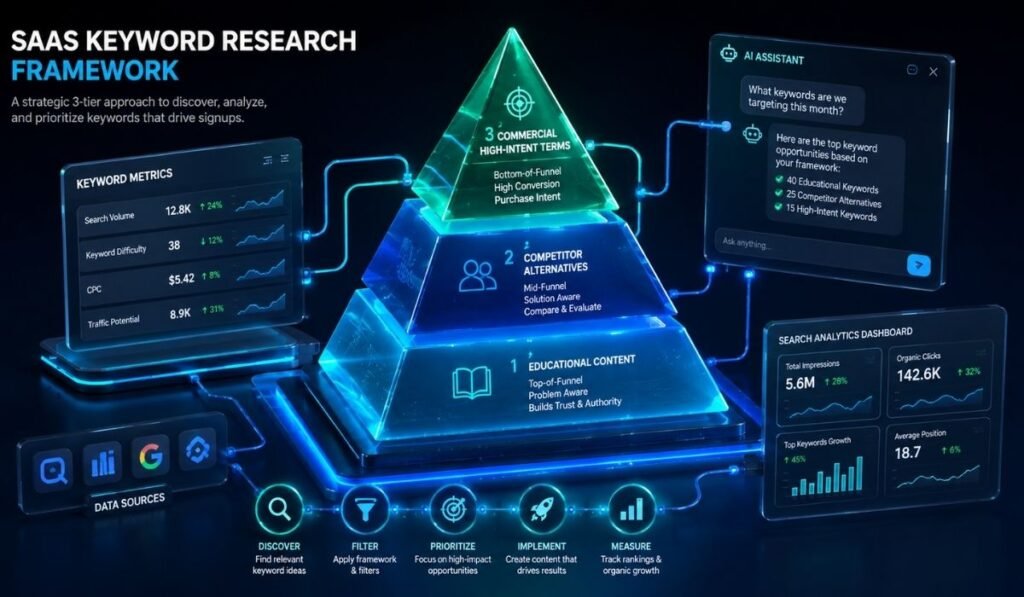
SaaS buyers typically move through several stages before becoming customers. Someone may initially search for information about a problem, later compare different solutions, and eventually search for a specific software product.
For example, a business owner who needs project management software might search:
- How to manage projects effectively
- Project management workflow
- Best project management tools
- Asana alternatives
- Project management software for small businesses
- Project management software pricing
These searches indicate different levels of buying intent.
A successful SaaS SEO strategy needs to target users throughout this journey while giving greater attention to keywords that are closely connected to the product and purchasing decision.
Focus on Search Intent Before Search Volume
Search volume is useful, but it should not be the first filter.
Ask one question before targeting any keyword:
If someone searches for this phrase, is there a realistic reason they would need our software?
For example, suppose you sell customer support software.
The keyword “customer service tips” might have significant search volume, but the searcher may only want general advice.
Meanwhile, “customer support ticketing software” may have lower volume but much stronger commercial intent.
This is why SaaS companies should evaluate keywords based on business value, not just traffic potential.
The Four Main Keyword Intent Categories for SaaS
A useful SaaS keyword strategy divides keywords into four major categories.
| Keyword Intent | Example | Buyer Stage | Signup Potential |
| Informational | How to automate invoices | Problem awareness | Low–Medium |
| Solution-focused | Invoice automation software | Solution research | High |
| Commercial | Best invoice software | Product comparison | High |
| Transactional | Invoice software pricing | Purchase decision | Very High |
Informational keywords are still valuable because they can introduce your brand to potential customers. However, commercial and transactional keywords often deserve greater priority when the primary objective is generating signups.
Start With Your Product, Not a Keyword Tool
One of the biggest mistakes SaaS companies make is opening a keyword research tool before understanding their own product.
Start by documenting:
- What problem does the software solve?
- Who uses it?
- What industries use it?
- What features make it different?
- What alternatives do customers consider?
- What problems occur before customers discover the product?
- What questions do prospects ask during sales calls?
- Why do customers choose your product?
- Why do prospects reject it?
These answers create your initial keyword universe.
For example, an email marketing platform could build keyword categories around:
Email Marketing → Automation → Segmentation → Campaign Management → Analytics → Integrations → Deliverability
Each category can then be expanded into specific search opportunities.
Find Problem-Based Keywords
Many SaaS customers do not initially search for software.
They search for the problem they are experiencing.
For example:
- How to reduce customer churn
- How to automate employee onboarding
- How to track sales leads
- How to manage recurring invoices
- How to schedule social media posts
- How to automate reporting
These keywords may not have obvious purchase intent, but they can introduce potential customers to your solution.
The important part is connecting the educational content to a genuine solution without turning every article into an aggressive sales pitch.
Find Solution-Based Keywords
Solution-based searches are usually closer to conversion.
Examples include:
- CRM software for startups
- Employee scheduling software
- Automated reporting software
- SEO reporting platform
- Inventory management software
- Customer feedback software
These searches tell you that the user is actively looking for a solution rather than simply researching a problem.
For many SaaS companies, these keywords should be among the highest priorities.
Target “Best” and Comparison Keywords
Users searching for “best,” “top,” “alternative,” or “comparison” terms are often evaluating products.
Examples include:
- Best CRM for small businesses
- Best accounting software for startups
- HubSpot alternatives
- Salesforce alternatives
- Slack vs Microsoft Teams
- Best project management tools
These searches can be highly competitive, but they can also attract users who are relatively close to making a purchasing decision.
Your content needs to be genuinely useful. If a comparison page simply declares your product the winner without explaining meaningful differences, it is unlikely to build trust.
Don’t Ignore Alternative Keywords
Alternative searches can be particularly valuable for SaaS businesses.
People search for alternatives when they already know an existing product but are considering another option.
Examples include:
- [Competitor] alternatives
- [Competitor] pricing alternatives
- [Competitor] vs [Your Product]
- Best alternatives to [Competitor]
- [Competitor] alternative for small businesses
These searches have strong commercial intent because the user already understands the category.
However, comparison pages need to be accurate and fair. Misrepresenting competitors may produce short-term clicks but can damage credibility.
Use Customer Language
Your customers may describe your product differently from how your marketing team describes it.
Your website might call something “workflow orchestration,” while customers search for “automated business processes.”
That difference matters.
Use real customer language from:
- Sales calls
- Customer support tickets
- Product reviews
- Community discussions
- Surveys
- Demo questions
- Reddit discussions
- Competitor reviews
- Customer interviews
The language customers actually use can reveal keyword opportunities that conventional keyword tools miss.
Build a SaaS Keyword Map
Once you have collected keywords, organize them into logical groups instead of creating a separate article for every keyword.
For example:
Topic: CRM Software
Supporting clusters could include:
- CRM for small businesses
- CRM for startups
- CRM features
- CRM automation
- CRM integrations
- CRM pricing
- CRM implementation
- CRM reporting
- CRM alternatives
- CRM comparison
This approach helps prevent keyword cannibalization and creates a stronger topical structure.
Map Keywords to the Right Page Type
Not every keyword should lead to a blog post.
This is an important distinction for SaaS SEO.
A commercial keyword such as “project management software” probably deserves a product or category page.
A question such as “how to manage remote projects” may be better suited to an educational article.
A comparison such as “Asana alternatives” needs a comparison page.
A pricing query may require a pricing or commercial landing page.
The page should match the searcher’s intent.
Use a Keyword Prioritization Framework
Instead of simply sorting keywords by search volume, evaluate them using multiple factors.
You can score keywords based on:
- Relevance to the product
- Commercial intent
- Search volume
- Ranking difficulty
- Conversion potential
- Business value
- Existing authority
- Competitive landscape
A simple scoring model can help your team decide what to target first.
For example:
Keyword Opportunity Score = Relevance × Intent × Conversion Potential ÷ Difficulty
It does not need to be mathematically perfect. The purpose is to create a consistent framework for prioritization.
Look Beyond Search Volume
Consider two keywords:
Keyword A: 30,000 monthly searches
Keyword B: 1,000 monthly searches
If Keyword A is a broad informational query and Keyword B is a highly relevant commercial query, Keyword B could produce significantly more revenue.
For SaaS, you should care about:
Traffic → Qualified Visitors → Trials/Demos → Activated Users → Paid Customers
Not simply:
Traffic → More Traffic
This distinction is critical.
Analyze the SERP Before Targeting a Keyword
Keyword tools can tell you search volume and difficulty, but the search results themselves reveal what Google believes users want.
Before creating content, examine the SERP.
Look for:
- Product pages
- Blog posts
- Comparison pages
- Listicles
- Forums
- Videos
- Featured snippets
- People Also Ask results
- AI-generated search experiences
- Review websites
If the first page is dominated by established software companies and major review platforms, ranking may require substantial authority.
If the results contain weak or outdated pages, there may be a stronger opportunity.
Find Keyword Gaps From Competitors
Competitor research can uncover keywords your website currently does not target.
Look at competitors’:
- Product pages
- Blog categories
- Comparison pages
- Integration pages
- Industry landing pages
- Alternative pages
- Feature pages
The goal is not to copy their content.
Instead, identify areas where customers are searching for solutions and determine whether your product has something genuinely useful to say.
Don’t Forget Integration Keywords
Integration searches can be extremely valuable for SaaS companies.
Users may search for:
- Salesforce Slack integration
- Shopify accounting integration
- HubSpot reporting integration
- CRM Zapier integration
- Project management Google Drive integration
If your software supports integrations, create useful pages explaining what the integration does, who needs it, how it works, and what problems it solves.
These pages can capture users who already have specific software requirements.
Target Industry-Specific Keywords
A SaaS product can often serve multiple industries, but generic pages may not communicate the product’s value clearly enough.
Consider creating content around legitimate use cases such as:
- CRM for real estate
- Accounting software for agencies
- Project management software for construction
- Scheduling software for healthcare businesses
- HR software for startups
The page should provide genuinely different information for the industry rather than simply replacing the industry name in the title.
Thin doorway-style pages can create a poor user experience.
Build Feature-Based Keyword Clusters
Your product features can also reveal valuable keyword opportunities.
Suppose your SaaS product offers:
- Automated reporting
- Team collaboration
- API access
- Workflow automation
- Real-time analytics
Potential keyword clusters could include:
- Automated reporting software
- Business reporting automation
- Team collaboration software
- Workflow automation tools
- Real-time analytics platform
- Business analytics API
Feature-based pages work best when they explain the actual customer problem that the feature solves.
Connect Keywords to Conversion Pages
Your content strategy should eventually lead users toward relevant commercial pages.
For example:
Informational article
How to Automate Sales Reporting
Solution article
Sales Reporting Automation Software
Feature page
“Automated Reporting Features”
Commercial page
Sales Reporting Platform
Conversion
Start Free Trial
This creates a logical path from education to product discovery.
Track Revenue, Not Just Rankings
Ranking #1 for a keyword is not the ultimate objective.
A SaaS SEO campaign should connect organic search with business outcomes.
Track:
- Organic traffic
- Qualified organic traffic
- Trial signups
- Demo requests
- Activation rate
- Conversion rate
- Customer acquisition cost
- Pipeline generated
- Revenue from organic search
For example, if one article receives 10,000 visits but generates almost no trials, while another receives 1,000 visits and generates 50 qualified signups, the second article may be far more valuable.
Common SaaS Keyword Research Mistakes
Several mistakes repeatedly limit SaaS SEO performance.
Chasing High-Volume Keywords
High volume does not automatically mean high revenue.
Targeting Only Product Keywords
If you only target “software” keywords, you may miss potential customers who are still searching for solutions to their problems.
Creating Content for Every Keyword
One keyword does not always require one page. Closely related queries can often be covered by the same resource.
Ignoring Commercial Intent
An enormous informational traffic strategy can produce disappointing business results if it never connects users with the product.
Copying Competitor Content
Competitor keyword gaps are useful for research, but copying their structure and ideas creates little differentiation.
Measuring Only Rankings
Rankings matter, but signups, qualified leads, activation, and revenue matter more.
A Practical SaaS Keyword Research Process
Use this workflow to build a keyword strategy:
- Understand the product — Identify problems, features, customers, and use cases.
- Research customer language — Collect phrases from real prospects and customers.
- Build seed topics — Create categories around problems, solutions, features, industries, and integrations.
- Expand the keyword list — Use keyword research tools and competitor analysis.
- Classify search intent — Separate informational, solution, commercial, comparison, and transactional searches.
- Analyze the SERP — Determine what type of page Google is rewarding.
- Group related keywords — Build clusters instead of creating hundreds of disconnected pages.
- Assign keywords to URLs — Decide whether each cluster needs a product page, landing page, comparison page, or article.
- Prioritize opportunities — Consider relevance, intent, difficulty, and conversion potential.
- Measure business results — Track signups, demos, customers, and revenue.
Final Thoughts
Effective SaaS keyword research is not about finding the biggest list of keywords possible. It is about finding the right searches from the right people at the right stage of the buying journey.
The strongest SaaS SEO strategies combine problem-based content, solution-focused keywords, commercial searches, comparison pages, feature terms, integrations, and industry-specific opportunities.
Most importantly, connect keyword research to business outcomes. A keyword that generates fewer visitors but consistently produces qualified trials and paying customers can be significantly more valuable than a high-volume keyword that produces nothing but traffic.
For SaaS companies, the winning formula is simple:
Relevant keyword → Correct search intent → Useful content → Strong product connection → Signup → Customer
That is how keyword research becomes a growth channel instead of just another SEO activity.