
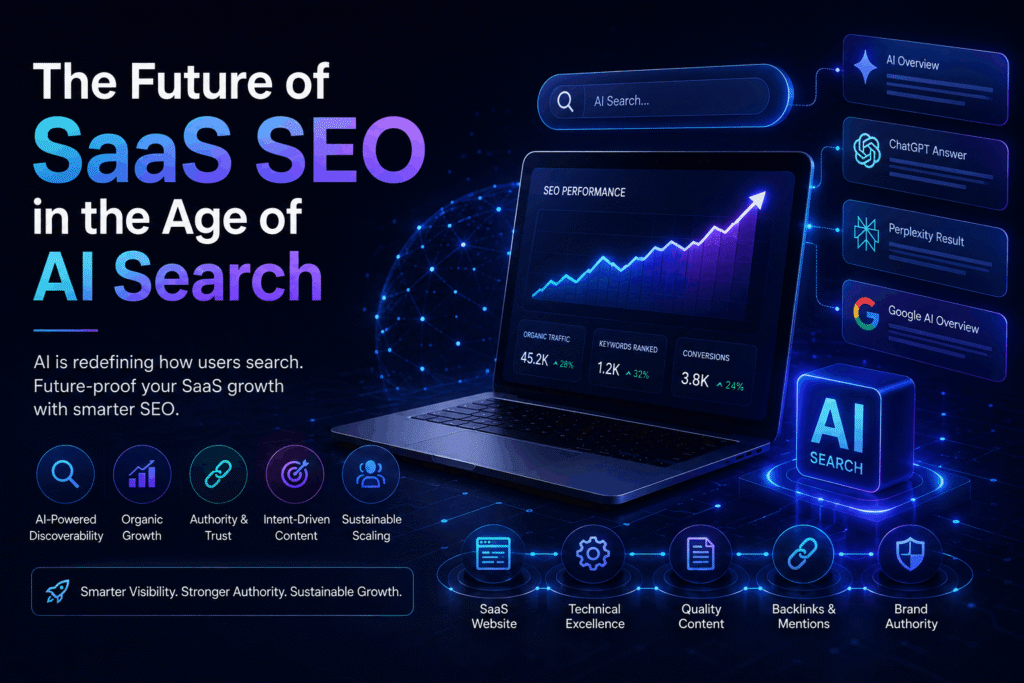
Search has changed dramatically for SaaS companies. Ranking on Google still matters, but it is no longer the whole game. Buyers now discover software through AI-generated answers, comparison pages, review platforms, communities, product roundups, YouTube, Reddit, and increasingly sophisticated search experiences.
That shift makes SaaS SEO strategies that matter in the AI search era very different from the old approach of publishing hundreds of keyword-focused blog posts and building as many backlinks as possible.
The SaaS companies that perform well today are building something bigger than rankings: topical authority, recognizable brands, useful content, strong digital reputation, and pages that genuinely solve problems.
What Has Changed in SaaS SEO?
Traditional SEO was heavily focused on ranking a webpage for a specific keyword. The modern search environment is more complicated.
Someone searching for “best project management software” may see traditional organic results, AI-generated summaries, product comparison pages, videos, community discussions, software review websites, and individual brand pages before ever clicking a SaaS company’s homepage.
This means SaaS marketers need to optimize for visibility across the entire search journey, not just one position in Google’s results.
Three changes are especially important:
- Search journeys are becoming more conversational.
- AI systems increasingly summarize information from multiple sources.
- Brand reputation and third-party mentions influence how a company is discovered and evaluated.
The practical lesson is simple: don’t build an SEO strategy around rankings alone. Build it around being the best-known and most useful answer in your category.
1. Build Topical Authority Around Real Customer Problems
One of the strongest SaaS SEO strategies is to stop treating keywords as isolated targets.
Instead, build content around the problems your ideal customers actually face.
For example, a CRM company shouldn’t only publish articles targeting phrases such as “best CRM software.” It should cover the entire customer problem space:
- How to choose a CRM
- CRM implementation
- CRM migration
- Sales pipeline management
- Lead management
- Customer retention
- CRM integrations
- CRM automation
- CRM reporting
- CRM data quality
- CRM workflows
- CRM comparisons
This creates a much stronger topical footprint than publishing unrelated articles simply because they have search volume.
Create Topic Clusters That Match the Buying Journey
A useful SaaS content structure usually includes several layers:
Educational content: Answers beginner and informational questions.
Problem-solving content: Helps users solve a specific operational problem.
Comparison content: Helps prospects evaluate different solutions.
Alternative content: Captures users looking for competitors or different approaches.
Product-led content: Shows how your software solves a particular problem.
Bottom-of-funnel content: Targets users who are close to making a purchase.
The goal isn’t to publish the most content. The goal is to create the most useful coverage of the problems your target audience cares about.
2. Create Content That Demonstrates First-Hand Experience
This is where many SaaS blogs fail.
A large number of articles simply summarize information already available elsewhere. They may be grammatically perfect, but they don’t provide anything particularly valuable.
AI search makes this weakness even more obvious.
If your article could have been produced without using your product, talking to customers, analyzing original data, or having practical industry experience, it probably needs more substance.
Add evidence that demonstrates real experience.
For example:
- Screenshots from your software
- Original research
- Customer examples
- Workflow examples
- Real implementation lessons
- Performance data
- Product demonstrations
- Expert commentary
- Testing results
- Detailed comparisons
- Lessons from failed approaches
Instead of writing:
“CRM automation can improve sales productivity.”
Explain what actually changes when automation is implemented, which workflows are worth automating, what mistakes companies commonly make, and when automation creates more problems than it solves.
Specificity is a competitive advantage.
3. Optimize for AI Search Without Abandoning Google
AI search doesn’t mean traditional SEO is dead.
That is an important distinction.
Google still has enormous commercial value, and many AI search systems depend on information that exists across the web. A strong technical SEO foundation, useful content, crawlable pages, authoritative links, and brand visibility remain important.
What changes is the optimization target.
Instead of asking only:
“How do I rank this page for this keyword?”
also ask:
“Would an AI system consider this source useful enough to reference when answering a customer’s question?”
That requires content that is:
- Clear
- Factually reliable
- Specific
- Well structured
- Easy to extract information from
- Supported by evidence
- Written for real users rather than algorithms
4. Write Direct Answers Before Adding Detailed Explanations
AI-driven search favors content that can be understood efficiently.
That doesn’t mean writing shallow articles.
It means making important information easy to identify.
For example, if an article answers “How much does CRM implementation cost?”, don’t hide the answer behind five paragraphs of background information.
Give the reader the useful answer first, then explain the variables that affect the cost.
Use:
- Descriptive headings
- Short paragraphs
- Bullet points
- Tables where appropriate
- Definitions
- Step-by-step explanations
- Clear conclusions
This structure helps both human readers and search systems understand the page.
5. Invest in Comparison and Alternative Pages
For SaaS companies, comparison searches can be extremely valuable because the user is often already evaluating solutions.
Examples include:
- Product A vs Product B
- Best alternatives to Product A
- Product A alternatives for small businesses
- Product A vs spreadsheets
- Best tools for a specific workflow
- Product A pricing alternatives
However, comparison pages only work when they are genuinely useful.
Don’t create a thin page that says your product is better in every category.
Compare products using meaningful criteria such as:
- Pricing
- Features
- Ease of use
- Integrations
- Customer support
- Automation
- Reporting
- Scalability
- Ideal customer
- Limitations
And be honest about where competitors may be stronger.
That honesty can actually increase trust and make your own recommendation more credible.
6. Build a Strong SaaS Brand, Not Just a Website
Brand visibility has become increasingly important in modern search.
If your company exists only on its own website, you are missing a significant part of the ecosystem.
A strong SaaS brand should appear naturally across relevant third-party environments, including:
- Industry publications
- Software review websites
- Relevant communities
- Podcasts
- Interviews
- Partner websites
- Expert articles
- Digital PR coverage
- Industry directories
- Social platforms
This doesn’t mean buying random mentions.
It means creating genuine reasons for other websites and people to talk about your company.
Why Brand Mentions Matter
Imagine two SaaS companies competing for the same category.
One has a website with hundreds of SEO articles but almost no external recognition.
The other has useful content, customer stories, expert interviews, industry mentions, reviews, and consistent brand references across trusted websites.
The second company has a much stronger overall web presence.
SEO is no longer just about what you say about yourself.
It’s also about what the rest of the web says about you.
7. Use Link Building for Authority, Not Just Metrics
Backlinks still matter, but chasing DA or DR alone is a weak strategy.
A backlink from a website with a high metric isn’t automatically valuable.
When evaluating a potential SaaS backlink, look at:
- Topical relevance
- Real organic traffic
- Editorial quality
- Website reputation
- Audience relevance
- Placement context
- Link attributes
- Existing outbound link patterns
A relevant link from a respected industry publication can be more useful than several unrelated links from websites that exist mainly to sell backlinks.
For SaaS companies, relevance should come before raw volume.
Better Link Building Opportunities for SaaS
Consider:
- Original research
- Data studies
- Expert contributions
- Digital PR
- Product integrations
- Partner content
- Industry reports
- Useful tools and calculators
- Statistics pages
- Expert interviews
- High-quality guest contributions
The best link-building assets give publishers an actual reason to reference you.
8. Create Product-Led SEO Content
Product-led SEO is especially powerful for SaaS businesses because it connects search demand with the product itself.
Instead of publishing generic content about a problem, demonstrate how users can solve that problem.
For example:
Generic approach:
“How to Manage Customer Support Tickets”
Product-led approach:
“How to Automate Customer Support Ticket Routing”
Then show the workflow, explain the process, demonstrate relevant functionality, and provide practical implementation guidance.
This attracts users with a problem while naturally introducing the product as part of the solution.
The key is not to turn every article into a sales pitch.
Teach first. Sell when the context makes sense.
9. Don’t Ignore Programmatic SEO—But Don’t Abuse It
Programmatic SEO can work extremely well for SaaS companies with large datasets or repeatable search patterns.
Examples might include pages for:
- Integrations
- Locations
- Industry use cases
- Software categories
- Templates
- Tools
- Features
- Comparisons
But creating thousands of near-identical pages with minimal value is not a sustainable SEO strategy.
Before launching a programmatic section, ask:
Does every page provide unique value to the person searching for that specific query?
If the answer is no, don’t create the page.
A smaller number of genuinely useful pages will usually be better than a massive collection of thin variations.
10. Optimize SaaS Websites for Conversion, Not Traffic Alone
SEO traffic is useless if it doesn’t produce business results.
This is one of the biggest mistakes in SaaS SEO reporting.
A page generating 20,000 visitors might contribute less revenue than another page generating 1,000 highly qualified visitors.
Track metrics closer to business outcomes:
- Qualified organic leads
- Demo requests
- Free-trial registrations
- Product signups
- Assisted conversions
- Pipeline generated
- Revenue influenced by organic search
- Conversion rate by landing page
Also examine which topics produce customers rather than simply attracting visitors.
Your SEO strategy should eventually answer:
Which organic searches bring us customers?
Not just:
How much organic traffic did we get?
11. Strengthen Technical SEO Fundamentals
AI search doesn’t eliminate technical SEO.
If anything, a messy website makes every other SEO investment less effective.
Regularly check:
- Indexation
- Crawlability
- Internal linking
- Canonicalization
- Redirects
- Broken links
- Duplicate content
- Structured data
- Mobile usability
- Page performance
- JavaScript rendering
- XML sitemaps
- Robots directives
Don’t obsess over technical SEO indefinitely, though.
Once the major technical problems are fixed, spending another month optimizing tiny technical details may produce less value than improving your content, authority, or conversion strategy.
12. Build Internal Links Around Search Intent
Internal linking is often treated as an afterthought.
For SaaS websites, it should be part of the content architecture.
An informational article should naturally connect to deeper educational content, product pages, use cases, comparisons, and relevant conversion pages.
For example:
CRM Guide → Lead Management → Lead Automation → CRM Automation Feature → Demo
This creates a logical path from information to commercial intent.
Use descriptive anchor text that tells users what they will find after clicking.
Avoid stuffing every page with dozens of forced internal links.
13. Refresh Content Based on Evidence
Publishing an article and forgetting about it is not a real content strategy.
SaaS markets change quickly. Features change. Pricing changes. Competitors change. Search behavior changes.
Review important pages periodically.
Look for:
- Declining organic traffic
- Falling rankings
- Outdated statistics
- Old screenshots
- Changed product features
- New competitors
- Better search results
- New customer questions
- Missing sections
- Low conversion rates
Don’t refresh content just to change the publication date.
Improve it because the information or user intent has changed.
14. Use First-Party Data as an SEO Advantage
SaaS companies have access to something many publishers don’t: their own product and customer data.
Where appropriate and privacy-safe, turn that knowledge into original content.
Examples include:
- Industry benchmarks
- Usage trends
- Customer behavior insights
- Anonymous aggregated statistics
- Survey results
- Original research
- Annual reports
- Industry studies
Original data is difficult for competitors to copy.
It can also attract journalists, researchers, bloggers, and other websites that want credible sources to reference.
15. Optimize for the Entire Search Ecosystem
The modern SaaS buyer rarely follows a perfectly linear path.
They may discover a company through Google, watch a YouTube review, read Reddit discussions, visit a software review website, compare competitors, ask an AI assistant, and finally return directly to the brand.
Your SEO strategy should therefore connect multiple channels instead of treating Google as an isolated platform.
Think in terms of search visibility, not simply Google rankings.
That includes:
- AI search experiences
- YouTube
- Industry communities
- Review platforms
- News and publications
- Social discovery
- Branded searches
The objective is to make your company easy to discover and easy to trust wherever prospects conduct research.
A Practical SaaS SEO Strategy for the AI Search Era
If you’re starting from scratch, don’t attempt everything simultaneously.
A practical sequence is:
Phase 1: Fix the Foundation
Audit technical SEO, indexation, internal linking, site structure, and important commercial pages.
Phase 2: Map the Customer Journey
Identify the questions prospects ask before, during, and after evaluating your product.
Organize those questions by search intent and buying stage.
Phase 3: Build Topic Authority
Create comprehensive content around your most commercially important problem areas.
Prioritize quality and relevance over publishing volume.
Phase 4: Strengthen Authority
Invest in digital PR, genuine partnerships, expert contributions, relevant backlinks, original research, and brand mentions.
Phase 5: Improve Product-Led Content
Connect informational searches with practical product use cases without turning educational content into advertisements.
Phase 6: Measure Business Results
Track leads, trials, demos, pipeline, and revenue—not just impressions and rankings.
Then use the data to decide what deserves more investment.
Common SaaS SEO Mistakes to Avoid
Publishing Content Just Because a Keyword Has Search Volume
Search volume does not automatically equal business value.
A keyword can generate thousands of visitors and zero customers.
Chasing Backlinks by Domain Rating Alone
High authority metrics don’t guarantee relevance, traffic, editorial quality, or useful referral exposure.
Creating Hundreds of AI-Generated Articles
Using AI as a productivity tool isn’t the problem.
Publishing large volumes of generic content without expert review, original insights, or meaningful value is.
Ignoring Commercial Intent
If your entire SEO strategy focuses on informational searches, you may build traffic without building a pipeline.
Making Every Page Promotional
People don’t want every answer to end with “Book a demo.”
Give them useful information first.
Treating AI Search as a Completely Separate SEO Discipline
It isn’t.
The fundamentals still matter: useful information, technical accessibility, authority, reputation, and a strong user experience.
The difference is that your content now needs to work across a broader discovery environment.
Final Thoughts
The biggest mistake SaaS companies can make in the AI search era is chasing shortcuts.
There is no reliable strategy based on publishing endless articles, stuffing keywords, or buying huge quantities of low-quality backlinks.
The stronger approach is straightforward:
Create genuinely useful content, demonstrate real expertise, build topical authority, earn credible mentions and links, strengthen your brand, and connect SEO activity to revenue.
The SaaS companies that win organic search over the long term won’t necessarily be the ones publishing the most content.
They’ll be the ones that consistently provide the best answers, strongest evidence, clearest solutions, and most trustworthy brand experience across the places where modern buyers search.
That is what sustainable SaaS SEO looks like in the AI search era.