
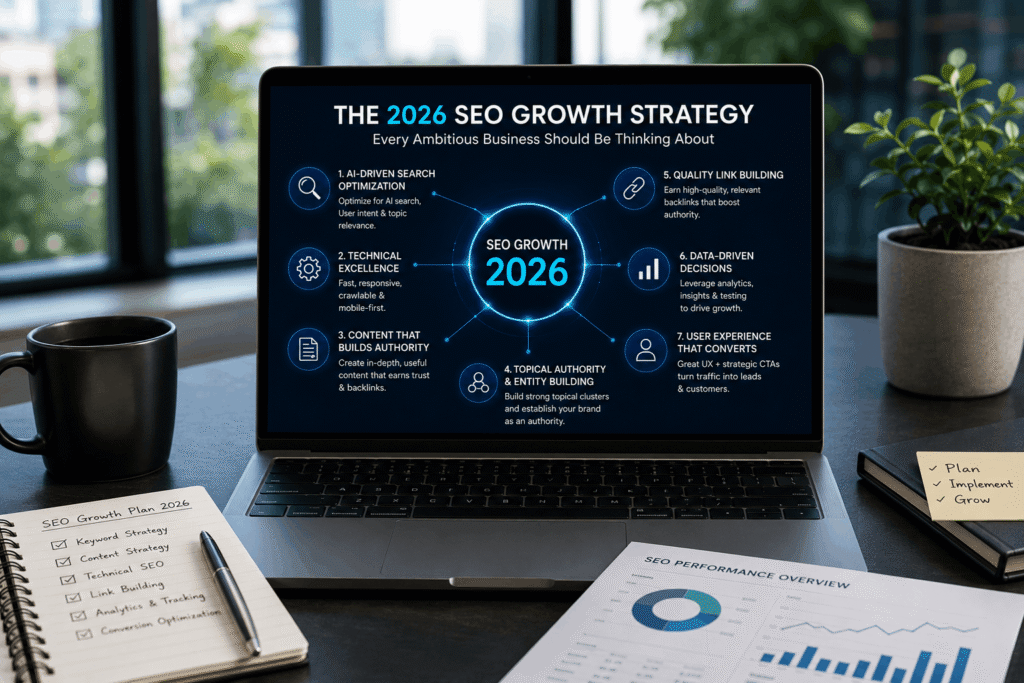
SEO in 2026 is no longer just about ranking a website on Google.
Search is becoming more conversational, more visual, more personalized, and increasingly influenced by artificial intelligence. Users can now discover businesses through traditional search results, AI Overviews, AI Mode, ChatGPT, social platforms, reviews, videos, communities, and third-party publications.
For ambitious businesses, this creates a bigger opportunity but it also requires a smarter SEO strategy.
The companies that win in 2026 will not simply chase rankings. They will build search visibility, authority, trust, and demand across the entire modern search ecosystem.
SEO Has Changed But the Fundamentals Still Matter
There is a common misconception that AI search has made traditional SEO obsolete.
It hasn’t.
Google’s current guidance makes it clear that established SEO fundamentals remain important for AI-powered search experiences. Websites still need to be crawlable, indexable, technically sound, useful, and built around high-quality content.
What has changed is where and how visibility is generated.
The old model looked like:
Keyword → Ranking → Click → Website → Conversion
The modern model is becoming:
Search → AI Answer → Brand Mention → Multiple Sources → Website → Trust → Conversion
This means businesses need to optimize not only for rankings, but also for discoverability and credibility.
1. Build a Strong Technical SEO Foundation
Before investing heavily in content, backlinks, or AI search optimization, make sure your website has a solid technical foundation.
Google still needs to crawl, render, understand, and index your pages before they can compete in search.
Your 2026 technical SEO strategy should include:
- Crawlability and indexation
- Clean site architecture
- Logical internal linking
- HTTPS and security
- Mobile usability
- Fast page performance
- Canonicalization
- XML sitemaps
- Structured data
- Proper redirects
- Image optimization
- JavaScript SEO
- Core Web Vitals
- Removal of duplicate and low-value pages
Google’s Search Essentials continue to emphasize technical requirements, spam policies, and people-first content as the foundation for search visibility.
The goal isn’t technical perfection for its own sake.
The goal is to create a website that both users and search systems can understand easily.
2. Stop Creating Content Just to Fill a Content Calendar
One of the biggest SEO mistakes businesses can make in 2026 is publishing large quantities of generic content.
AI makes content production easier than ever.
That also means generic content is becoming easier to ignore.
Google specifically warns against producing large amounts of low-value content through automation or AI simply to manipulate search rankings. Content should provide originality, accuracy, relevance, and genuine value.
Instead of asking:
How many blog posts can we publish this month?
Ask:
What useful information can our business provide that competitors cannot easily replicate?
Create content based on:
- Real customer questions
- Original research
- First-hand experience
- Case studies
- Industry data
- Expert opinions
- Product comparisons
- Detailed tutorials
- Original frameworks
- Customer problems
- Real examples
Quality, expertise, and usefulness should become the foundation of your content strategy.
3. Move From Keyword Targeting to Topic Authority
Traditional SEO often focused heavily on individual keywords.
In 2026, businesses should think in terms of topics, entities, search journeys, and user intent.
For example, a digital marketing agency shouldn’t create one article targeting “SEO agency.”
It could build an entire topical ecosystem around:
- SEO strategy
- Technical SEO
- Local SEO
- Ecommerce SEO
- SaaS SEO
- Programmatic SEO
- AI search optimization
- Content strategy
- Link building
- Digital PR
- Search analytics
- Conversion optimization
Then connect these resources through strategic internal links.
This creates a website that demonstrates depth rather than a collection of disconnected articles.
The objective is simple:
Become the source users—and search systems—can rely on for an entire subject.
4. Optimize for AI Search Without Abandoning SEO
AI Overviews and AI Mode are changing how users interact with Google.
Instead of always clicking through ten traditional results, users can receive synthesized answers and then explore supporting sources.
Google’s 2026 guidance says there isn’t a separate technical requirement or special markup needed specifically to appear in AI Overviews or AI Mode. Existing SEO fundamentals continue to matter.
That means your AI search strategy should focus on fundamentals such as:
- Helpful, original content
- Clear answers
- Strong topical authority
- Crawlable pages
- Structured information
- Accurate facts
- Strong brand credibility
- Relevant entities and relationships
- High-quality multimedia
- Author expertise
- Natural language and conversational relevance
Think of it as optimizing your brand to become a reliable source of information, rather than trying to “hack” an AI answer.
5. Build Brand Authority Beyond Your Website
Your website is only one part of your digital presence.
AI systems and modern search experiences can draw information from many parts of the web.
That makes your broader digital footprint increasingly important.
Build authority through:
- Industry publications
- Digital PR
- Expert interviews
- Podcasts
- YouTube
- Relevant communities
- Business directories
- Reviews
- Partnerships
- Guest contributions
- Original research
- Brand mentions
The objective is not simply to acquire as many backlinks as possible.
The objective is to make your business recognizable, credible, and consistently associated with your area of expertise.
6. Treat Digital PR as an SEO Growth Channel
Links still matter, but modern link acquisition should be approached differently.
Instead of buying low-quality links or creating artificial backlink networks, build assets that people actually want to reference.
For example:
Original Research → Media Coverage → Brand Mentions → Quality Links → Authority → Search Visibility
Create:
- Industry reports
- Surveys
- Statistics
- Original studies
- Data visualizations
- Expert commentary
- Research-driven articles
- Free tools
- Unique resources
Digital PR can turn useful information into both visibility and authority.
7. Create a Search Experience, Not Just Search Pages
Search traffic alone is not the ultimate goal.
Business growth is.
A visitor who arrives from Google but cannot understand your offer, trust your company, or take the next step has limited value.
Your SEO strategy should therefore connect:
SEO → UX → Content → Trust → Conversion
Every important landing page should answer:
- What does this business offer?
- Who is it for?
- Why should I trust this company?
- What makes it different?
- What evidence supports its claims?
- What should I do next?
This is where SEO and conversion optimization become inseparable.
8. Optimize for Multiple Search Formats
Search is no longer text-only.
Google’s guidance highlights the importance of supporting content with high-quality images and videos, while also keeping business information such as Business Profile and Merchant Center data accurate where relevant.
Your 2026 strategy should therefore consider:
Text Search
Articles, landing pages, guides, product pages and service pages.
Image Search
Original images, optimized image files, descriptive metadata and visual content.
Video Search
YouTube tutorials, demonstrations, explainers and educational videos.
Local Search
Google Business Profile, reviews, local content and location-specific relevance.
AI Search
Clear, authoritative information that can be understood and referenced by AI-powered search experiences.
The more discovery channels you cover, the less dependent your business becomes on a single search-result format.
9. Measure Visibility, Not Just Rankings
One of the biggest problems with traditional SEO reporting is over-reliance on keyword rankings.
A business can rank #1 for a keyword and still generate little revenue.
Your 2026 SEO dashboard should measure:
- Organic traffic
- Qualified organic traffic
- Leads
- Revenue
- Conversion rate
- Non-branded traffic
- Branded search growth
- Organic landing-page performance
- Backlinks
- Referring domains
- Brand mentions
- Local visibility
- Search impressions
- Search clicks
- Engagement
- Assisted conversions
- AI search visibility where measurable
Google has also begun rolling out dedicated Search Console reporting for visibility in generative AI features, including impressions and pages appearing in AI experiences.
This signals an important shift:
Search visibility is becoming broader than traditional blue-link rankings.
A Practical 2026 SEO Growth Framework
For ambitious businesses, a strong SEO program can be organized into six stages.
Stage 1: Foundation
Fix technical SEO, crawlability, indexation, site architecture, page experience, and structured data.
Stage 2: Strategy
Research your audience, competitors, topics, entities, commercial opportunities, and search intent.
Stage 3: Authority
Build high-quality content around your most valuable topics and establish genuine expertise.
Stage 4: Visibility
Expand beyond traditional rankings through digital PR, local search, video, images, communities, and brand mentions.
Stage 5: AI Search
Make your content clear, useful, authoritative, structured, and relevant to modern AI-powered search experiences.
Stage 6: Conversion
Connect organic visibility to landing pages, lead generation, sales, and measurable business outcomes.
This creates a much stronger growth loop:
Technical Foundation → Content → Authority → Visibility → Traffic → Trust → Conversions → Growth
The Biggest SEO Mistakes to Avoid in 2026
Businesses should also know what not to do.
Don’t publish hundreds of generic AI articles.
More content doesn’t automatically mean more authority.
Don’t obsess over one keyword.
Search intent and topical relevance matter more than repeatedly inserting the same phrase.
Don’t buy cheap backlinks.
Low-quality link building can create risk instead of sustainable authority.
Don’t ignore brand building.
Search visibility increasingly depends on the credibility and recognition surrounding your business.
Don’t treat AI search as a separate replacement for SEO.
Google’s own guidance emphasizes that traditional SEO fundamentals remain relevant to AI-powered search.
Don’t measure SEO only by rankings.
Ultimately, businesses need customers, leads, revenue, and growth.
What the Winning SEO Strategy Looks Like
The strongest businesses in 2026 will combine several disciplines:
Technical SEO
+
People-first content
+
Topical authority
+
Digital PR
+
Brand building
+
AI search visibility
+
Conversion optimization
+
Continuous measurement
This is no longer simply “doing SEO.”
It is building a search growth engine.
Final Thoughts
SEO isn’t disappearing in 2026.
It is becoming bigger.
The definition of search visibility is expanding from a list of blue links to a broader ecosystem of search results, AI-generated answers, videos, images, local results, publications, reviews, communities, and brand recommendations.
Google’s own 2026 documentation reinforces an important principle: businesses should continue focusing on technically accessible websites and unique, useful, people-first content while adapting to new AI-powered search experiences.
The businesses that win won’t necessarily be the ones publishing the most content or chasing every new SEO trend.
They will be the ones that consistently answer an important question:
Why should customers and the search ecosystem trust our brand?
In 2026, that is the real foundation of sustainable SEO growth.